# Learn Tagalog Online with Aralin World
> Learn Tagalog Grammar, Verb tenses, or Sentence Structure with expert guidance from a Native Speaker! Whether you’re a beginner or an advanced learner, enjoy either self-paced lessons or customized one-on-one coaching to help you speak Tagalog with confidence. Start your journey today!
Public Ghost content for AI and LLM tooling. This file includes a bounded export of public pages first, then recent public posts.
Append `.md` to any post or page URL to get the content in Markdown (for example, `/example-post.md`).
## Pages
### About Aralin World
URL: https://www.aralinworld.com/about/
Last updated: 2025-03-18T16:20:02.000Z
Aralín World is a one-person **tutoring business** based in the United States. It is committed to helping individuals **learn how to speak Tagalog**, a language in the Philippines. It focuses on mentoring individuals and groups so they achieve fluency, express themselves in their second language, and acquire a bigger world view as they practice their new language skills.
Aralín World wishes to **connect with you** because:
- You have difficulty constructing Tagalog sentences;
- You do not understand the context behind Filipino expressions;
- You have difficulty communicating with your loved ones in the Philippines; or
- As a tourist, you want to navigate the Philippines on your own.
Aralín World provides personalized guidance from a **100% human teacher** who understands your struggles and tailors lessons to fit your needs. If you subscribe to Aralín World, you will receive **exclusive learning materials**, **direct teacher support**, and **ongoing updates** plus an option to join the **weekly group coaching** calls.
## Sign up now for Aralin World Newsletters
Don't miss out on Updates and FREE Tagalog Language Lessons delivered to your Email.
Subscribe
Email sent! Check your inbox to complete your signup.
No spam. Unsubscribe anytime.
Aralín World's plan for growth and value creation includes leveraging **technology**, updating existing **skills**, enquiring on **students' needs**, developing **solutions**, and providing meaningful and fun **learning experiences**.
Its mission is to build a community of Tagalog speaking people who share with the following core values:
1. **Commitment To Mastery:** We commit to serve the community. We continue to lead and teach individuals and groups while we innovate our existing tools and processes. Such commitment lies on teacher-student synergy to key player's betterment.
2. **Consistency To Face Challenges:** We strive to be remarkably consistent in everything that we do. We don’t seem to follow the crowd but we’re noticeable to many.
3. **Connection With A Purpose:** While technology is essential to our growth, we prioritize human touch. Teaching a language means we want people to be able to connect with each other through speech communication and we help them realize that a Philippine language can be functional all over the world.
Its vision includes the following:
1. Tagalog is a functional language to the global community and can be used in both casual and formal conversations.
2. Children of Filipinos abroad are more connected to their roots because they have access to Tagalog language resources prepared by a native speaker.
3. Tourists speaking Tagalog consider the Philippines as the second home and they can confidently navigate the country.
Considering Tagalog as your second language? This site is for you! **Hit the link below** and feel free to leave a message. What kind of help do you need?
[FeedbackLeave a message to Aralin World. Leave your testimonials or suggestions on how we can help you learn Tagalog or submit your answers to a short quiz.Aralin World Online Tagalog ClassesAlbine Bodo](https://www.aralinworld.com/message-us/)
---
### Albine Bodo
Albine Bodo teaches Tagalog online since 2019\. She is the founder of Aralín World LLC. Albine is a program designer, content creator, artist, and coach. She was born and raised in the Philippines. She earned her Bachelor's degree in Computer Engineering from Adamson University in Manila. She started her career as applications developer for a hotel/resort operator, a property operator, and a couple of retail businesses.
She was a Faculty Member in Emilio Aguinaldo College - School of Engineering, Science & Technology in Dasmarinas, Cavite, Philippines. She also became the Head Of Laboratory in the same college and eventually founded the Robotics Center.
She earned units of M.S. in Information Technology from Polytechnic University of the Philippines. She also earned units of teaching from Southern Philippines Institute of Science & Technology and passed the board exams for Professional Teachers in the Philippines in 2015\. In 2016, she moved in United States and married Bruce Bodo.
[Aralin World Tagalog Online Classes | Your Teacher is a Native SpeakerShe is a teacher with a blend of tech expertise, creativity, and a deep passion for guiding you toward fluency. Be guided with warmth, humor, and true desire to see you succeed.Aralin World Online Tagalog ClassesAuthors](https://www.aralinworld.com/tag/tagalog-language-teacher/)
---
Albine is **open for collaboration** with a Filipino diaspora group, **partnership** with your brand, or **affiliation** with your association (provided that you're aligned with her values). Are you operating in the U.S.A. or Canada? Do you have an upcoming event and looking for a **Resource Speaker** in person or in podcast? Send her a message [via this link](https://www.aralinworld.com/message-us/).
### Contact Aralin World
URL: https://www.aralinworld.com/contact/
Last updated: 2025-02-28T02:43:02.000Z
Feel free to reach out.
### Privacy Policy
URL: https://www.aralinworld.com/privacy/
Last updated: 2025-01-02T17:39:13.000Z
Wondering how Aralin World fares when it comes to privacy and GDPR rules? Good news: We do not use any tracking cookies of any kind.
We may need to collect member's personal data for correspondence purposes and/or to allow us to provide them our services. We are committed to ensuring that the information we collect and use is appropriate for this purpose. Aralin World values its users’ data protection and privacy rights and we have no interest in collecting data beyond what we need to make our services work for you.
Thanks for checking out.
### Contribute
URL: https://www.aralinworld.com/contribute/
Last updated: 2022-01-20T02:25:56.000Z
Oh hey, you clicked every link of our starter content and even clicked this small link in the footer! If you like Aralin World and you're enjoying the Tagalog lessons so far, we'd hugely appreciate your support in any way you care to show it.
Aralin World is a startup business but part of our lives is to give away free resources to help students learn Tagalog. If you believe in what we do, there are a number of ways you can give us a hand, and we hugely appreciate all of them:
- Contribute by **submitting your artwork**
- Contribute by **submitting your Tagalog conversation**
- Contribute by **writing a code**
- Contribute reviews via **writing a blog post**
- Contribute good vibes via **telling your friends** about us
## Contribute Financially
Thanks for checking us out!
### Feedback
URL: https://www.aralinworld.com/message-us/
Last updated: 2025-03-26T00:56:57.000Z
**Welcome, and feel free to write your thoughts about your...**
## Tagalog Learning Journey
Loading…
### Podcast
URL: https://www.aralinworld.com/podcast/
Last updated: 2025-01-10T01:01:20.000Z
Good news to all listeners of our **General Tagalog Practice**! Our Tagalog tutorial is also available on various podcast platforms. We wish to reach out to as many Tagalog students as possible and we understand that you Porenoys & Porenays are possible to learn a new language while driving, commuting, waiting to board, doing chores, or just doing your physical fitness. Sweet, hindî ba?
Here's the latest from **Tagalog With Albine** Podcast:
---
## Don't Forget To Add Tagalog With Albine To Your Podcast Library
✔ Subscribe/Like/Follow and download the episodes!
[](https://podcasts.apple.com/us/podcast/tagalog-with-albine/id1605688154?itsct=podcast%5Fbox%5Fappicon&itscg=30200&ls=1&ref=aralinworld.com)
[  ](https://podcasts.google.com/feed/aHR0cHM6Ly9hbmNob3IuZm0vcy83ZTM5NTI4Yy9wb2RjYXN0L3Jzcw?ref=aralinworld.com)
Also available in:

### Contribute Financially
URL: https://www.aralinworld.com/contribute-financially/
Last updated: 2025-01-02T17:38:39.000Z
_No content available._
### Buy Our Merchandise
URL: https://www.aralinworld.com/buy-our-merchandise/
Last updated: 2024-12-01T02:49:56.000Z
_No content available._
### Continuing Tagalog Program | Learn Tagalog with Albine of Aralin World
URL: https://www.aralinworld.com/continuing-tagalog-program/
Last updated: 2025-12-14T00:19:30.000Z
### Build Your Tagalog Skills Step-by-step
The **Continuing Tagalog Program** by Albine Bodo of Aralin World is a structured learning ladder for building your Tagalog language skills: *from first words to confident conversations*.
**Format:** Personalized learning Tagalog using [Jitsi Meet](https://meet.jit.si/?ref=aralinworld.com) and [Moodle](https://tagalogwithalbine.moodlecloud.com/?ref=aralinworld.com). Private 1-on-1 with Albine.
**Commitment:** At least once a week with Albine.
**Teaching Style:** Guided, supportive, and tailored for heritage learners, self-starters, and dedicated students who want to connect deeply with the Filipino language and culture.
**Guarantee:** 100% or you'll get your money back within 90 days of purchase. Read our [Refund Policy](https://www.aralinworld.com/return-and-refund-policy/).
**📣 Effective Date:** August 9, 2025
## Level 1 - Beginner's Level to Tagalog
**First Steps into Tagalog**
**Goal:** Build a strong foundation in vocabulary, pronunciation, and basic sentence structure.
**Choose Your Entry Path:** [*Total Beginner Path*](https://www.aralinworld.com/learn-tagalog-step-by-step-with-a-native-speaker/)? or [*Upper Beginner Path*](https://www.aralinworld.com/beginner-tagalog-classes-online-for-ages-21/)?
---
### **Option 1 – Total Beginner Path**
**Course Code:** L101
**Duration:** 24 lessons, approximately 6 months if meeting once a week
**Topics** include, but not limited to:
1. Filipino Alphabet
2. Pronunciation Guides
3. Common Greetings
4. Time & Dates
5. Self-introduction
6. Family & Questions
7. Places, Environment & Directions
8. **Plus** all Beginner Essentials Path topics.
**Ideal For:** Absolute beginners ready for a comprehensive start.
[I Need More Information](https://www.aralinworld.com/learn-tagalog-step-by-step-with-a-native-speaker/)
[I Want to Sign Up Now](https://buy.stripe.com/cN29DNdy05tLdVKaEJ?ref=aralinworld.com)
---
### **Option 2 – Beginner Essentials Path**
**Course Code:** L102
**Duration:** 12 lessons, approximately 3 months if meeting once a week
**Topics** include, but not limited to:
1. Simple Sentence Structure
2. Parts of Speech
3. Root Words
4. Prefixes & Suffixes
5. Basic Verb Groups
6. Exclamatory Words
7. Listening/Speaking/Writing/Reading Skills
**Ideal For:** Learners with some Tagalog exposure (heritage speakers, DIY learners, app users).
[I Need More Information](https://www.aralinworld.com/beginner-tagalog-classes-online-for-ages-21/)
[I Want to Sign Up Now](https://buy.stripe.com/4gwg2b9hKe0h7xm8wC?ref=aralinworld.com)
---
## Level 2 – Intermediate Grammar: Tagalog in Real-Life Context
**Go Beyond the Basics**
**Goal:** Improve pronunciation, master correct tenses, expand vocabulary, and handle everyday conversations with ease.
### Intermediate Grammar
**Course Code:** L201-A
**Duration:** 24 lessons, approximately 6 months if meeting once a week
**Prerequisite:** Course L101 or L102
**Topics** include, but not limited to**:**
1. Accent Marks
2. Complex Sentence Patterns & Construction
3. Intermediate Tagalog Affixes
4. Intermediate Verb Groups
5. Skills Training in Speaking, Listening, Writing & Reading.
\[ insert a link: Why Choose Albine of Aralín World\]
[Intermediate Grammar syllabus with contractUpdated August 2025Intermediate Grammar syllabus with contract.pdf35 KBdownload-circle](https://www.aralinworld.com/content/files/2025/12/Intermediate-Grammar-syllabus-with-contract.pdf "Download")

#### 24-Unit One on One Premium Classes For Intermediate
Course Code L201A: A practical course for returning students. Did you just finish our Beginners Tagalog (Course L101 or L102)? If yes, you are now qualified to learn Albine's Intermediate lessons in Tagalog. By signing up, you have read and understood our [Refund Policy](https://www.aralinworld.com/return-and-refund-policy/). Are you ready? See you then!
[Enroll Now](https://buy.stripe.com/fZu6oGa6g4Tt2o3ctmdQQ09?ref=aralinworld.com)
---
### Mastering Verbs
**Course Code:** L201-B
**Prerequisite:** Course L201-A
**Duration:** 12 lessons, approximately 3 months if meeting once a week
**Topics** include, but not limited to:
1. Verb Families
2. Voluntary/Involuntary Actions
3. Impersonal Verbs
4. Intransitive Verbs
5. Reflexive & Transitive Verbs
6. Ability/Possibility of Action
7. Beneficial Action
8. Reciprocity
9. Active/Passive Voice
\[ insert a link: Why Choose Albine of Aralín World \]

#### Mastering Tagalog Verbs: 12-Unit One On One Premium Classes
Course Code L201B. Boost your Tagalog fluency with Mastering Tagalog Verbs, a one-on-one online tutorial designed for intermediate learners. Learn how to conjugate, use, and master Tagalog verbs in real-life conversations with personalized coaching. Perfect for those who want to improve sentence structure, verb tenses, and natural speaking flow. Take this course only if you're through with Course L201A.
[Sign Up](https://buy.stripe.com/8wM4jt65y09r8BqaEH?ref=aralinworld.com)
---
### Upper Intermediate Grammar
**Course Code:** L202
**Prerequisite:** Course L201-B
**Duration:** 24 lessons, approximately 6 months if meeting once a week
**Topics** include, but not limited to:
1. Speaking Naturally
2. Word Formation
3. Polite/Formal Speech
4. Storytelling
5. Song Analysis
6. Movie Reviews
\[ insert a link: Why Choose Albine of Aralín World \]

#### Upper Intermediate Tagalog: 3-Month 1-on-1 Coaching up to 2 Meetings per Week
Course Code L202\. Learn Tagalog grammar thoroughly as you progress in the intermediate level. A 3-month one-on-one online tutorial designed for Upper Intermediate learners. Learn how to use various parts of speech, and speak Tagalog language in real-life conversations with personalized coaching. Perfect for those who want to improve sentence structure, verb tenses, and natural speaking flow. Only learners who've finished Mastering Tagalog Verbs (Course L201B) are to be admitted.
[Sign Up](https://buy.stripe.com/dRmaEWfqAgCbgeTbpidQQ08?ref=aralinworld.com)
---
## Level 3 – Mastery of Tagalog Language
**Fluency with Depth**
**Goal:** Achieve natural, fluent conversations with cultural authenticity.
**Prerequisite:** Course L202
**Possible Focus Areas:**
🇵🇭 Philippine History
📚 Epics, Idioms, Humor & Cultural Deep Dives
🌿 Indigenous Flora & Fauna
🫕 Filipino Recipes
👜 Business/Travel Tips & Stories
🎗️Collaborative Projects with Native Speakers.
\[ insert a link: Why Choose Albine of Aralín World \]
#### Can I Talk To The Tutor Before Signing Up?
Absolutely! You will be given a 30-minute Discovery Call FREE of charge. [Book an appointment now](https://www.aralinworld.com/book-an-appointment/).
### Terms Of Use For Aralín World
URL: https://www.aralinworld.com/terms-of-use-for-aralin-world-website/
Last updated: 2025-08-30T02:41:50.000Z
Effective Date: December 04, 2024
Welcome to Aralin World. By accessing and using our blog, subscribing to our content, and purchasing any products or services, you agree to comply with and be bound by the following terms and conditions. If you do not agree to these terms, please do not use our blog.
1. **Acceptance of Terms**
By using Aralin World and subscribing to our content, you acknowledge that you have read, understood, and agree to be bound by these Terms of Use and any future updates or modifications.
1. **Modifications to Terms**
We may update or modify these Terms of Use at any time. Changes will be effective immediately upon posting on this page. It is your responsibility to review the Terms regularly.
1. **Subscription and Account**
1. **Eligibility**: You must be at least 18 years old to subscribe to our content.
2. **Subscription Plan**: By subscribing, you gain access to certain premium content and features. Subscription plans and their benefits are outlined on [Account Page](https://www.aralinworld.com/#/portal).
3. **Payment**: All payments for subscriptions are processed through a third-party payment processor. You agree to provide accurate payment information and authorize the processing of payments.
4. **Cancellations and Refunds**: You can cancel your subscription at any time through [Account Page](https://www.aralinworld.com/contact/#/portal). Refunds are not typically provided unless otherwise stated in our Refund Policy.
2. **Use of Content**
1. **Intellectual Property**: All content, including articles, images, graphics, and digital products, are protected by copyright, trademark, and other intellectual property laws. You may not copy, distribute, modify, or republish content without our express written permission.
2. **Personal Use**: Content from the blog may only be used for personal, non-commercial purposes unless otherwise specified.
3. **User-Generated Content**: If you contribute comments, reviews, video participation, or other content, you grant Aralin World non-exclusive, royalty-free license to use, display, and distribute that content.
3. **Digital Products**
1. **Purchases**: By purchasing digital products from Aralin World, you agree to pay the specified price and any applicable taxes. All purchases are non-refundable, except as required by law or as otherwise stated in our refund policy.
2. **License and Use**: Digital products are licensed for personal use only unless otherwise specified. You may not resell, redistribute, or modify any digital product without express written permission.
4. **Affiliate Links and Third-Party Content**
1. **Affiliate Disclosures**: Some of the links on our blog may be affiliate links. This means that if you click on an affiliate link and make a purchase, we may receive a commission at no additional cost to you. We only promote products and services that we believe provide value to our readers.
2. **Third-Party Websites**: Our blog may contain links to third-party websites. We are not responsible for the content, privacy practices, or activities of these third-party sites.
5. **User Conduct**
1. You agree to use Aralin World in a manner that is lawful and does not violate the rights of others.
2. You may not use the blog to:
1. Engage in harassment, defamation, or abusive behavior.
2. Post or transmit any malicious code, viruses, or harmful content.
3. Attempt to access or modify content not intended for you or access systems, data, or networks without proper authorization.
6. **Privacy**
Your use of Aralin World is also governed by our [Privacy Policy](https://www.aralinworld.com/privacy/), which outlines how we collect, use, and protect your personal information.
1. **Disclaimer**
Aralin World provides content for general informational purposes only. We make no guarantees about the accuracy, completeness, or usefulness of any information on the blog. Use of any information on this blog is at your own risk.
1. **Limitation of Liability**
Aralin World is not liable for any indirect, incidental, special, consequential, or punitive damages resulting from your use of the blog or subscription services.
1. **Termination**
We may suspend or terminate your access to Aralin World at our discretion if you violate any of these Terms of Use or engage in conduct that is harmful to our blog or other users.
1. **Contact Information**
If you have any questions or concerns regarding these Terms of Use, please proceed to our [Feedback Page](https://www.aralinworld.com/message-us/) and leave us a message.
1. **Acceptance**
By accessing and using Aralin World, you acknowledge that you have read, understood, and agree to these Terms of Use.
### Book An Appointment
URL: https://www.aralinworld.com/book-an-appointment/
Last updated: 2025-02-28T19:48:39.000Z
_No content available._
### Return And Refund Policy
URL: https://www.aralinworld.com/return-and-refund-policy/
Last updated: 2025-04-03T21:04:33.000Z
Effective Date: April 3, 2025
Thank you for choosing **Aralín World LLC** for your Tagalog learning journey! We are committed to providing high-quality tutoring services and learning materials. Please review our return and refund policy below.
### **1\. Tutoring Sessions (Tagalog Language Online Classes)**
1.1\. **Non-Refundable Policy:** Our tutoring programs are structured as a **series of meet-ups**, as specified in each offer. All sales for tutoring sessions are **non-refundable**; however, we stand by our **100% satisfaction guarantee**.
1.2\. **Satisfaction Guarantee:** If you are not satisfied with your learning experience, you may request a **full refund within 90 days from your first session**.
1.3\. **Booking & Rescheduling:**
1.3.1\. Students must book appointments through this site's [Booking Page](https://www.aralinworld.com/book-an-appointment/).
1.3.2\. Appointments are accepted within 36 hours upon booking.
1.3.3\. If you need to reschedule, you may do so **at least 24 hours before the confirmed session** at no extra charge.
1.3.4\. **No-Show Policy:** If you do not attend a scheduled session and did not reschedule in advance, the session is considered **forfeited** and will not be refunded or rescheduled.
### 2\. Digital Products (Tagalog Grammar Worksheets, and Learning Tools)
2.1\. **All digital product sales are final.** Due to the nature of digital products, we do not offer refunds, exchanges, or cancellations once a purchase is made.
2.2\. If you experience technical issues accessing your digital product, please contact us at tagalogwithalbine@gmail.com within **7 days of purchase**, and we will assist you in resolving the issue.
### **3\. Contact Us**
For any questions or concerns about our return policy, please [send us a message](https://www.aralinworld.com/message-us/). We’re happy to assist you!
### The Tagalog Quest
URL: https://www.aralinworld.com/tagalog-quest/
Last updated: 2025-10-27T14:02:53.000Z
## Aralin World: The Tagalog Quest – Where Language Meets Legend
**Tired of boring language lessons? Let’s turn Tagalog into an epic quest. Sign up with Aralin World!*
[Roll for Initiative - Start Your Quest](#/portal/signup/free)
---
## **Why a Quest? (You ask)**
Because memorizing vocabulary lists is about as fun as stirring your 🍨 *halo-halo* while remembering all the ingredients. At Aralin World, we believe that **learning should feel like an ⛳️ adventure**—not a chore. In this world, *Gurô Albine* is your Game Master, guiding you through the rich world of 🇵🇭 Tagalog and Filipino culture, one quest at a time.
Here, you’re not just a student—**you’re a hero in a story**. And every hero needs a party. That’s where our community comes in: a band of learners, storytellers, culture enthusiasts who’ve got your back (and maybe a healing potion or an *antíng-antíng*).

How about "camping" with your tribe at Aralin world?
---
## Your Quest Awaits: Here’s How to Play


1. **Choose Your Path:** [Sign up for our newsletter](#/portal/signup/free) to **receive your first quest**. Will you be a ‘*Word Warrior*’, a '*Heritage Seeker*', a '*Storyteller*', a ‘*Culture Explorer*’ or an '*OPM Killer*'? The choice is yours!
2. **Gather Your Party:** Join our community forum, say '*hi*' by commenting down below or [subscribe to Albine's YouTube channel](https://www.youtube.com/@guro-albine?ref=aralinworld.com) to **team up with fellow adventurers**. Share stories, practice Tagalog, and maybe even form a study guild.
3. **Earn Loot (aka Rewards):** Complete quests to unlock badges, exclusive content, behind the scene stories, and live ‘campfire’ sessions where **we dive deep into Filipino language and culture**.
4. **Level Up:** Track your progress, celebrate milestones, and **watch as your Tagalog skills grow** from ‘tavern newbie’ to ‘confident speaker'.
---
## Meet Your Fellow Adventurers
\[ available soon \]
---
## FAQ (Frequently Asked Questions)
#### ****What is Aralin World: The Tagalog Quest?**
A gamified, community-driven program where you learn Tagalog and explore Filipino culture through D&D-inspired quests, storytelling, and collaborative challenges. Think of it as a language-learning adventure!
#### ****Do I need to know Dungeons & Dragons to join?**
Not at all! The D&D theme is just a fun way to structure learning and community building. No prior knowledge of role-playing games is required.
#### ****How often will I receive quests?**
Quests (lessons/challenges) may be sent any day, at least once a week. You can also join our community forum for daily interactions and bonus quests.
#### ****Is this suitable for absolute beginners?**
Yes! Our quests are designed for all levels, from complete beginners to heritage learners looking to deepen their skills.
#### ****What kind of rewards can I earn?**
Complete quests to unlock badges, exclusive content, live "campfire" sessions (Q&A/webinars), and even community recognition like "Hero of the Month."
#### ****How do I join the community?**
Sign up for our newsletter to start your quest, reply 'hi' plus a short introduction in the comment section down below. Next, open Gurô Albine's emails, then join our forum or [subscribe to Albine's YouTube channel](https://www.youtube.com/@guro-albine?ref=aralinworld.com) to connect with fellow adventurers.
#### ****Is there a cost to join?**
The basic quests and community access are free. We offer optional premium quests and resources for those who want to level up faster.
#### ****Can I contribute my own quests or stories?**
Absolutely! We encourage community members to share their knowledge, stories, and even create quests for others.
---
### 👇 Visit our Forum Pages
[About | Aralin World: Tagalog QuestAre you passionate about the 🇵🇭 Philippine’s Tagalog language? Do you want to expand your Filipino linguistic & cultural fluency? Join us!Aralin World: Tagalog Quest](https://www.gokollab.com/aralin-world-tagalog-quest-m2j50b/about?ref=aralinworld.com)
A 3rd Party community-based platform ideal for specific activity discussions and calendar.
[Tagalog Quest Forum - Learn Tagalog Online with Aralin WorldLearn Tagalog Grammar, Verb tenses, or Sentence Structure with expert guidance from a Native Speaker! Whether you’re a beginner or an advanced learner, enjoy either self-paced lessons or customized one-on-one coaching to help you speak Tagalog with confidence. Start your journey today!Learn Tagalog Online with Aralin WorldAuthors](https://www.aralinworld.com/tag/tagalog-quest-forum/)
Join the discussion, post your questions, share your experiences without leaving our website.
## Ready to Embark?
**Whether you’re a heritage learner or a culture enthusiast, your adventure starts now.*
Read our [Privacy Policy](https://www.aralinworld.com/privacy/).
[Sign up](#/portal/signup/free), wear your *tapis* or *baróng* plus your cape, and *tara na*!
[Join The Tagalog Quest: Sign up for FREE!](#/portal/signup/free)
---
> The Tagalog Quest: Where language meets legend.
## Posts
### How One Tagalog Teacher Runs Aralin World: A Solo Teaching Model
URL: https://www.aralinworld.com/how-one-tagalog-teacher-runs-aralin-world-a-solo-teaching-model/
Last updated: 2026-10-01T12:19:36.000Z
I'm designing my life to be peaceful but simple. I'd like to live daily with a greater sense of purpose, and **this is about nurturing myself, my family, and my community**. This is what Aralin World could look like.
Aralin World is as much about language learning as it is about finding the real *me*. Even though **Aralin World is known for 1:1 Tagalog coaching and bite sized online tutorials**, I’d like to see it as a more profound relationship between myself and others, with you hopefully included.
### **Your Tagalog Teacher Weaves Her Love for the Language Into Her Relationships with Herself, Family, and the Community**
Every day, I take a moment to think about what I’m doing and what I’d really like to do. These personal reflections are super important, and they help me successfully connect with family, friends, colleagues, and clients. I’ve come to understand that **I can’t really separate teaching from other parts of my life**, like family, my husband’s business, and all my other projects.
Today, I’m showing **Aralin World as a ‘blank canvass’ full of endless possibilities for storytelling**. Take a look at the diagram below to see how this world will shape our journey for the next few months.
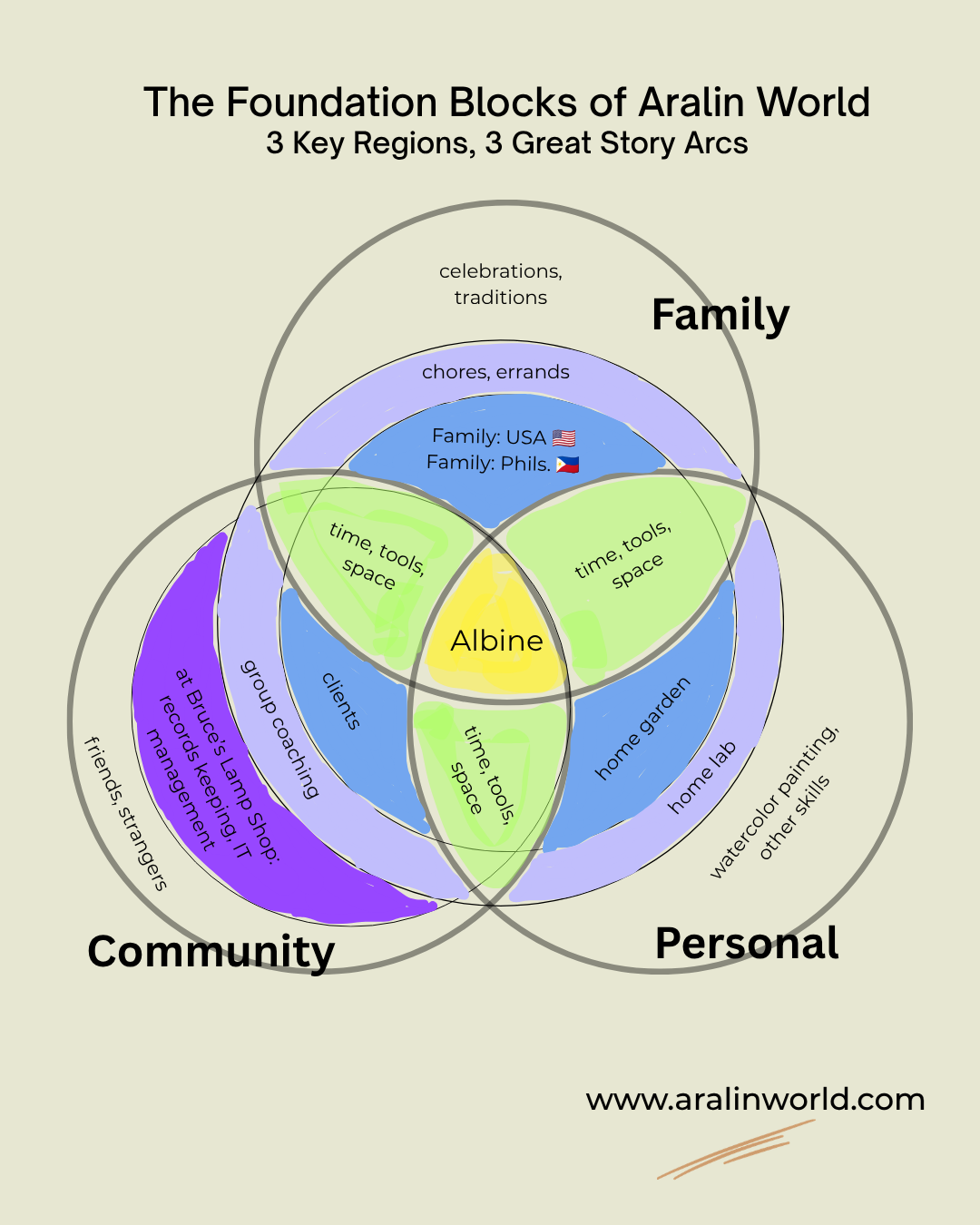
The Foundation Blocks of Aralin World: 3 key regions blended with Tagalog teaching and storytelling
**Aralin World is divided into three wonderful regions: Personal, Family, and Community**. Yours truly is at the heart of all these three regions. The intersection between the two distinct regions all touch on time, tools, and space.
Unlike many people, I'm in a good position to be working for myself. It means **I have flexible work hours and I can focus thoughtfully and strategically**. But, it can be a bit tricky when something threatening happens in any of the Aralin World regions. Since I’m the only one in my position, it’s easy to put extra time and attention on the menacing areas while putting another part of my world on hold, unfortunately. For example, **I’m growing my own home garden** because I need the good stuff from *ampalaya* (bitter gourd) and other fiber-rich veggies to help keep my LDL (bad cholesterol) levels in check. I’d love to have fresh produce right out of our yard, since the store-bought stuff often has all sorts of nasty chemicals, additives, and preservatives. Plus, gardening is a great way to get some exercise, lift things up, or soak up the sun. That’s why **I tend to cut back on writing lessons or newsletters a bit** when spring rolls around.
### **Who's the Unsung Hero Keeping Things Running Smoothly at Aralin World?**
At Aralin World, there’s Bruce. Even though I’m the main character and the master artist here, **I always give Bruce the credit**. He’s always there for me and very supportive of what I’m doing. In this world, he’s like a solid rock… a monolith with enough space dedicated for me. That space lets me be myself! That’s where I can declare my wins and losses without worrying about imperfections or trying to be performative. I might have a tendency to come to him to vent about all my worries, but he’s always there to listen. He’s authentic. As a life partner, he's always reassuring, helping me brainstorm ideas and most of all, I learn a lot from him. I’m so grateful to have him in my life.
I'm the public face of Aralin World, but **Bruce keeps things running smoothly behind the scenes**. He’s got a knack for all sorts of technical stuff. When it comes to computers and the internet, I always turn to him for advice on picking the right hardware, connecting devices, or setting up lights and cameras so everyone can enjoy Aralin World. I also depend on him to install operating systems, especially those from the Linux family.
## Sign up for our Newsletters
Free to join! Master Tagalog with immersion, accountability, and cultural orientation. Learn from a native speaker and connect with your Filipino friends and family today.
Subscribe
Email sent! Check your inbox to complete your signup.
No spam. Unsubscribe anytime.
### **Aralin World: Teaching Tagalog with a Human Heart** ♥️
For average people, they feel like work and life are constantly at odds, and that sets me apart from them. I don’t want to choose life over work, and I shouldn’t have to choose work over life either. **I’d much rather enjoy life while working**. Aralin World is designed to help me exist successfully with my personal, family, and community relationships.
I’m the heart of Aralin World, and **I’m the only Tagalog teacher here**. This world is small for now, so I’ll make do with what I have. After some reflection, I’ve mapped out the three building blocks of *my world*:
1. Lugar na Pangkatauhan (*The Personal Region*)
2. Lugar na Pampamilya (*The Family Region*)
3. Lugar na Pampamayanan (*The Community Region*)
I remain in these three "regions". Each has its own sub-regions which I refer to as "divisions", and I’ll be sharing more about this *map* in my future messages, using stories fused with Tagalog vocabulary building or quick tutorials. **I will try to inspire you as I build Aralin World**.
Are you an introspective person like me? Please share me your story, what does *your world* look like? I'm sending you +20 LPs (language points) if you can write it in Tagalog. 😉
Hanggáng sa mulî,
Albine
---
**PS.**
If you’re looking to improve your Tagalog skills, I offer a 1:1 coaching program tailored just for you! We can meet once a week, and I’m here to provide you with personalized feedback. Depending on how quickly you learn, you might reach the intermediate level in about 9 months. It’s a private program, so it comes with a bit of a price tag. But rest assured, there’s no risk because it’s 100% guaranteed. If you’re not satisfied with my service, I’ll refund your money within 90 days. Sign up here: [Beginner Essentials Path](https://www.aralinworld.com/beginner-tagalog-classes-online-for-ages-21/).
### Learn Tagalog Through Storytelling (and Building Aralin World)
URL: https://www.aralinworld.com/learn-tagalog-through-storytelling-and-building-aralin-world/
Last updated: 2026-09-17T12:30:22.000Z
Wow, I'm building the new Aralin World, and it's storytelling time!
Before we begin, I want to **thank you** for being here—whether you’ve just signed up for my email list, visited my website, or have been following me for some time now. I’m so grateful for this chance to connect with you! *Maraming samalat po*.
Also, **I’d love for you to join our Group Coaching Calls!** I’m here to help you get comfortable speaking conversational Tagalog. I have a few spots available for newcomers. To get the most out of it, it would be great if you already have some Tagalog knowledge. This is just for Aralin World Members like you. **It’s totally free and runs every Saturday at 11:00 A.M.** (US/Canada East Cost). More details here: [Learn Tagalog for Free](https://www.aralinworld.com/schedule-your-tagalog-practice/).
Anyway, let’s dive into today’s episode!
## **From Exhaustion to Empowerment: The Narrative of the Past Teaching Experience in Tagalog**
This month, I’m stepping back a bit and combining storytelling with introducing Tagalog words. So, I’ve set aside some time and space for self-reflection, and I’m excited to share my thoughts with you.
Here's **what you don't know** about my *old world*…
The *old Aralin World* was interesting but very exhausting. It had all the 'toys' that I wanted, but that old me was naive to the consequences of my actions. I had people and relationships in this old world—lots of them. Many are worth remembering, but some are meant to cut loose.
It feels like I've built bridges unknowingly—bridges for people using other people. I’ve set up lounges for folks, but it seems like they weren’t quite their cup of tea. I’ve shared some *lugaw* (rice porridge) with them. It’s great that some people have returned the favor, which is truly appreciated. However, others enjoyed the food but didn’t express their gratitude.
I went to the parties, but it was a mix of people who were both nice and a bit annoying. It felt like everyone was just trying to get attention, and it really drained me. I spent so much time at these gatherings that I felt sick.
It feels like there’s just too much going on—too many noises, too many shiny things to pull your attention away, and too many things to take in in that old world.
I thought that was where I would truly flourish. I imagined that everyone in that environment would be supportive of me. The old me was assertive, but also deeply insecure, burdened with worries, and filled with fear. Because of unmet expectations, I lost the ability to remain calm.
I was a people pleaser, and I often felt like I had to change to fit in when others didn’t like me. The old me was very apologetic to everyone, even people I didn't know well.
Now guess what? That old world doesn't exist anymore! That old me is gone.
Today, I'm destroying that *childish* builder of Aralin World.
## Sign up with Aralin World Membership
Free to join! Master Tagalog with immersion, accountability, and cultural orientation. Learn from a native speaker and connect with your Filipino heritage today.
Subscribe
Email sent! Check your inbox to complete your signup.
No spam. Unsubscribe anytime.
## **Building Aralin World: A Journey of Letting Go, Stepping Into Maturity and Infinite Possibilities**
I’ve learned to let go of those who aren’t a good fit for my projects. It’s important to focus on people who appreciate and support me.
I've decided to let go of complex projects that are hard to maintain. I may return to a few mini projects I’ve started, but I’m not sure. I shelve them. I might recreate at least one if time permits.
I’m entering my maturity phase. **I'm embracing a new Aralin World**.
I’m looking at **the new me tuning into my Spirit**. I set aside at least 45 minutes each day to jot down my thoughts. I really need to have this sacred hour and space to get some clarity.
I'm still learning, and I might not always be perfect. I could find myself swinging like a pendulum bouncing back and forth, from point A to point B, and back to point A again. I'm okay with that. I shouldn't feel like I'm being thrown around in this roller coaster ride of life.
I’m creating a brand-new world, and it’s huge—so vast and endless!
I'm creating **the real Aralin World**. 💪
---
**Task**
Prepare your 'trip' to Aralin World, fill in your backpack with the following *world words*:
1. mundó (*world*)
2. lumang mundó (*old world*)
3. bagong mundó (*new world*)
4. ibáng mundó (*other world*)
5. bilóg ang mundó (*the world is round*)
6. baguhin ang mundó (*change the world*)
7. mundó ng mga aralín (*world of lessons*)
8. makamundó (*lustful*)
9. kamunduhán (*lust*)
10. mundóng malayà (*free world*)
11. mundóng masayá (*joyful/happy world*)
12. mundóng maligaya (*blissful world*)
13. mundóng may pag-asa (*hopeful world*)
14. daigdíg (*world*)
15. pandaigdíg (*international*)
16. paliparang pandaigdíg (*international airport*)
17. mga balitang pandaigdíg (*world news*)
18. digmaang pandaigdíg (*world war*)
19. pandaigdíg na labanán (*world competition*)
20. daigdíg ng musika (*world of music*)
21. daigdíg ng himalâ (*world of magic or miracles*)
22. mahiwagang daigdíg (*mysterious world*)
23. daigdíg ng kababalaghán (*enchanted world*)
Tara! (*Let's go*.)
Albine Bodo
Aralin World 🇵🇭 Builder
### Aralin World Building: Beyond Tagalog, It's Storytelling
URL: https://www.aralinworld.com/aralin-world-building-beyond-tagalog-its-storytelling/
Last updated: 2026-09-11T17:37:36.000Z
Wait, did I mention that Aralin World and the 'soil garden' are **the 2 parallel worlds** that are getting my attention these days? I hope you didn't miss [my previous post](https://www.aralinworld.com/buwan-ng-wika-is-almost-over-but-tonight-its-bilog-ang-buwan-full-moon/), and you know what I'm meaning to say.
Today, I changed my perspective. They're not two separate worlds, by the way. So, let me take it back: **I can see Aralin World as one whole world!**
Allow me to explain…
Aralin World is divided into **several regions**, and then the regions must have **several departments**. This sounds like a heavy mental exercise, but I need to present it this way so cool ideas keep arriving, and then I can develop a **substantial storytelling**.
The home gardens are regions within Aralin World. The gardening region has been around 5 years now. This garden is broken down into two departments: **the ornamental department and the food-producing department**. These departments are further divided into garden beds.
The garden beds **must have names**. For example, one bed is identified as the Moon Garden, and another is called the Pollinator Garden. Other beds are still unnamed. While it's fun to come up with words as labels to garden beds, I'll sit down with my spouse, so that together we'll name the nameless beds. He has to be involved because he's a co-developer of the garden beds.
Then there's one region that you're quite familiar with for some time now. I've been working on it since 2019\. That's the **Learning Tagalog with Aralin World**. In its first few years of activity, we called it the **Tagalog With Albine.** I kinda dropped the old title so that Aralin World develops a stronger brand identity while my name sits in the backseat.
### **Tagalog Vocabulary Words for Things in the Garden**
As part of your Tagalog practice, here's a list of words that you may use when describing a garden and the world where it sits on:
- hardín (*garden*)
- taniman (*plantation*)
- taním (*plant*)
- halaman (*plant*)
- bunga (*fruit*)
- bulaklák (*flower*)
- dahon (*leaf*)
- sangá (*branch*)
- punò (*tree*)
- ugát (*root*)
- damó (*weed*)
- lupà (*soil or land*)
- tubig (*water*)
- araw (*sun or day*)
- hangin (*air or wind*)
- mundó (*world or earth*)
- kulisap (*insect*)
- pamatáy-kulisap (*insecticide*)
- patabâ (*fertilizer*)
---
**If you're a beginner in Tagalog**, I wish to let you know that **I have a curriculum** designed to help you learn faster, but my teachings are personalized according to your upbringing and purpose for learning the language.
This is for a limited number of learners only, so I can focus on helping you. **I don't accept a huge number of students at a time** because I'm just one person teaching at Aralin World. I'll work with you one-to-one, and we'll both enjoy working together.
When you finish my series of courses, you'll be able to engage in a meaningful conversation with your Filipino family and friends. **Your earned Tagalog skills will open up a new kind of world for you!** Think of a world beyond measure– your attitude towards people is elevated, or your questionable relationships with family is healed.
You'll be able to speak your target language with my help **through immersion, accountability,** and exercises which enhances your **understanding on Filipino culture**. Depending on your dedication and commitment to learning, you'll **arrive at Intermediate level in one year** of continuous training.
**My courses are proven effective** and I have learners that keep returning to me because they're achieving their goals and they love my chill approach to coaching.
If you're interested, **reply with 'beginner lessons'** and I'll send you the link for more information.
### **What Makes Aralin World Interesting?**
I've been introducing Aralin World as our Tagalog learning community. It's actually more than that. Today, and in the future, **I'd like to present Aralin World in various ways**. There are virtual, abstract, and concrete components in this space.
As for the concrete part, notice that I've started it by telling you that I'm a gardener. The home gardens are some of the visible interests that help you know who I am outside the virtual Tagalog classroom.
While I've already introduced some of the tangible parts of Aralin World, there's more for you to see. Imagine you've picked up a bestselling book and you're transported into a new kind of experience. While Tagalog learning is educational in nature, Aralin World is created to make the language learning worthwhile.
**I'm restructuring the contents that I have to deliver to you**. I can develop a long story arc, and God forbid, it should not be boring.
I'll be in your space to tell you stories surrounding the Tagalog learning (and teaching) in Aralin World. I'll also love to come up with metaphors to reference our activities, its places, objects and inhabitants. That way, I'll be able to define the abstract concepts of this particular space.
That's gonna be **all memorable for you**.
### **At Aralin World, You Have a Path to Tagalog Learning**
As you discern who to trust as your personal coach in Tagalog, you might be looking for **someone you can relate with on a personal level**. If I put in extra effort to open up spaces and reveal more stuff about me, that'll help you decide if Aralin World is for you.
There are noble actions that I can engage in to lead you to the path to your Tagalog journey. **It involves daily reflection and introspection**. Listening to my inner voice is an avenue that I have to take. That way, I'll be able to see all the 'regions and departments' that revolve around Aralin World. These places will be identified, I'll have fun writing about them, and I'll be happy to share them with you. We can have the experiences together.
You'll have to know me even more, and hopefully you'll allow yourself to be known as well. Please keep the conversation going—much better if you'd speak with me in Tagalog, though that's optional, especially if you have not attended any of my virtual classes.
I leave you this question: can we make it a 2-way street? Start telling me your story so I can identify which path to Tagalog learning is for you.
Usap tayo! (*Let's talk.*)
**Albine Bodo**
Builder of Aralin World 🇵🇭
### Buwán Ng Wikà is Almost Over... But Tonight It's Bilóg Ang Buwán (Full Moon)
URL: https://www.aralinworld.com/buwan-ng-wika-is-almost-over-but-tonight-its-bilog-ang-buwan-full-moon/
Last updated: 2026-09-09T19:35:07.000Z
Hold your breath and realize that we're shifting gears. 😉
Today, I'd like to bring the phrase:
> Bilóg ang buwán (full moon)
*Bilóg* means round; *buwán* means month or moon. '*Bilóg ang buwán*' can be translated as "round is the moon" but Filipino natives simply use this phrase to express the cycle of time we call 'full moon'.
*Bilóg na namán ang buwán.* (It's full moon once again.)
I keep track of the phases of the moon because I'm a gardener at times. It's been 5 years since I started gardening in our yard: front and back, but lately I found it helpful to synchronize my sets of tasks with the phases of the moon.
What I mean to say is that:
Time is running fast!
I only have this full moon and another one after 29 days for my sun-loving plants to thrive. Summer will wave bye-bye soon.
I'd wait for another planting season next year.
## A Tagalog Teacher and A Gardener Wrapped in One
Isn't it funny if I tell you that **I'm a gardener in two parallel worlds**?
First, I'm a gardener in Aralín World: the online space. Aralin World is where I teach Tagalog. I've been teaching for 7 years now. **I'm tending the Aralin World garden, that's the fact**. This garden is more than just teaching. It's running a business while not losing my sanity.
I'm more of a **master gardener in online Tagalog** than the other one: the soil gardening.
I love doing both. Both are not easy to do. They both don't give me an overnight success, but both give me wisdom. Both give me a space to grow as a person. Both give me opportunities **to express myself**.
That is, to create and then to serve.
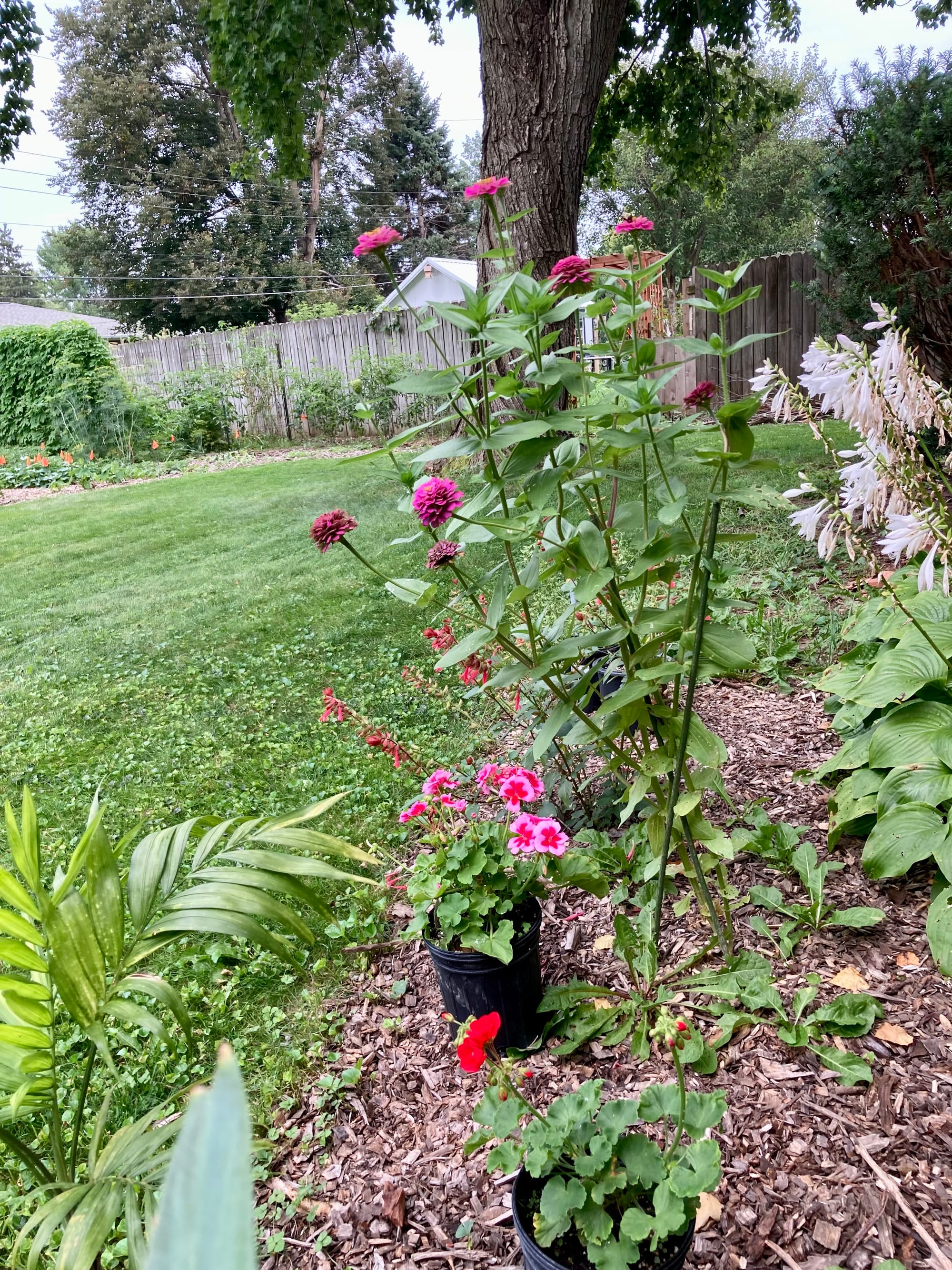
A glimpse of Albine's unfinished flower bed on the top left is the veggie garden: started by Bruce and Ryan while Albine occasionally weeds them out.
## Albine of Aralin World Is Creating A New Cycle
I may have some hiccups or my light seems not shining on some occasions. I, as a teacher or a gardener is like the *buwán*. I have many phases as well, and that's beautiful.
Lately, I've **pushed the button to create more and to serve more**. Thanks for not going anywhere else. Once again, welcome to Aralin World! I honor you.
My idea of this new cycle could be simple but meaningful. I can pick up what I've left off (e.g., series of Tagalog lessons). However, I've plans of connecting with you **like no other human beings have tried**. I can promise you more intimate conversations and I encourage you to reciprocate because...
You are part of my world.
Not superficial, not mechanical, but totally high touch.
---
**Reply To This Post**
1. Kailán ka hulíng tumingín sa buwán? (*When is the last time you look at the moon?*)
2. May nakita ka bang serye sa buhay mo (o sa pag-aaral ng Tagalog) na natapos mo na at nakaalís ka na doón? Pwede mo bang ibahagi sa akin? (*Do you recognize a pattern in your life (or Tagalog learning) where you've closed the cycle and done with it? Will you share it with me?*)
Please say it in Tagalog if you can.
Regards,
Albine
### Buwán ng Wikà: Wear Your Traditional Filipino Clothing
URL: https://www.aralinworld.com/buwan-ng-wika-wear-your-traditional-filipino-clothing/
Last updated: 2026-08-14T01:17:07.000Z
In this month of August, **we at Aralin World are**[ **honoring the Filipino's Buwán ng Wika**](https://www.aralinworld.com/buwan-ng-wika-why-the-philippines-celebrate-this/) (language month). We join the entire Philippines in its call to strengthen the **national language** which is Filipino. While Filipino as a language deserves to be discussed separately, Tagalog (as a language and people) could be difficult to distinguish and confusing to foreign observers.
Let's put aside those various nuances, but for now let's study the field of **traditional clothing in the Philippines**.
Clothing in the tropical Philippines, for both male and female, for both children and adult, should be light as possible. Wear it thin and loose. Climate is hot and humid almost throughout the year so dresses are worn to carry off your perspiration.
Depending on how much you can afford, and on which occasion to go, choose fabrics like linen, cotton, or anything made from natural fiber. **As you understand the culture, and for Buwan ng Wika celebrations,** [**you may attend a cosplay**](https://www.aralinworld.com/buwan-ng-wika-reconnect-with-your-target-language-tagalog/)and consider looking for sets of garments made from hemp, silk, abaca, or ramie.
### Baróng Tagalog
These days, Baróng Tagalog is a type of formal wear. Depending on price value and the purpose of wearing them, this garment can be made from abaca fiber, banana fiber, pineapple leaf fibers, or silkworm cocoons.
*Husi* is the local term to refer to pineapple leaf fiber or any textile made from natural fiber. *Pinya* is the Tagalog term for 'pineapple'. Thus, people specifically describe this garment as '*husi baróng*'.
The following are classifications of husi:
- Traditional husi - made out of plant fibers like abaca fiber or banana leaf silk
- Evolved husi - blend of silk and banana fibers
- Modern husi - silk blended with synthetic fibers also known as organza
- Pinya husi - woven from pineapple leaf fibers
- Pinya seda - blend of pineapple leaf and silkworm cocoons
- Seda - pure silkworm cocoon fibers
Baróngs are transparent, with gaps between interwoven threads making the textile a good canvas for embroidery. Intricate embroidered baróng is a statement of Filipino ingenuity and culture.
### Kamisa
Kamisa is a collarless, round scoop, with two or three buttons at the neckline. It is made from soft, thin, breathable cotton fibers. It comes either in short-sleeve or long-sleeve variant. This serves as an undergarment with Barong Tagalog on top of it.
A variant of kamisa is worn by working class individual. Join a cosplay inspired by Andres Bonifacio and his Katipunan members wearing a **plain white kamisa with a red scarf tied around your neck**.
### Kimona
Just like Baróng Tagalog, kimona is also a lightweight, transparent outer garment using textiles of natural fiber. It is embellished to express feminine spirits. It can be embroidered or adorned with lace, sequins, pearls, or precious gems.
It's just a top garment so it requires a bottom piece to match the period one may wish to portray. Don't forget: an undershirt is necessary.
### Patadyóng
A good garment to match the kimona, patadyóng is a high-waisted wrap-around skirt. The fabric is traditionally woven using colorful cotton threads. It's **a tube-like piece of clothing** available for both men and women. It's known for checkered patterns with vibrant colors, **covering one's waist down to his/her ankle**.
### Tapis
Tapis is similar to patadyóng, only that it covers a **woman's body from waist down to her knees**. It comes in basic rectangular hand-woven piece of cloth to wrap around the bottom part of the woman's body.
### Bahág
Bahág is made from barkcloth or from woven textiles with color and quality indicative of one's status. It is the **most basic covering for men**.


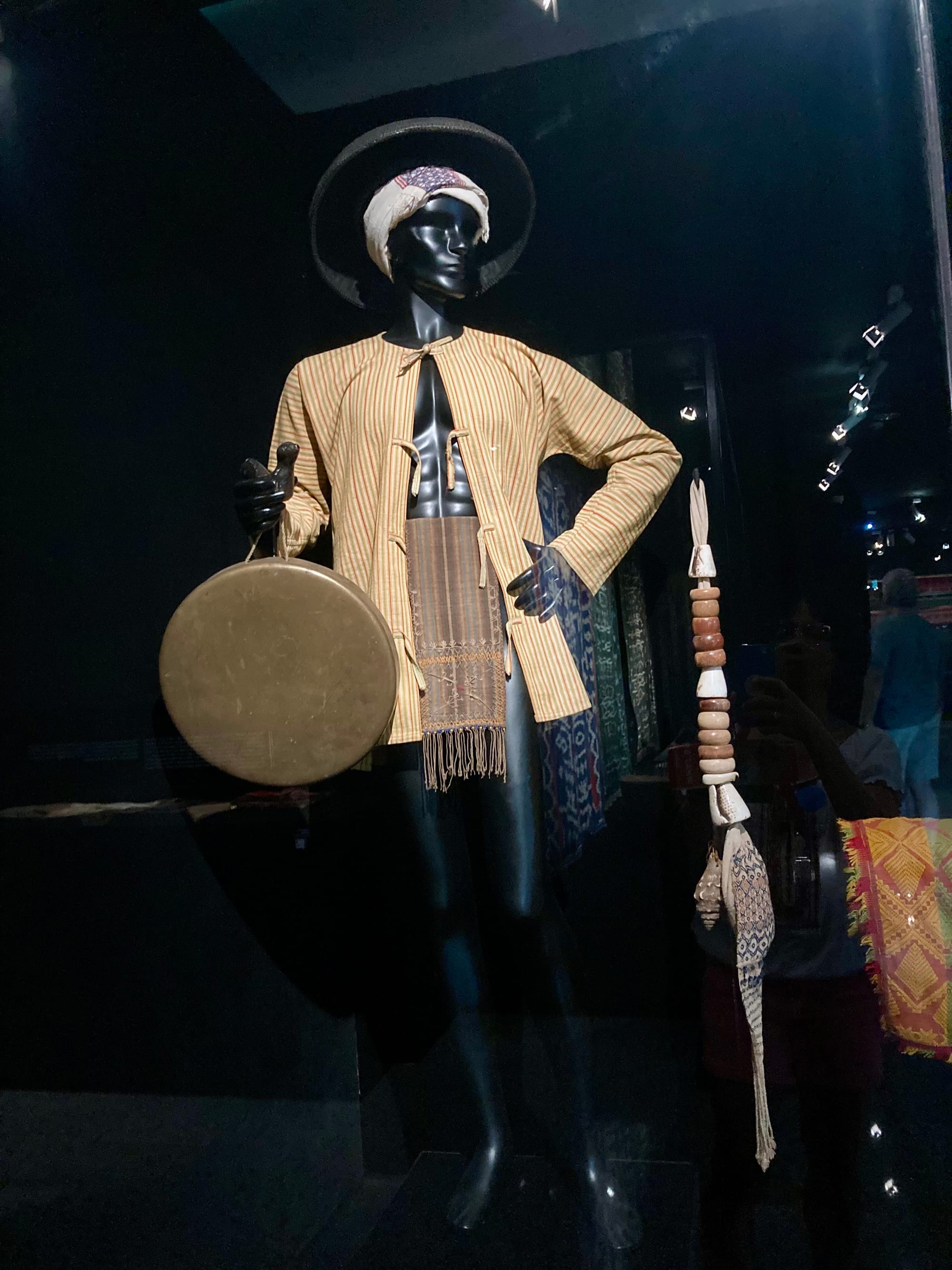
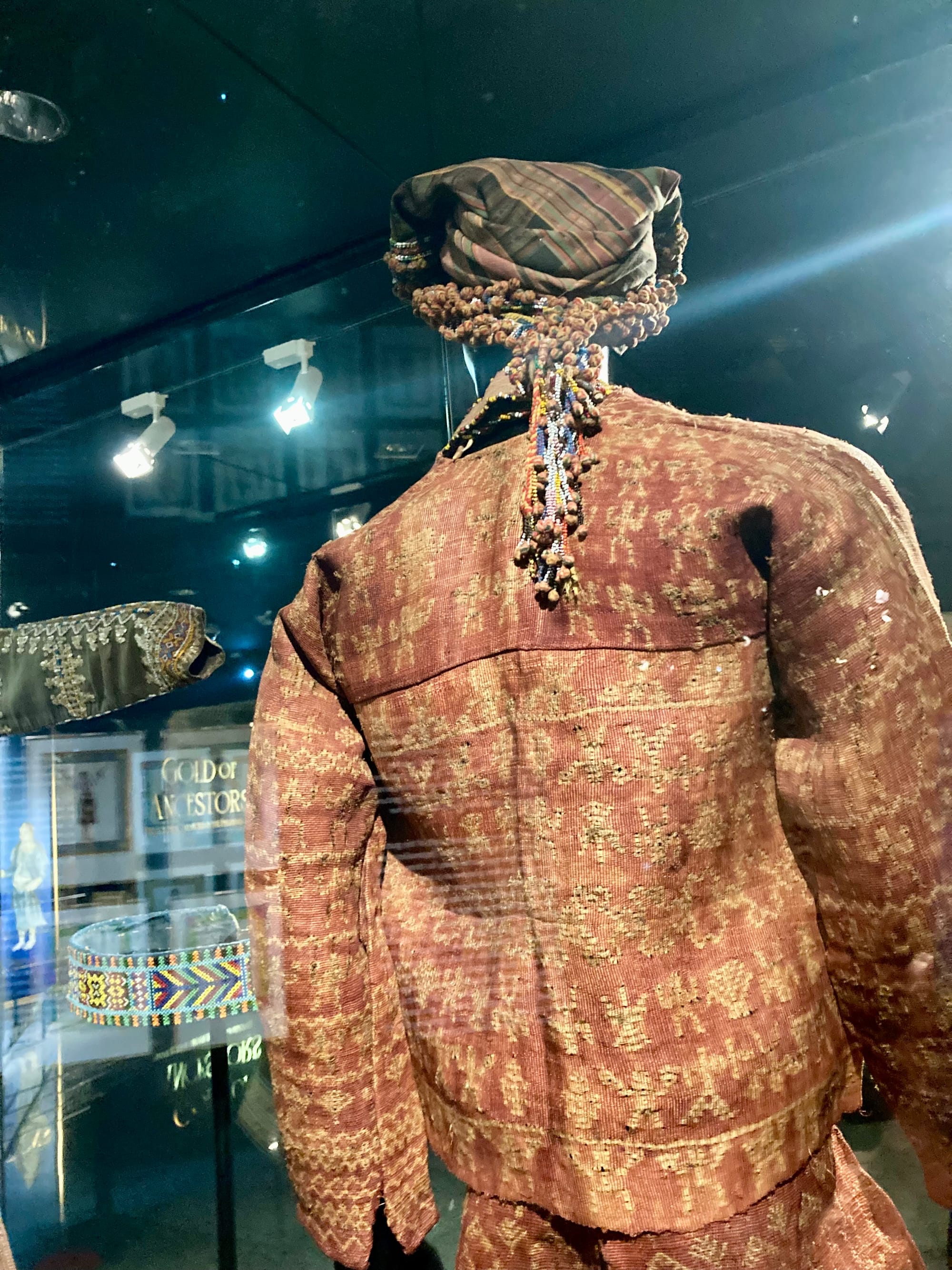
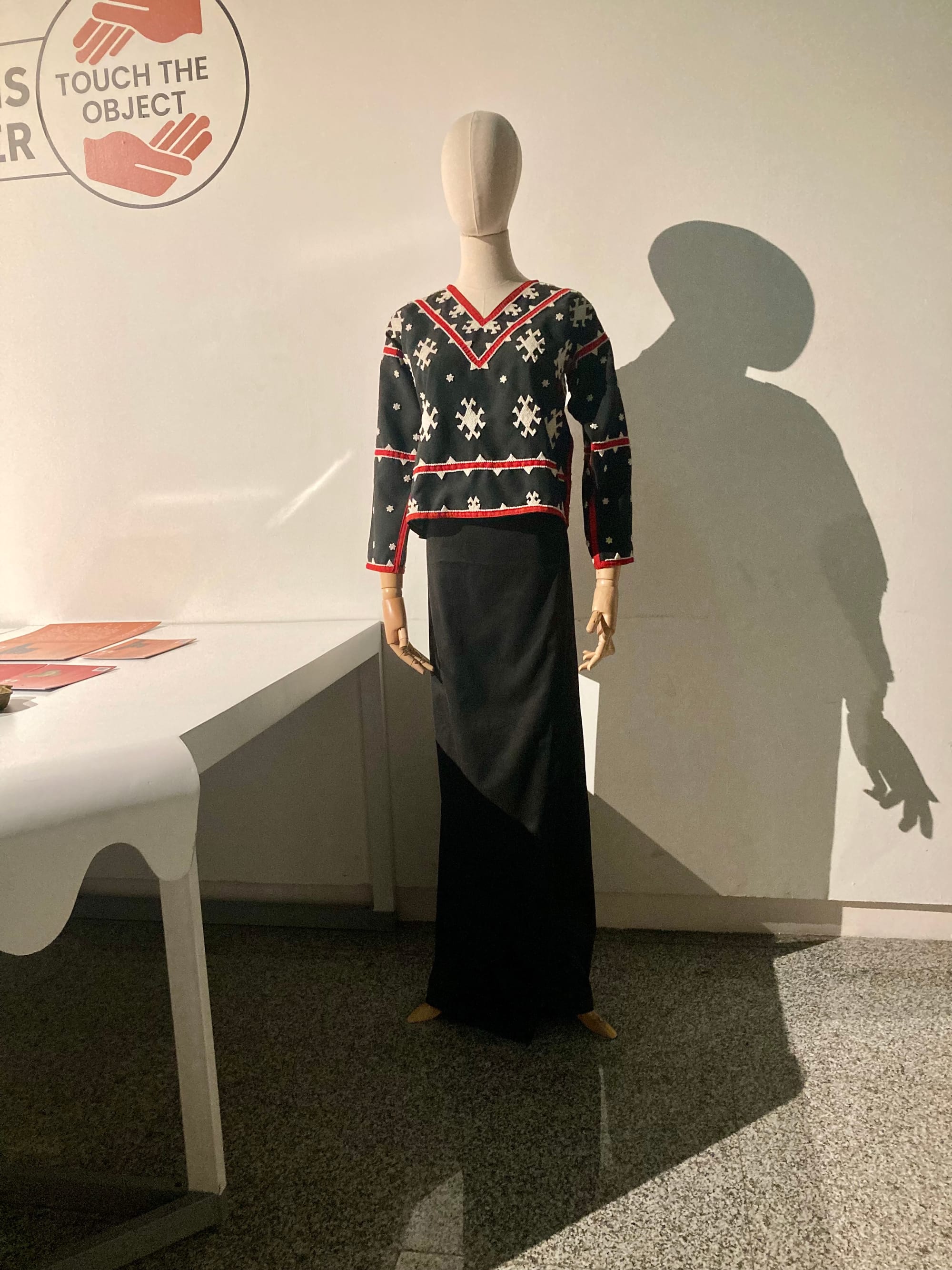
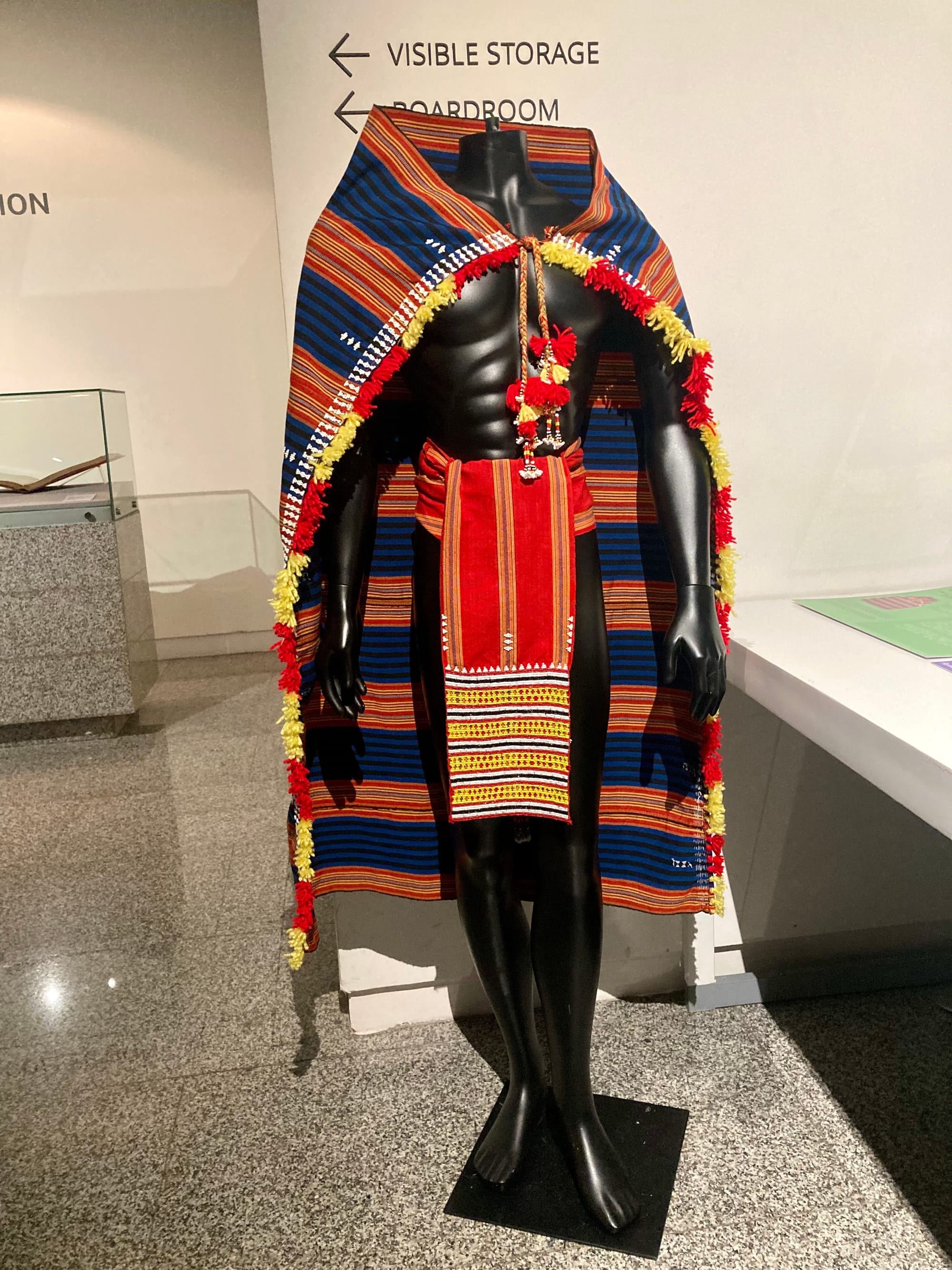
Combined photo collections of exhibits at Ayala Museum and National Museum in the Philippines. Taken September 2023.
## Additional Filipino Garments and Accessories
The indigenous Filipino look is not complete without other articles to serve particular purposes such as: to depict nobility, to protect from sun and rain, or to display status in the community.
### Alampáy
Alampáy is a triangular piece of cloth which works similar to a shawl. The fabric should be made from pinya, husi, or seda but embellished with embroidery. Women wear alampáy on top of their kimona.
### Panwelo
Panwelo is the evolved version of alampáy during the Spanish occupation in the **Las Islas Filipinas** (old name for the Philippines). It's larger than alampáy that comes as a huge square shape cloth folded into a triangle before wearing. Like alampáy, it's also adorned with embroidery
### Kalumbigas
Kalumbigas refers to large armlets, bangles, or bracelets typically made of gold, brass, or other metals.
### Putong
Putong is a narrow strips of cloth bound around one's foreheads and temples.
### Pudong-pudong
Pudong-pudong is a headdress worn like a headband or crown. **A red pudong-pudong indicates that one has killed an enemy**, and it's locally called '*magalong*'.
### Neck Ornaments
Filipino neck ornaments are heavy and thick in gold filigree. These are statements of regional indigenous craftsmanship with designs coming from various themes such as amulets, fertility, religious alliance, or heritage.
### Salakót
Salakot is a cone or dome-shaped headgear worn as protection from the sun and rain. It's made from bamboo, rattan, nitò, or bottle gourd. This indicates a peasant lifestyle.
### Bakyâ
Bakyâ is a footwear, also known as the wooden clogs. A specific variety of native wood such as *santól* or *laniti* is cut to the desired size and then shaven until smooth. A strap of cloth or any other natural material would be nailed on upper side of shaven wood to serve its purpose as a wearer's foot protection.
## Other Local Terms Familiar To A Filipino Peasant
The following are articles that come in cheaper variety as they've been processed in its most original form, very basic and not necessarily embellished:
1. **Ramie** is a type of natural fabric made from stalks of the Chinese nettle plant. People in the past complain that this material is hard and itchy to the skin.
2. **Katsa** is another type of material for clothing. It comes in plain, natural, unbleached, open weave cotton fabric. Most popularly used as a flour sack or money bag.
3. **Karsonsilyo** is the local term for 'boxer shorts'.
4. **Salawál** is a loose knee-length or shin-length pants
5. **Saya** is the local term for women's long skirt.
---
**Task**
Decide which clothing from above would speak most about you and then **join Buwan ng Wika Get Together this year**. Be there on Friday, August 14 at 10:30 AM (US East Coast time) or find your local time:
*[Time converter](https://www.worldtimebuddy.com/?ref=aralinworld.com) at worldtimebuddy.com*
## Save Your Seat to Join Our Buwán ng Wikà Party
Meet up with Albine and other fellow Tagalog learners to observe Buwán Ng Wikà (language month) in August 2026\. Teachers and alumni are also invited.
Join
Email sent! Check your inbox to complete your signup.
No spam. Unsubscribe anytime.
Late for the announcement? Don't worry. Simply **leave your email here at Aralin World so you'd receive invitations to our upcoming events** in the near future.
**Conclusion**
Now that we've identified a long list of traditional garment specifics, please realize that **we're barely scratching the surface of this mind-blowing and fascinating Filipino styles, history, and culture**. As a Tagalog native, I have yet to understand the various traditional clothing of regional tribes from north of Luzon down to the southern part of the archipelago in Mindanao.
I'm glad you've come this far. Whether you're attending our Buwán ng Wikà celebration, or looking for cosplay ideas, or considering to enhance your sense of fashion, or finding a new character to your unfinished novel: **I hope you've found Aralin World lessons like this helpful and inspiring**.
Salamat po!
### Buwán ng Wikà: Why Do Filipinos Celebrate This?
URL: https://www.aralinworld.com/buwan-ng-wika-why-the-philippines-celebrate-this/
Last updated: 2026-08-08T21:02:46.000Z
This journal tries **to introduce Buwán ng Wikà** as a significant month-long celebration **to honor the Philippine National Language** while at the same time, encouraging everyone to also pay stronger attention to various indigenous languages referred to, in the current Constitution, as the **Regional Languages**.
## What Paves the Way to the Adoption of a National Language?
The idea behind the **Philippines' Buwán ng Wikà** can be traced far back during the **American occupation from 1898 to 1946**.
First, let's take a quick review on how the American rulers came to the Philippines. There was a Spanish-American War in 1898\. United States won the war but the [**Treaty of Paris of 1898**](https://history.state.gov/historicaldocuments/frus1898/d712a?ref=aralinworld.com) became part of the peace process between the declining empire (Spain) and the rising one (United States). **This treaty includes the victor's acquisition of territories** in the western Pacific and Latin America.
At that time, President William McKinley had **no interest in acquiring the Philippines, but** his people in the navy saw a potential in Manila Bay as an **outpost to enhance their influence in the Far East**. Some American legislators, businessmen, and Protestant Church leaders were threatened about European interests in China. Manila appealed to them as a base from which American interests in China can easily be defended. Along with that, the British and Japanese governments were in favor of the United States to keep the Philippines. (See Britannica website: [Fighting in the Philippines and Cuba | Spanish-American War](https://www.britannica.com/event/Spanish-American-War/Fighting-in-the-Philippines-and-Cuba?ref=aralinworld.com#ref338470))
## Were Filipinos Incapable of Running Their Own Country?
Outside the Philippine archipelago, specifically United States, Britain, and Japan, they believed that Filipinos have no education, training, or experience in running their own government. (See Britannica website: same link as above.) What a **strong prejudicial expression** coming from the then global powers!
Probably **having lack of platform and chaotic internal politics among Philippine natives** brought the Filipinos into its unfortunate and unsuccessful defense as the international politics tilts towards another form. After long deliberation and lack of representation among (a.k.a. silencing the) Filipinos, **United States then decided Philippines to be its own colony**.
American soldiers started to teach children in the Philippines and **they forced the locals to speak English to them**. They opened a handful of schools in Manila and ordered lots of textbooks in the Spanish language. They believed that Spanish is the common language but later realized that less than 5 percent of the population could speak Spanish. The books were useless to the most parts of the archipelago.
A detailed description of **the early American education system in the Philippines** are presented by William Edward Ezzell through his paper entitled: [Secular Missionaries: The Early American Teachers in the Philippines](https://www.columbusstate.edu/archives/%5Fdocs/gah/1985/pgs96-107.pdf?ref=aralinworld.com); date written not specified; online access August 5, 2026 through Columbus State University archives.
On January 21, 1901, [the Act No. 74 was enacted by the United States Philippine Commission](https://elibrary.judiciary.gov.ph/thebookshelf/showdocs/28/15605?ref=aralinworld.com). This establishes the Department of Public Instruction for the Philippine Islands, along with **guidelines on how to run the American education system**. Section 14 states that:
> The English language shall, as soon as practicable, be made the basis of all public school instructions, and soldiers may be detailed as instructors until such time as they may be replaced by trained teachers.
The act mandated an American hierarchical structure of academic institution with central office in Manila while extending its reach to the whole archipelago. Since then, the U.S. government hired thousands of trained teachers from their soil to be transported to the Philippine Islands.
A story featuring the ship which departed from San Francisco, California to bring American educators to Manila is described in the post: "[A Brief History of the Thomasites](https://philippines.michiganintheworld.history.lsa.umich.edu/s/exhibit/page/a-brief-history-of-the-thomasites?ref=aralinworld.com)".
With the presence of American powers, **democracy was slowly introduced**. Students learned English, Science, Mathematics, Practical Arts, and American literature at schools, but those living in the remote mountainous regions could hardly access the American school system. Wikipedia states that only [26.3 percent of the population spoke English, based on 1939 census](https://en.wikipedia.org/wiki/Commonwealth%5Fof%5Fthe%5FPhilippines?ref=aralinworld.com). **Highly educated Filipinos were able to communicate globally** and opens the door to understanding different kinds of worlds.
However, at least two Filipinos who studied under American teachers became thought leaders in their own rights. They were too critical of the American influences in the Philippines. First is **Carlos P. Romulo** (1899-1985), a close friend of General Douglas MacArthur, author, and world traveler. Another is **Luis Taruc** (1913-2005), a socialist and guerilla leader of the Hukbalahap (*Hukbong Bayan Laban sa Hapon*) against the Japanese occupants of the Philippines. Ezzell wrote:
> Both of them **were aware of the condescending attitude that the colonizers held towards Filipinos**.
Romulo was quite gentle in critiquing the American teachers but Taruc openly stated that education system in schools was established as part of the colonial rule of American imperialism.
Furthermore, Taruc pointed out that **the American styles of teaching did not result in growth of native Filipino literatures**. Locals were made to feel ashamed and unworthy if they stick to their own languages, culture, and traditions.
**The Treaty of Manila of 1946 ended the American occupation in the Philippines** and the United States recognized the sovereign Philippines. It was signed on July 4, 1946.
## As a Newly Independent Country, Linggó Ng Wikà is Observed in the Philippines
On March 26, 1946, President Sergio Osmeña signed **Proclamation No. 35**, designating the period from March 27th to April 2nd of each year "National Language Week". In local vernacular, it is referred to as **"Linggó ng Wiká"**. April 2nd was chosen as the end date because it is Francisco Baltazar's birthday anniversary. **Baltazar was a poet, litterateur of the Tagalog language, the renowned author of "Florante at Laura"**.
There is a drawback, however, in observing *Linggó ng Wikà* during the later days of the month of March up to the first two days of April each year. Such is outside the school year which prevents the participation of schools in its celebration. To address this concern, President Ramon Magsaysay signed **Proclamation No. 186** on September 23, 1955\. It declares the period from August 13 to 19 of every year as National Language Week. The significance of **August 19 being the birthday of Manuel L. Quezon who became known as the Father of the National Language**.
## Tagalog as the Strongest Contender Towards the Basis of Adopting a National Language
**Prior to Philippine Independence period**, Commonwealth Republic President Manuel L. Quezon **declared Tagalog as the basis for the national language**. He signed the **Executive Order No. 134** prescribing the adoption of the national language based upon one of the existing native tongues.
He appointed a Chairman, a member and Secretary, and 5 other members of the *Surián ng Wikang Pambansâ* (Institute of National Language). They shall observe the conditions and proceedings in adopting a national language.
The Executive Order declares that the *Surián*has come to a conclusion that Tagalog is unanimously chosen as the basis of the "adoption of the national language" based not only from the conviction of the *Surián* but from the opinions of Filipino scholars and patriots of various origins and different educational backgrounds.
During that period, **they found Tagalog to have been used and accepted by the greatest number of Filipinos especially in Manila where the seat of power is situated** while the local newspapers, publications, and individual writers use Tagalog in their categorical views and expressions.
Since the establishment of the Philippines as a country, 80 years past, the distinct identity of its national language have gone a long and winding road.
There was a time **during President Ferdinand E. Marcos' presidency** when another Constitution was proclaimed, and thus the Article on General Provisions of the **1973 Constitution** **mandates that English and Pilipino shall be official languages** while still calling for taking steps towards the development and formal adoption and a common national language to be known as Filipino.
These leaves us a question on **how to distinguish between Tagalog and Pilipino**. Potentially, the discussion on Pilipino versus Tagalog deserves another time and place as it might be irrelevant in contemporary times. The Marcos Constitution is already phased out.
## The Philippine 1987 Constitution Declares Filipino as the National Language
The 1987 Constitution, written during President Corazon C. Aquino's administration, **declares Filipino as the national language while Filipino and English are the official languages**. This constitution mandates that Filipino is to be developed from all local languages of the Philippines.
Through **Proclamation No. 1041**, signed by President Fidel Ramos on July 15, 1997, the original week-long days of *Linggó ng Wikà* was extended to the full month of observance. **It declares August as Buwán ng Wikà** (language month).
Thus, the celebration of language month in the Philippines is **highly encouraged among academic communities and mainstream media**.
## Are Contemporary Leaders Successful in Uniting the Philippines Through Its National Language Mandate?
There is a major confusion throughout the local and international discourse regarding **Filipino versus Tagalog to be one and the same**. One may have varying explanations coming from different Filipino thinkers, depending on whether they are born and raised in Manila, in any Tagalog provinces, in northern Luzon, in the Bicol region, in the Visayan islands, or in Mindanao.
In a similar manner, it is interesting to compare the **Tagalog versions of both official rulings**: the 1987 Constitution versus the Proclamation No. 1041 of 1997.
Apparently Proclamation 1041 is published only in Filipino (or Tagalog). The constitution mentions the terms "*wikang pambansâ*" (national language) as well as "*wikang panrehiyon*" (regional language) from sections 6 up to 9 of article XIV; whereas Proclamation 1041 also used the term "*wikang pambansâ*" (national language), along with other identifiers like "*katutubong wikang pambansâ*" (indigenous national language), and "*katutubong wikang panlahát*" (indigenous language for all).
It is ironic to see how different administrations of different times **wish to unite the country through a national language**, but as leaders in the collective sense, they fail to identify what local terms to use when they mean to say **"national language", which is a foreign label**. Is President Ramos more accurate when he used "**katutubong wikang panlahat**" referring to Filipino language as "indigenous language for all"?
## Buwán Ng Wika: A Time to Contemplate on Philippine Languages, Explain the Culture, and Reconnect With Your Filipino Roots
Despite the hiccups, **we at Aralin World encourage everyone** to join the Philippines in observing Buwán ng Wikà every August each year. This is the time when we may air out our concerns on Philippine languages, understand the culture, and reconnect with your roots if part of your ancestry is Filipino.
## Save Your Seat Now
Meet up with Albine and other fellow Tagalog learners to observe Buwán Ng Wikà (language month) in August 2026\. Teachers and alumni are also invited.
Join
Email sent! Check your inbox to complete your signup.
No spam. Unsubscribe anytime.
### **Task**
Reply with '*buwan ng wika 2026*' if you're interested in participating in **Aralin World's Virtual Get Together** for this year's Buwán ng Wikà. Block your calendar for August 14, Friday at 10:30 AM (US East Coast time).
**Sign up for my Newsletter** or check either your SPAM folder or Promotions tabso you don't miss further details and updates regarding this event.
I hope to hear from you!
### Buwán Ng Wikà: Reconnect with Your Target Language, Tagalog
URL: https://www.aralinworld.com/buwan-ng-wika-reconnect-with-your-target-language-tagalog/
Last updated: 2026-08-08T02:56:52.000Z
The month of August is here! Do you know that **August is a significant month for Philippine languages**?
Think of August as the **Buwán ng Wikà** (Philippine Languages Month) celebration. It is observed among Filipinos and **Philippine language enthusiasts** everywhere. It is tied to **your target language: Tagalog**.
Hi! **I'm Albine of Aralin World**. I help people learn Tagalog.
In today's post, **I wish to remind you about Buwán ng Wiká 2026**. Did you have **experience of Buwán ng Wiká** celebration?
I'll be gathering a small group of people for **Buwán ng Wikà meet up**. If you're interested, we'll get together for an hour (or more) so you can immerse yourself in Tagalog language.
Its purpose is to find a language partner, discover new words and phrases, or engage in small talk with fellow learners.
We'll feature the following:
1. Telling Filipino Jokes
2. OPM Sing Along
3. Cosplay (e.g., Maria Clara, Sisa, Padre Damaso/Salvi, Katipunero, Gabriela Silang, Lapu-lapu, Makapili, Filipino Tribal Prince/Princess)
4. Filipino Meryenda Time (prepare your snacks & drinks and we'll eat together synchronously)
It's **set on August 14, Friday at 10:30 AM (US East Coast time)**.
*[Time converter](https://www.worldtimebuddy.com/?ref=aralinworld.com) at worldtimebuddy.com*
Are you interested?
Submit your email and **I will get back at you for the link to our Jitsi Meet code**. This works like Zoom.
## Save Your Seat Now
Meet up with Albine and other fellow learners to observe Buwan Ng Wika (Language Month) in August of 2026
I'm Going
Email sent! Check your inbox to complete your signup.
No spam. Unsubscribe anytime.
I'm excited and I can't wait to make this happen.
Albine Bodo
Your Personal Tagalog Teacher
---
PS. Reply with *'let's go'* and we'll go from there.
### Tagalog Verb Groups Made Easy: 5 Must-Know Categories for Natural Speech (With Real-Life Examples)
URL: https://www.aralinworld.com/tagalog-verb-groups-made-easy-5-must-know-categories-for-natural-speech-with-real-life-examples/
Last updated: 2026-02-25T04:54:58.000Z
Tired of ‘textbook Tagalog’? This guide breaks down 5 verb groups (mag, um, in, an, & i) so you can speak like a local—not mechanical. 🌟 Includes real-life example sentense! Perfect for Upper Beginners.
_This post is for paying subscribers only._
### Tagalog Grammar: Exploring Prefix 'Ka-'
URL: https://www.aralinworld.com/tagalog-grammar-exploring-prefix-ka/
Last updated: 2026-01-28T03:12:13.000Z
Have you ever felt an instant connection with someone—like you are part of the same circle, sharing the same vibe or even the same mission? In Tagalog, that bond is not just a feeling; it is built right into the language!
Today, we are diving into the powerful **prefix ‘ka-’**, a mighty tool that transforms words to show **relationships between people, belonging to a group, likeness, or doing the same activity**. Whether you are thinking about the word *kababayan* (fellow countryman), *kaklase* (classmate), or *katuwáng* (partner in a task), this prefix helps you express unity and shared identity in ways that go beyond simple translation.
_This post is for subscribers on the Intermediate tier only._
### Tagalog Verb Groups for Upper Beginner: Guide to Suffixes -in/hin, -an/han, and Prefix i
URL: https://www.aralinworld.com/tagalog-verb-groups-for-upper-beginner-guide-to-suffixes-in-hin-an-han-and-prefix-i/
Last updated: 2026-01-28T03:50:22.000Z
There are 3 verb groups that Upper Beginners in Tagalog need to master before they'd get conversational in the language. Let's break them down with just clear rules and real-life examples. Know the difference, and use it and be fluent Tagalog.
_This post is for subscribers only._
### The Filipino Generosity: What Moves Balíkbayan Boxes?
URL: https://www.aralinworld.com/the-filipino-generosity-what-moves-balikbayan-boxes/
Last updated: 2026-01-06T20:32:40.000Z
"Binuksán nilá ang balíkbayan *box*." (*They opened the balíkbayan box*.)
For millions of Filipinos abroad, this expression is not just about stuffing a box and shipping it to the Philippines. It is about love, sacrifice, and the unbreakable bond with family back home. The *balíkbayan box* is more than just a package filled with goods; it is a symbol of hope, connection, and the spirit of giving that defines the Filipino diaspora. But what makes these boxes so special, and what emotions do they bring for both the sender and the receiver?
### Etymology
The term **balíkbayan** is a Tagalog compound word:
- The first word, *balík,* means "return" or "come back".
- The second word, *bayan,* means "town" or "country".
- Together, the word *balíkbayan* means "someone who comes home", often referring to OFWs (overseas Filipino workers) returning to the Philippines or expats abroad visiting the homeland.
- The word *balíkbayan* is either an adjective or a verb.
- *Balíkbayan box* is an expression meaning "a package".
Here is a quick demonstration on how to use "balíkbayan" and "balíkbayan box" in the sentence:
1. Inaanyayahan ang mga **balíkbayan** na dumaló sa isáng palatuntunan. (*The Filipinos coming home are invited to see a program.*)
2. Susunduín ko sa *airport* ang tiyuhin kong **magbabalíkbayan**. Siyá ay taga-California. (*I will fetch my uncle from the airport. He is a balíkbayan from California.*)
3. Aabutin ng halos tatlóng buwán para matanggáp ang mga **balíkbayan boxes** kung itó ay ipapasok sa *shipping container* na isasakáy sa barkó. (*It will take around 3 months for the balíkbayan boxes to be received if they will be shipped via container for sea travel.*)
4. Namilí siyá ng mga sarì-saring bagay na ilalagáy sa **balíkbayan box**. (*He/she shopped for various things to fill the balíkbayan box.*)
## Balíkbayan Box is Not Just a Trend
*Balíkbayan box* is usually a luggage that Filipinos bring on their plane trip from abroad, but they have options to send it as a package via a known courier service. It represents the physical and emotional bridge between overseas Filipinos and their loved ones back home.
For decades, *balíkbayan* boxes have been normalized especially during the holidays. When OFWs (overseas Filipino workers) return home or send packages, these boxes are a tangible expression of their hard work and love. Packages have become so common that:
- **Shipping companies** offer special services and discounts for *balikbayan* boxes, especially during peak seasons like Christmas.
- **Families eagerly await** their arrival, often treating the unboxing as a special event.
- **Communities abroad** organize group shipments to save on costs, turning the process into a collective effort.
The *balikbayan* box is a tradition that transcends generations, symbolizing the sacrifices and dedication of Filipinos working far from home.
## Sign up for Learn Tagalog Online with Aralin World
Master Tagalog with interactive lessons, cultural tips, and practical exercises. Learn from a native speaker and connect with your Filipino heritage today.
Subscribe
Email sent! Check your inbox to complete your signup.
No spam. Unsubscribe anytime.
## What’s Inside a *Balikbayan* Box—and Who Is It For?
A *balikbayan* box is a treasure trove, carefully curated to bring joy to family and friends. The box's average size would be 24 x 18 x 24 cubic inches. While the contents vary, they often include:
- **Food:** Canned goods, chocolates, cookies, and specialty items like *Spam*, *corned beef*, or *potato chips* that are harder to find or more expensive in the Philippines.
- **Clothes and Shoes:** Gently used or brand-new items, often passed down or chosen specifically for family members.
- **Toiletries:** Soap, shampoo, lotions, and perfumes—practical items that are appreciated as luxuries.
- **Toys and School Supplies:** For the younger members of the family, ensuring they feel included and special.
- **Household Items:** Kitchenware, decor, or small appliances that can make daily life a little easier.
These boxes are typically sent to immediate family: *magulang* (parents), *kapatíd* (sibling), *lolo/lola* (grandparent) or *anák* (child). Part of the goodies may be shared to extended family: *pinsán* (cousin), *tiyo* (uncle), *tiya* (aunt), *pamangkín* (niece/nephew), or *inaanák* (godchild).
Every item in the box is chosen with care, reflecting the sender’s love and the unique needs of their loved ones.
## Why *Balíkbayan* Boxes Matter To Me
As someone who left the Philippines to build a life abroad, I understand the emotional connection of a *balíkbayan* box. It is not just about the items inside—it is about the love, longing, and attention it represents. For me, these boxes are a reminder of:
- **Support:** The unusual scents, tastes, and textures in the box are a message to say that: *"When times are tough, I am with you even if I am thousand of miles away."*
- **Sacrifice:** The hard work and dedication of Filipinos abroad who send these boxes, often setting aside their own needs to provide for their families.
- **Hope:** The joy and excitement on the faces of loved ones when they receive a box, knowing they are remembered and cherished.
*Balikbayan* boxes are a testament to the Filipino spirit of giving—a spirit that transcends distance and time.
### Conclusion
The *balíkbayan* box is an expression of love, resilience, and the unbreakable bond between Filipinos in the homeland and abroad. It is a tradition that speaks to the heart of what it means to be Filipino: generous, thoughtful, and deeply connected to family.
Want to explore more about Filipino culture and language? [**Become a Paid Member**](https://www.aralinworld.com/#/portal/signup) **of Aralin World!** Whether you are part of the Filipino diaspora, a language learner, or simply curious about Filipino traditions, you can unlock Tagalog lessons and behind the scene stories exclusively prepared for higher tier members only.
Connect with us, start your journey to deeper cultural understanding and **let us welcome 2026** with generosity while leaving a room for more blessings to come.
**Manigong Bagong Taón!** (*Happy New Year!*) 🎊 🫶🏼
### The Filipino Spirit of Giving: The Thoughtfulness of Pasalubong
URL: https://www.aralinworld.com/the-filipino-spirit-of-giving-the-thoughtfulness-of-pasalubong/
Last updated: 2025-12-20T14:50:11.000Z
"*May pasalubong akó para sa iyó!*" (I have *pasalubong* for you!)
If you have ever heard these words, you know the joy they bring. *Pasalubong*—the act of bringing nice things or food to a person you care for, as you meet up again—is a cherished Filipino tradition. It is more than just a gift; it is a symbol of love, thoughtfulness, and connection. But what makes *pasalubong* so special, and why does it hold such a meaningful place in Filipino culture?
## **Etymology**
The word **pasalubong** comes from the root *salubong*, meaning "to meet up" or "encounter." It reflects the idea of bringing something special to share when you reunite with someone, turning an ordinary trip into a heartfelt moment.
The root word *salubong* is a verb, but when you apply the *prefix pa*, it turns into a noun. The prefix 'pa' usually means "let" or "allow" or "towards":
*Pasalubong* (noun): Towards giving something upon arrival.
*Pasalubong* (noun): Let somebody receive a thing upon meeting up.
*Pasalubong* can be defined as an item you pick up (or made) for someone when you are away, so that you have something to give when you return from a trip, or when you arrived for a visit. It is a predetermined goodie. It should be simple and affordable.
## **The Giver and the Recipient in *Pasalubong* Context**
*Pasalubong* is a two-way street of joy:
- **The Giver:** Bringing *pasalubong* is a way to show you have thought of someone while you were away. It is a gesture of love and a sign that you value the relationship.
- **The Recipient:** Receiving *pasalubong* feels like a warm hug—it is a reminder that someone cares enough to bring you something special.
## **Not All *Pasalubong* Can Be Bought**
*Pasalubong* does not have to be expensive or store-bought. Often, the most meaningful gifts are those that come from the heart or the home:
- **From Your Yard:** Fresh fruits like *mangga*, *saging*, or *bayabas*.
- **Homemade Treats:** *Kakanín* like *bibingka*, *puto*, or *leche flan*.
- **Local Specialties:** *Pastilyás*, *tunsóy, patís, bagoóng*, or *laing*.
- **Handmade Crafts:** *Pamaypáy* (fan), *banig* (woven mat), or *bilao* (woven tray).
## Sign up for Learn Tagalog Online with Aralin World
Master Tagalog with interactive lessons, cultural tips, and practical exercises. Learn from a native speaker and connect with your Filipino heritage today.
Subscribe
Email sent! Check your inbox to complete your signup.
No spam. Unsubscribe anytime.
## **Developing Connection Through *Pasalubong***
*Pasalubong* is a way to strengthen bonds. Whether it is a small token or a grand gesture, the act of giving *pasalubong* creates lasting memories and deepens relationships. It is a reminder that you are thinking of someone, even when you are apart.
A mother, for example, who ran an errand would stop at a bakeshop so she can grab a piece of bread to bring home for her child. A friend from another town or province, who is invited to stay for a weekend holiday or fiesta would bring *pasalubong* to his/her host. An OFW (Overseas Filipino Worker), who works abroad piles up a **luggage of *pasalubong*** for her family and friends in time for their Christmas homecoming.
*Pasalubong* is optional but when given voluntarily, it can be a meaningful conversation piece aside from catching up, or telling about how fun (or difficult) the trip has been.
## **Visiting a Filipino Family or Friend This Christmas?**
Who will you bring *pasalubong* to this holiday season? Reply to this email and share your plans this **Paskó and Bagong Taón.** I would love to hear about your special traditions.
*Mabuhay ang diwà ng Paskó at pagbibigayan!* (Cheers to the spirit of Christmas and giving!)
Albine Bodo
**PS.** Good news! I have got one new sign up for our 12-Unit Beginner Essentials Path to Tagalog. New **sign ups this week are given huge discounts,** and there's just 1 slot left. Last day to avail of this marked down rate is today, December 19\. Reply with "Pasko Na" if you want to be part of my small bespoke Tagalog learning for 2026.
### The Filipino Spirit of Hospitality: With Panuluyan, There's Always a Place for You to Stay
URL: https://www.aralinworld.com/the-filipino-spirit-of-hospitality-with-panuluyan-theres-always-a-place-for-you-to-stay/
Last updated: 2025-12-17T18:35:10.000Z
"*Pasok! Tulóy ka dito sa amin.*" (Come in! Welcome to our home.)
If you have ever visited a Filipino home, you have likely heard this warm greeting. Filipinos take honor and pride accepting visitors. They welcome you wholeheartedly and they pay attention to you.
In this season of Christmas, let us talk about Filipino hospitality and why does it shine brightest during the holidays? With *panuluyan*, let us find the magic behind opening their doors to you, and discover why there is always a place for you to stay when you visit the Philippine islands.
_This post is for subscribers only._
### The Filipino Spirit of Giving: The Power of Bayanihán
URL: https://www.aralinworld.com/the-filipino-spirit-of-giving-the-power-of-bayanihan/
Last updated: 2025-12-16T19:11:57.000Z
"*Magbayanihan tayo at nang patuloy na umusad ang ating pamayanán*." (Let us engage in bayanihan so that our community can move forward.)
Christmas in the Philippines is not just about gifts and feasts. It is a period where *bayanihán* activities may be found*. Bayanihán* is about the spirit of community and helping one another. This timeless value reminds us that true joy comes from lifting others up. But what does *bayanihan* really mean, and how does it shape the Filipino way of life, especially during the holidays?
_This post is for subscribers only._
### The Filipino Values of Generosity: Pakimkím as a Tradition
URL: https://www.aralinworld.com/the-filipino-values-of-generosity-pakimkim-as-a-tradition/
Last updated: 2025-12-13T15:00:23.000Z
"*Magbigáy tayo ng pakimkím!*" (Let us give him/her *pakimkím!*)
If you have ever visited a Filipino newborn or have attended baptism, you have likely heard this expression.
*Pakimkím–*the cash gift personally handed to a baby or newly baptized child—is a cherished tradition that embodies the Filipino spirit of generosity. But why do we give money to babies who do not even understand its value? Let’s explore the beauty and meaning behind this heartwarming practice.
**Etymology**
The word **pakimkím** comes from the root *kimkím*, which means "to hold dear" or "to keep." The prefix pa may be interpreted as "let" or "allow" or "towards".
## Sign up for Learn Tagalog Online with Aralin World
Master Tagalog with interactive lessons, cultural tips, and practical exercises. Learn from a native speaker and connect with your Filipino heritage today.
Subscribe
Email sent! Check your inbox to complete your signup.
No spam. Unsubscribe anytime.
*Pakimkím* (noun: to let him/her take the money)
*Pakimkím* (adjective/adverb: towards giving money)
Example Sentences:
1. **Nagpakimkím** akó sa pamangkín ko ng sampúng dolyar. (*I gave $10 as pakimkím to my niece/nephew*.)
2. Ilalagáy ko ang **pakimkím** ko sa isáng puláng sobre at sakâ ko itó iaabót sa bagong binyág na batà. (*I will place my pakimkím in a red envelop and then I will hand it to the newly baptized child*.)
3. Ibinigáy niyá sa inaanák niyá ang isáng malutóng na limáng daáng pisong papel bilang **pakimkím** sa Araw ng Paskó. (*He/she gave his/her godchild a crisp 500 peso bill as pakimkím for Christmas Day*.)
4. **Pinakimkimán** ko ng halagáng isáng daáng piso ang anák ng kapit-bahay ko . (*I gifted my neighbor's child worth 100 pesos*.)
**But the Children Have No Concept of Money—Why *Pakimkím* Still Works?**
You might wonder: *Why give money to a baby?* The answer lies in the intention. *Pakimkím* is not about the child’s understanding of money. It is about the giver’s wish to contribute to their future. It is a way to say, *"I believe in you, and I want to be part of your journey."*
This tradition reflects the value of generosity. The idea of sharing something precious to a child also means sending blessings and well wishes as they grow. Unlike regular gifts, *pakimkím* is often given discreetly, tucked into an envelope or slipped into a tiny hand, symbolizing love and hope for the child’s future.
For Filipinos, *pakimkím* also means helping the parents ease their financial worries. A cash gift is a way of showing how much they care for the child’s well-being, whether for education, emergencies, or simply as a token of love. It’s a gesture that speaks volumes, even if the child is too young to grasp its meaning.
**How Filipino Parents Deal with Their Child’s *Pakimkim***
Parents often handle *pakimkím* with care and purpose:
- **Saving for the Future:** Many parents deposit the money in a bank account or keep it in a safe place, ensuring it grows with the child.
- **Teaching Values:** As the child grows older, parents use *pakimkím* to teach financial responsibility and the importance of gratitude.
- **Celebrating Milestones:** Some parents use the funds for special occasions, like birthdays or school needs, turning the gift into a lasting blessing.
**The Effect of Sharing Your Blessings with Children**
*Pakimkím* is more than just money—it’s a ripple effect of kindness:
- **Strengthens Bonds:** It fosters a sense of community, as family and friends come together to celebrate the child’s life.
- **Creates Memories:** The act of giving *pakimkím* becomes a cherished memory, reminding the child of the love surrounding them.
- **Encourages Generosity:** Children who receive *pakimkím* often grow up understanding the joy of giving, continuing the cycle of blessings.
**Share Your Blessings this Christmas!**
Did you like Guro Albine's works? Even if Albine is not a child, you can still share the spirit of *pakimkím*! Your gift is a way to acknowledge her hard work and creativity in teaching Tagalog to learners worldwide. By supporting her, you help reach more students and keep the Filipino language and culture alive.
**Ready to give?** [Click here to send your *pakimkím*](https://www.aralinworld.com/#/portal/support) and be part of this beautiful tradition!
**Conclusion**
*Pakimkím* is a testament to the Filipino heart... generous, hopeful, helpful, and full of love. It is a tradition that transcends age, reminding us that blessings are meant to be shared. This Christmas, let’s keep the spirit of *pakimkím* alive, whether for a child or someone who inspires us.
**How about you? Do you have a *pakimkím* story to share? Tell us in the comments!** 💛🎄
### The Filipino Spirit of Giving: Understanding Inaanák, and Pamaskó
URL: https://www.aralinworld.com/the-filipino-spirit-of-giving-understanding-inaanak-and-pamasko/
Last updated: 2025-12-12T19:56:08.000Z
> “*Ninong, ninang, namamaskó pò (akó)*!”
(Godfather, godmother, I'm here for your Christmas blessings!)
If you have spent holidays in the Philippines, you have likely heard this cheerful call during Christmas. The bond between a *ninong* or *ninang* (godparent) and their *inaanák* (godchild) is one of the most cherished relationships in Filipino culture. It is not just a title. It is a lifelong connection filled with love, guidance, and, of course, *pamaskó* (Christmas gifts) during the holidays!
But what does *inaanák* really mean? Why is this relationship so special? Let’s dive into the heart of this Filipino tradition.
_This post is for subscribers only._
### The Filipino Spirit of Giving & Sharing: A Christmas Series
URL: https://www.aralinworld.com/the-filipino-spirit-of-giving-sharing-a-christmas-series/
Last updated: 2025-12-12T19:48:50.000Z
The holidays are here, and with them comes the familiar warmth of Filipino traditions—those special ways we give, share, and connect with one another. This December, I’m excited to invite you to join me in exploring *"The Filipino Spirit of Giving and Sharing"* through a series of articles.
## **What to Expect?**
For 12 days, we will unpack the buzzwords and heartfelt practices that define Filipino generosity: from the joy of **balik-bayan boxes** and the thoughtfulness of **pasalubong**, to the community spirit of **bayanihan** and the simple act of **pagbabalot ng mga sobrang pagkain**. I will also be sharing my personal reflections and stories—because these traditions are more than just words; they are the threads that bind us to our culture and to each other.
## Sign up for Learn Tagalog Online with Aralin World
Master Tagalog with interactive lessons, cultural tips, and practical exercises. Learn from a native speaker and connect with your Filipino heritage today.
Subscribe
Email sent! Check your inbox to complete your signup.
No spam. Unsubscribe anytime.
## **Why This Matters?**
Whether you’re celebrating Christmas in the Philippines or thousands of miles away, these traditions remind us of what it means to be Filipino—generous, thoughtful, and deeply connected. Let’s celebrate and reflect on these practices together!
**Your Turn:**
I’d love to hear from you:
- **What reflections or memories do you have for this December?** Share your favorite holiday moments or traditions!
- **What are your plans for the holidays?** Are you sending a *balik-bayan box*, preparing *pabaon* for loved ones, or joining a *bayanihan* effort?
- **Are there Filipino Christmas practices that confuse you?** Let me know—I might just write a post about it!
**Reply to this email** or leave a comment on the blog. Your stories could inspire future articles!
**Stay tuned for the first post—coming soon!** In the meantime, may your December be filled with love, laughter, and the joy of giving.
*Kitakits!*
Albine Bodo
### Paanyaya: Aralin World’s Christmas & End-of-Year Get-Together 2025
URL: https://www.aralinworld.com/paanyaya-aralin-worlds-christmas-end-of-year-get-together-2025/
Last updated: 2025-12-05T15:43:04.000Z
The holidays are here—and so are we!
You’re officially invited to...
**Aralin World’s Christmas & End-of-Year Get-Together**—a cozy, virtual celebration for **Tagalog heritage learners and language enthusiasts** (age 21+) around the globe.
Let’s cap off 2025 with **laughter, games, and a whole lot of *chika*** as we connect across time zones!
**📅 When:** **Friday, December 5, 2025**
🕰️ **7:00 PM US East Coast** | **4:00 PM Los Angeles** | **12:00 PM London** | **11:00 AM Sydney** | **8:00 AM Manila** *(Pick your timezone and join when you can!)*
**📍 Where:** **Online via Jitsi Meet** (code 'tagalogwithalbinegroup') or try this link:
[https://meet.jit.si/tagalogwithalbinegroup](https://meet.jit.si/tagalogwithalbinegroup?ref=aralinworld.com)
**🍿 What’s in Store?**
**Team Building Games:**
*Journaling Prompts* (reflect on your Christmas & End-of-Year 2025 Tagalog journey!)
*Never Have I Ever* (Filipino edition—prepare to gain new friends!)
*2 Truths and 1 Lie* (Do you know your partner really well?)
*Pictionary Without Drawing* (Yes, it’s as wild as it sounds!)
*Sing-a-Long* (Belting out *OPM (Original Pilipino Music)* classics—lyrics provided!)
**Virtual Kamustahan:** Share your 2025 wins, funny language bloopers, or holiday plans.
**Bonus:** A **special Tagalog phrase** to impress your *pamilya* this Christmas!
[via](https://www.canva.com/design/DAG6f4K1NM0/oeMQU2Jpd7Zwr40QGiL9sQ/view?utm%5Fcontent=DAG6f4K1NM0&utm%5Fcampaign=designshare&utm%5Fmedium=embeds&utm%5Fsource=link) by Albine Bodo
**🎄 Who’s This For?**
- **Heritage learners** reconnecting with their roots.
- **Language enthusiasts** who love all things Filipino.
- **Anyone 21 years old or above** who wants to celebrate with our *barkada*!
- Anyone who **know a little bit of Tagalog**
**🍽️ What to Bring:**
✅ Your favorite holiday snack/drink (bonus points for *bibingka* or *tsokolate*!).
✅ A pen and paper for games.
✅ Your best holiday spirit (ugly sweaters optional but encouraged!).
**🎟️ How to Join:** Sign up for a **Free Memberhip** and **RSVP by December 4, 2025** so we can send you the **Jitsi link** and game prep details! Reply or comment with "G na G" or "gora tayo".
## Sign up for Learn Tagalog Online with Aralin World
Master Tagalog with interactive lessons, cultural tips, and practical exercises. Learn from a native speaker and connect with your Filipino heritage today.
Subscribe
Email sent! Check your inbox to complete your signup.
No spam. Unsubscribe anytime.
**Can’t make it?** No worries—we’ll miss you, but we’ll share highlights in our next newsletter!
Let’s make this a *G na G* (gigil sa galing) Pasko to remember—wherever you are in the world!
*Kitakits!*
**Guro Albine & the Aralin World Team**
**PS:** Know someone who’d love this? **Forward this invite!** The more, the merrier. 🎶
### Comprehensive Guide to Tagalog Sentence Structure and Pronouns: Unlock the Magic of Filipino Conversation!
URL: https://www.aralinworld.com/comprehensive-guide-to-tagalog-sentence-structure-and-pronouns-unlock-the-magic-of-filipino-conversation/
Last updated: 2025-12-03T03:01:51.000Z
Have you ever felt like Tagalog sentences are a puzzle—where words seem to dance around, and pronouns change like chameleons? What if you could **crack the code** in just a few minutes?
Welcome to your **quick-start guide** to Tagalog sentence structure and pronouns! Whether you’re a *dayuhan* (beginner) or *kaibigan* (upper beginner), this tutorial will help you **build sentences with confidence**—just like a true *manlalakbay* (traveler) in the world of Tagalog language.
### **Objectives**
By the end of this tutorial, you will be able to:
1. Master the two key sentence structures (*karaniwang ayos* versus *di-karaniwang ayos*)
2. Use subjective, objective, and demonstrative pronouns like a native speaker
3. Construct natural-sounding sentences in Tagalog
Ready to turn confusion into clarity? Let’s dive in!
_This post is for subscribers only._
### Tagalog Lesson on Adverbs of Time
URL: https://www.aralinworld.com/tagalog-lesson-on-adverbs-of-time/
Last updated: 2025-11-25T04:35:20.000Z
In the Philippines, time is often perceived with flexibility and warmth, reflecting the culture’s tolerance of others' shortcomings but instilling patience while valuing relationships and community. Hence, the phrase 'Filipino time' may mean any of these two:
1. "*That's funny*."
2. "*That's annoying, but well... better late than never*."
Unfortunately, this tutorial will not give you the answer why most Filipinos are perpetually late, and why Filipino time is not a good trait to bear among any one of us. Instead, this will help you express your awareness of time in Tagalog.
### **Objectives**
By the end of this tutorial, you will be able to:
_This post is for paying subscribers only._
### How Aralin World Grew, and Where We’re Headed Next
URL: https://www.aralinworld.com/how-aralin-world-grew-and-where-were-headed-next/
Last updated: 2025-11-21T04:35:13.000Z
**Aralin World** is our humble website. Specifically, it is a home for Tagalog learners like you. Launched on **September 8, 2021**, it started as my way to share lessons and build a space where heritage learners and language lovers could **speak Tagalog with confidence**.
However, its journey has not been a straight line. Let me tell you how it evolved, and why it looks the way it does today.
### Why I Built It My Way
As a Computer Engineer and IT professional, it was one of my bizarre dreams to launch an app or build a platform that can compete with your favorite tech giants... and I did not want to be just a user.
That's why I chose to go independent from the get go.
I wanted the freedom to teach my way, stay true to my values, and avoid rules or algorithms I don’t believe in.
That doesn’t mean I avoid all big platforms! I am still active on **YouTube**, and by mid-2026, I will return to podcasting. (Yes, self-hosted. Tech folks, you know what that means 😉).
### The Big Dreams (And the Reality Check)
In the first three years, I dreamed HUGE: a bustling community, a team of teachers, even an online university.
I wanted to create jobs, especially for professionals back in the Philippines. But life had other plans.
Between family drama and challenges with a virtual assistant, I was stretched thin... working almost 24/7 across time zones.
It felt like a nightmare. So, I stepped back. I didn’t quit, but I **paused to breathe** and rethink everything.
For two whole years, I stayed off social media. Then, in **January 2025**, I came back. Then, with a **new mindset**.
### Aralin World Today: Small, Focused, and Personal
Now, Aralin World is a one-person show (with love and advice from my husband, Bruce). I’m not chasing fame or massive numbers. Instead, I want to serve **learners who truly connect** with my style and values.
Here’s what that looks like:
- **Premium 1-to-1 Courses**: Always open, always improving. Slots are limited because I focus on **customized, high-quality lessons** for each student.
- **Paid Memberships**: Access to **vocabulary, grammar, verb tenses**, and more—with frequent updates. (Paid members: Keep an eye on your inbox and the website for new lessons!)
- **RPG-Style Learning**: Open to **all members** (even free ones!). If you’re confused about how it works, reply with "I love seeing your quests" (it’s how I check your progress!).
### Your Turn: How Do You Want to Learn?
Now that you know the story, I’d love to hear from you:
- Are you happy learning at your own pace?
- Do you prefer **email lessons** over **live coaching calls**?
- What’s your ideal way to access Aralin World?
Hit reply and let me know. Your answer helps me shape what comes next!
Sumasaiyó,
**Albine**
Your Tagalog Tutor & Founder of Aralin World LLC
### 14-Day Tagalog Challenge: Beginner’s Roadmap for Heritage Learners & Enthusiasts
URL: https://www.aralinworld.com/14-day-tagalog-challenge-beginners-roadmap-for-heritage-learners-enthusiasts/
Last updated: 2025-11-18T21:31:54.000Z
*Tulóy ka!* (Welcome!)
Are you a **heritage learner** reconnecting with your roots or a **language enthusiast** eager to explore Tagalog? Many beginners struggle with where to start, how to stay consistent, or how to make real progress without feeling overwhelmed. Traditional language courses can be rigid, expensive, or too generic which leave learners frustrated and unmotivated.
That is why we designed the **14-Day to Tagalog for Beginner Challenge**: a **structured, self-paced, and worksheet-based program** tailored for **adults aged 21+** who want to learn Tagalog in a practical, engaging, and stress-free way.
### **This 14-Day Tagalog is perfect for you if:**
✅ You are a **heritage learner** looking to reconnect with your Filipino roots.
✅ You are a **language enthusiast** eager to explore Tagalog for travel, work, or personal growth.
✅ You prefer **flexible, self-paced learning** with clear, actionable steps.
✅ You want a **no-pressure, worksheet-based approach** to build confidence in Tagalog.
---
### Course Definition
The **14-Day to Tagalog for Beginner Challenge** is an **on-demand online tutorial** designed to help you learn Tagalog through **easy-to-follow worksheets**. Unlike traditional courses, this challenge is **contact-less**, allowing you to learn independently while still having the option to book a **one-time 1:1 call** with Albine to set goals or review your progress.
### Why choose this challenge?
📌 You can fit your lessons into your schedule.
📌 It has structured, practical exercises to reinforce learning.
📌 With **optional 1:1 call,** you will receive a personalized guidance to keep you on track.
📌 **Affordable and focused,** it is a small investment for a clear, results-driven roadmap.
_This post is for paying subscribers only._
### Tagalog Lesson on Linker 'at'
URL: https://www.aralinworld.com/template-tagalog-lesson-on-specific-topic-2/
Last updated: 2025-11-25T03:55:37.000Z
Tagalog language has several particles which play essential part in building phrases. Particles (also referred to as linkers) are words that have no meaning by itself, and one such particle is '*at'*.
As a beginner in Tagalog, you might already know a few nouns, a few pronouns, a few adjectives, and a few verbs. Then you may have started to **form your own phrases**. For instance, you might have tried enumerating the objects you see in front of you. When listing those objects, the particle '*at'* is a useful tool to indicate that the next word is the final part of the list.
Today, let us discover the use of the linker *at*, and how a contracted speech can be applied to sound like a native speaker.
### Objectives
By the end of this tutorial, you will be able to:
_This post is for paying subscribers only._
### Tagalog Lesson on Ligature 'na'
URL: https://www.aralinworld.com/tagalog-lesson-on-ligature-na/
Last updated: 2025-11-11T17:27:04.000Z
Understanding the Tagalog ligature ***na*** is crucial for learners because it links pronouns and adjectives, transforming simple phrases into meaningful, context-rich sentences. Mastering its usage not only clarifies relationships between words but also unlocks natural fluency, helping learners express ideas with precision and cultural authenticity in everyday conversations.
**Objectives**
By the end of this tutorial, you will be able to:
_This post is for paying subscribers only._
### Tagalog Lesson on Adverbs of Place
URL: https://www.aralinworld.com/tagalog-lesson-on-adverbs-of-place/
Last updated: 2025-11-11T15:26:54.000Z
A pizza delivery person knocks on your door by mistake. How would you quickly redirect them in Tagalog using adverbs of place to say, "Not here! You might want to go next door"?
**Objectives**
By the end of this tutorial, you will be able to:
_This post is for subscribers on the Intermediate tier only._
### From Binary Code to Classroom: How My Unconventional Path Led Me to Teaching Tagalog
URL: https://www.aralinworld.com/from-binary-code-to-classroom-how-my-unconventional-path-led-me-to-teaching-tagalog/
Last updated: 2025-11-04T12:31:01.000Z
If you spoke to a 22-year old me in 1992, fresh out of Adamson University with a degree in Computer Engineering, that I would one day be teaching Tagalog to learners around the world, I would have laughed. Back then, my life was all about software, startups, and solving problems with 1's and zeroes—not language, culture, nor anything Filipino.
But life, as it turns out, has a way of rewriting our plans.
### The Early Years: Building Software in the Philippines
After graduating, I landed a job at a Japanese-owned property development corporation specific to hotel/resort and golf course. My role? Building guest folio and reservation software for the Fantasy Elephant Club in Marinduque (now known as Bella Roca). It was my first taste of real-world projects—finding bottlenecks, developing tools that people could use.
By 1996, I moved to an I.T. focused startup, specialized on payroll and POS (point-of-sale). I customized software for small and medium businesses, learning how technology could adapt to real-world needs. But the startup life was unpredictable, and by 1998, I decided to go freelance.
Freelancing in the early days of the internet was tough. I was building standalone applications, but without funding or a team, it was a struggle. After four years, I had to admit defeat—my projects weren’t sustaining me, and I found myself jobless for three years.
### A Career Pivot: From Developer to Educator
In 2005, I made a bold decision: I switched careers and became an instructor at Emilio Aguinaldo College in Dasmariñas, Cavite. Teaching Programming, Calculus, Physics, Electronics, and Software Engineering to future engineers and computer scientists was a whole new challenge. I loved it. There was something deeply rewarding about helping students prepare for their careers, just as my own mentors had once done for me.
I even pursued a Master’s in Information Systems (though I didn’t finish—life had other plans). But by 2016, I was ready for another change. I left academia and moved to the United States, thinking I was leaving teaching behind.
### The Unexpected Return to Teaching—This Time, Tagalog
After three years in the U.S., I realized something: I was still a teacher. Just not the kind I expected.
In 2019, I started teaching Tagalog online. What began as a small passion project—helping heritage learners and enthusiasts connect with the language—turned into Aralin World, a space where culture, storytelling, and language learning come together.
Now, instead of writing code, I am crafting lessons, building community, and helping people find their voice in Tagalog. It is not the career path I imagined, but it is the one that feels right.
### Why This Matters to You
If you are here, you are probably learning Tagalog for your own reasons—to reconnect with your roots, communicate with family, or simply explore something new. My journey reminds me that paths are not always straight. Sometimes, the skills we pick up along the way (even the unexpected ones) prepare us for what is next.
So whether you are a beginner, a heritage learner, or someone just curious about the language, I am here to guide you—not just as a teacher, but as someone who has reinvented herself more than once.
### Let’s Connect
I would love to hear from you:
- What is your story? Have you ever made a career pivot that surprised you?
- What is your biggest challenge in learning Tagalog right now?
Drop a comment or reply. I am reading all your replies.
Mabuhay!
—-<--@
Albine Bodo
### Learn Tagalog Through A Quest | Sa Gubat
URL: https://www.aralinworld.com/learn-tagalog-through-a-quest-sa-gubat/
Last updated: 2025-11-01T22:15:23.000Z
## Chapter 2
---
The *Colossal Eye* drifts in front of you, stopping every so often as if it’s checking what you’ll do next. It doesn’t speak, but you can’t shake the feeling that it’s guiding (or maybe testing) you.
The air is thick and sticky after the rain. Drops slide down from the wide leaves above, and the ground squishes under your feet. Around you are plants and trees you don’t recognize: spiky shrubs, nut trees, and ferns that look like they belong to another world. You can't identify what is beyond this jungle. The sun has just set a couple of hours ago.
In your hands, the map feels strange. It's almost alive. The surface is warm, and sometimes it seems to pulse. You wonder if more Tagalog words are waiting to appear.
_This post is for paying subscribers only._
### From Taro Roots to Jack-o’-Lanterns: Finding My Place in Fall
URL: https://www.aralinworld.com/from-taro-roots-to-jack-o-lanterns-finding-my-place-in-fall/
Last updated: 2025-10-28T17:17:00.000Z
Nine years in the United States, and I still find myself surprised by the little things.
I grew up in the Philippines, where October meant *semestral breaks*—no school, family visits, and the kind of warmth that had nothing to do with the weather. When I first moved here, Fall was just… pretty.
The leaves changed, the air got crisper, and everyone around me seemed to love it. But I didn’t *get* it. Not really. I’d tell my husband, *"It’s nice, but it doesn’t feel like mine."*
Then, this year, something shifted.
Bruce and I planted **gabi (taro)** last summer. Yesterday, we dug up the roots, saved the leaves, and stems. Our first real harvest.
Holding that taro, I finally understood: *This is what Fall is about.* It’s about gathering what you’ve grown, celebrating abundance, and preparing for what comes next. And for the first time, I thought, *"Okay, maybe I see why pumpkins matter so much here."*
### **The Slow Work of Belonging**
I’m Albine. I left the Philippines years ago, chasing dreams and a life beyond what I knew. The first few years were hard—adjusting to the cold, missing home, figuring out how to build something new while holding onto the old. Some days, I still feel like a student in a culture I’m only beginning to understand.
But that’s the thing about living in a new place: *You don’t have to love everything right away*. Some traditions take time. Some never fully click ... and that’s okay.
Fall, for me, used to be just a season. Now? It’s starting to feel like a story I’m slowly becoming part of.
## Sign up for Learn Tagalog Online with Aralin World
Master Tagalog with interactive lessons, cultural tips, and practical exercises. Learn from a native speaker and connect with your Filipino heritage today.
Subscribe
Email sent! Check your inbox to complete your signup.
No spam. Unsubscribe anytime.
### **What About You?**
I’d love to know: **What’s a tradition—from your heritage or where you live now—that took you a while to appreciate?** Or maybe one you still don’t quite connect with?
(And if you’ve ever grown taro—or pumpkins, or anything else—tell me how it went. I’m still learning.)
— Albine
### Welcome to Aralin World, Let’s Learn Tagalog Together!
URL: https://www.aralinworld.com/welcome-to-aralin-world-lets-learn-tagalog-together/
Last updated: 2025-10-16T12:25:06.000Z
Welcome to **Aralin World**! I’m **Albine Bodo**, your guide, Tagalog storyteller, and fellow language lover. I'm glad you came here, but which one are you:
A. starting from scratch?
B. dusting off old skills?
C. aiming for fluency?
D. something else and you like the vibe?
**You are in the right place!**
At Aralin World, we believe learning Tagalog should be as vibrant and dynamic as the culture itself. Every week, I will send you emails packed with **quick lessons**, **cultural insights**, or **short narratives** to keep you inspired and progressing, regardless of your level.
**Here’s what you can expect:**
- **Weekly emails,** especially if you have claimed your role as "*Dayuhan*" in the ongoing RPG- (role playing game) style Tagalog practice. You will get bite-sized lessons, tasks, and feedbacks.
- **Content tailored to you**: Are you a heritage learner, a spouse of a *Pinóy*, or simply a language enthusiast? Let me know a part of your identity, so I can send what fits you best.
- **A community of learners** just like you, all exploring the richness of Tagalog and Filipino culture.
## Sign up for Learn Tagalog Online with Aralin World
Master Tagalog with interactive lessons, cultural tips, and practical exercises. Learn from a native speaker and connect with your Filipino heritage (or in-laws, or friends) today.
Subscribe
Email sent! Check your inbox to complete your signup.
No spam. Unsubscribe anytime.
We are here not just to know vocabulary and grammar. We are here **to connect**, **to tell a story**, **to touch people's heart**, and **to provide a space for you** to share a part of yourself.
**Mabuhay!** Let’s make this journey unforgettable.
**Albine Bodo**
Founder, Aralin World
### Tagalog Quest Forum & FAQ
URL: https://www.aralinworld.com/tagalog-quest-forum-faq/
Last updated: 2025-10-15T20:54:53.000Z
Welcome to the **official forum page** for **Aralin World: The Tagalog Quest**! Whether you’re a *Dayuhan* just starting your journey or a *Kaibigan* leveling up, this is the place to:
- **Ask questions** if you’re stuck on a quest.
- **Share your progress** and celebrate your wins.
- **Connect with fellow learners** and exchange tips.
- **Get help from your GM (Game Master), Albine**, and the community.
## 🗣️ Your Tagalog Quest Community Hub
**Start commenting below!** Share your experiences, ask for help, or cheer on your fellow questers.
---
## ❓ Frequently Asked Questions (FAQ)
#### Who is this game for?
The Tagalog Quest is designed for ****adults 21+** who want to learn Tagalog in a fun, immersive way—whether you’re a ****complete beginner** or already know some basics. No prior knowledge of Tagalog or RPGs is required.
#### Do I need to know Tagalog to join?
Not at all! The quest starts at ****Level 1**, where you’ll learn Tagalog from scratch. Even if you know a little, you’ll still begin as a **Dayuhan* to experience the full adventure.
#### What's a **Dayuhan*?
**Dayuhan* means "foreigner" in Tagalog. It’s your starting role (Level 1) in the quest! As you complete tasks and earn **Language Points (LPs)*, you’ll level up to **Kaibigan* (Level 2) and beyond.
#### How do I earn Language Points (LPs)?
You earn LPs by:
- Completing quests (e.g., solving puzzles, filling in the blanks, writing phrases, practicing conversations).
- Finishing optional tasks for bonus points.
- Engaging in the forum (sharing tips, helping others).
#### How do I start the Tagalog Quest?
Simply reply ****"RPG"** to the email you received from Albine, your GM. You’ll get your first quest and instructions right away!
#### What is the timeline for the RPG-style Tagalog learning?
The Tagalog Quest is ****self-paced** and ****ongoing**. You can take as much time as you need to complete quests and level up. New arcs and chapters are added regularly, so there’s always something fresh to explore!
#### How are quests distributed?
Quests are sent via ****email** from Albine (your Game Master). Each quest includes:
- A ****storyline** to immerse you in the adventure.
- ****Tagalog lessons** tied to the quest’s theme.
- ****Tasks** to complete (e.g., puzzles, conversations, or challenges).
- ****Optional tasks** for bonus **Language Points (LPs)*.
#### Can I invite friends or family?
Absolutely! The Tagalog Quest is ****free** and open to age ****21+**. The more, the merrier—and the more competition! Invite them to sign up [here](#/portal/signup/free/).
#### What if I get stuck on a quest?
No worries! ****Comment below** or [email Albine](https://www.aralinworld.com/message-us/) (your GM) for hints. You can also ask the community—someone might have the perfect tip!
#### ****How do I level up from** ***Dayuhan** **to** ***Kaibigan** **?**
Earn enough LPs by completing quests in the **Ang Nawawaláng Bayan ng Tansô* arc. Albine will track your progress and notify you when you’re ready to level up!
#### ****Will my progress be shared in the forum?**
Only if you want it to be! Let Albine know if you’d like your scores or achievements shared to inspire others. Otherwise, your progress stays private.
#### ****What’s the story behind** ***Ang Nawawaláng Bayan ng Tansô** **?**
**Ang Nawawaláng Bayan ng Tansô* ("The Lost Village of Tanso") is a fictional mystery you’ll unravel through quests. Each chapter takes you to a new location, blending Tagalog lessons with immersive storytelling.
#### ****How often are new quests released?**
The Tagalog Quest is ****ongoing**, with new arcs and chapters added regularly. Stay tuned for announcements!
#### ****Can I compete with others?**
Yes! While the quest is self-paced, you can ****compare LPs and levels** in the forum. Friendly competition makes learning even more fun!
#### 🎉 How to Get the Most Out of This Forum?
1. ****Introduce yourself!** Tell us your name, your starting role (**Dayuhan*), and what you’re excited to learn.
2. ****Share your wins.** Completed a tough quest? Earned a bunch of LPs? Celebrate here!
3. ****Ask for help.** Stuck on a puzzle? Need a Tagalog phrase explained? Just ask!
4. ****Support others.** Answer questions, offer encouragement, and cheer on your fellow adventurers.
---
## **Ready to Dive In?**
[**Be a member now**](#/portal/signup/free/)**,** if you're not already.Start by commenting below! Tell us:
- What is your favorite Tagalog word or phrase?
- In learning Tagalog, what do you want to achieve in 2 weeks? In 3 months?
- Any tips or questions for the community?
**📍Remember:** This forum is what *you* make it. Let’s build a vibrant, supportive community together!
### The Tagalog Quest: The Lost Town of Tansô
URL: https://www.aralinworld.com/tagalog-rpg-lost-town-of-tanso/
Last updated: 2025-11-04T15:05:45.000Z
## Chapter 1: May Isáng Museyo
---
You find yourself wandering through the hushed halls of the *Museyo ng Gabáy-lakbáy*. The air is warm and sticky. The humidity hangs in the air like a memory, along with the scent of old paper and things past. Tall windows let in slivers of afternoon light through the heavy curtains, and the rays of light catch on some of the artifacts in the room. The echoes of your footsteps bounce softly off marble floors, as if the building itself is waiting.
Tucked between two shelves of dusty books, your hand brushes against a rolled parchment. When you pull it free…
_This post is for paying subscribers only._
### 📜 A Message from Your Game Master (GM), Albine
URL: https://www.aralinworld.com/a-message-from-your-game-master-gm-albine/
Last updated: 2025-09-30T17:17:12.000Z
No matter if you’re a **complete beginner** or already know a few phrases, **everyone starts as a *Dayuhan* (Level 1):** a foreigner stepping into a world of mystery, culture, and language. Your mission? **Complete quests, earn *Language Points* 🇵🇭 (LPs), and level up** from *Dayuhan* to *Kaibigan* (Level 2) and beyond!
**How it works:**
- Perform quests to earn **LPs** and unlock new skills.
- Tackle **optional tasks** to accelerate your progress.
- **Email me (your GM)** with your results. I track scores manually!
- Want to show off your progress? Let me share your scores in our **group forum** to inspire (and challenge!) your fellow adventurers.
---
**🗺️ The First Arc: *Ang Nawawalang Bayan ng Tansô.*** This is just the **beginning.** Aralin World’s quests will be available **indefinitely**, with each arc packed with **chapters set in fictional places**, blending Tagalog lessons with immersive storytelling. Think of it as a **language-learning adventure** where every chapter is a new discovery!
---
**👥 Bring Your Squad!** Sign up for **FREE** and invite your **family or friends (21+)** to join the fun. The more, the merrier... and the more competition!
**💬 Ready to start?** Reply with **"RPG"** to begin your journey **NOW**!
---
**⚔️ Why Wait?**
- Learn Tagalog **naturally** through adventure.
- Compete (or collaborate!) with fellow learners.
- Unlock the mystery of *Bayan ng Tansô* and beyond!
**📩 Reply “RPG” to start your quest!**
---
Yours truly,
Albine Bodo
**P.S.** Need help? Just hit reply and I’m here to guide you every step of the way. 📨 Sali na! (*Join now*.)
### Learn Tagalog the RPG Way! Join Aralin World's Adventure
URL: https://www.aralinworld.com/learn-tagalog-aralin-world-rpg/
Last updated: 2025-09-30T16:51:53.000Z
Are you ready to transform your Tagalog learning journey into an epic adventure? Welcome to **Aralin World’s RPG-style Tagalog program**, where every quest, dialogue, and challenge brings you closer to fluency... while having fun!
---
## Why Learn Tagalog Through an RPG?
Learning a new language does not have to be a chore. With **Aralin World**, you will:
- **Learn naturally:** Immerse yourself in stories and quests inspired by Filipino culture, making language acquisition feel like an adventure.
- **Earn Language Points (LPs):** The more you play, the more you level up! Unlock new skills, badges, and surprises as you progress.
- **Connect with a community:** Join fellow learners, share your progress, and celebrate milestones together.
---
## How Does It Work?
### 1️⃣ Linear Role Progression
In **Aralin World**, every player starts as a **Dayuhan (Level 1)** and advances through the following roles by earning **Language Points (LPs)**:
- **Dayuhan (Level 1):** Begin your journey as a foreigner, learning the basics of Tagalog.
- **Kaibigan (Level 2):** Become a "friend" as you build foundational skills and confidence.
- **Kapatid (Level 3):** Progress to "sibling" status, deepening your connection to the language and culture.
- **Kaisa (Level 4):** Achieve "ally" status, mastering more complex conversations and cultural nuances.
### 2️⃣ Complete Quest with Options to Accelerate Faster
Answer prompts, solve puzzles, and engage in mini-adventures. **Be entertained while learning Tagalog**. Every quest is designed to build your vocabulary, grammar, and confidence.
The fastest way to advance is by **answering optional quest questions**. Each reply earns you **LPs**, helping you unlock new roles and abilities. The more you engage, the faster you progress!
### 3️⃣ Track Your Progress
Albine, your GM (Game Master) manually tracks your LPs to ensure you get the support you need. **Watch your skills grow as you climb the levels** and embrace new challenges!
## Join Aralin World: The Tagalog Quest
Begin your journey as a **Dayuhan* (foreigner) and evolve into a **Kaibigan* (friend), **Kapatíd* (sibling), or **Kaisá* (ally). Each role comes with unique quests and abilities. It's FREE!
Join
Email sent! Check your inbox to complete your signup.
No spam. Unsubscribe anytime.
---
## Who Is This For?
- **Beginners:** No prior knowledge of Tagalog? No problem! Our quests start at the basics.
- **Heritage Learners:** Reconnect with your roots in a fun, interactive way.
- **Language Enthusiasts:** Love games and storytelling? This is the perfect way to learn Tagalog.
---
## Ready to Begin Your Adventure?
[**Sign up now**](#/portal/signup) **(it's free),** and start your journey in *Aralin World: The Tagalog Quests*. Whether you’re learning for travel, family, or fun, there’s a place for you here.
---
## FAQ
#### ****Do I need to know Tagalog to join?**
Not at all! Our program is designed for all levels, from complete beginners to those brushing up on their skills.
#### ****Is there a cost?**
We offer both free and paid memberships. ****Start for free** and upgrade whenever you’re ready for more!
#### ****What is the timeline for the RPG-style Tagalog learning program?**
The program is structured into ****story arcs**, with each arc unfolding like a novel. Currently, only one arc is available: ****"Ang Nawawaláng Bayan ng Tansô."** We’ll introduce the next arc once at least ****two players complete the current game**. The first arc is still in progress and is expected to run for ****approximately 6 months**.
#### ****What is an "arc" in Tagalog learning?**
Think of an ****arc as a complete story or novel**. Each arc is divided into ****chapters**, and each chapter contains ****scenes or narratives**. These narratives include ****quests** for you to complete, helping you learn Tagalog in a fun, immersive way.
#### ****How are quests distributed?**
Quests are delivered ****directly to your email**. Each quest is designed to build your Tagalog skills while keeping you engaged in the story.
#### ****Can I exit (and return) anytime?**
****Absolutely!** If you need to take a break, simply reply ****"STOP"** to any narrative email. Gurô Albine will pause the quests for you.
#### ****How can I return after leaving the game?**
Ready to jump back in? Just ****contact Aralin World** [****here**](https://www.aralinworld.com/message-us/) to resume your adventure. We’ll pick up right where you left off!
---
## Join the Adventure Today!
Don’t miss out on the fun. [Sign up now](#/portal/signup) and let’s make learning Tagalog an unforgettable journey!
## Aralin World: The Tagalog Quest
Where language meets legend.
[Sign Up Free](#/portal/signup/free)
### Invitation to Adventure: Ang Nawawaláng Bayan ng Tansô
URL: https://www.aralinworld.com/invitation-to-adventure-nawawalang-lungsod-ng-ginto/
Last updated: 2025-09-08T23:09:23.000Z
Be ready to step into a world of mystery, language, and imagination! ✨
Today, I am inviting you to join me in a one-of-a-kind experience:
> Aralin World: The Tagalog Quest - Where Learning Meets Legend.
an interactive role-playing game inspired by Dungeons & Dragons.
The campaign is called **“*Ang Nawawaláng Bayan ng Tansô*”** (The Lost Town of Tanso).
**Your quest:** to follow an ancient map, uncover secrets, and discover a mysterious city hidden deep in the east. But there’s a catch—you can only **move forward if you speak Tagalog**.
Each session, you will:
- Meet villagers, spirits, and guardians who only understand Tagalog
- Solve puzzles, unlock clues, and barter at markets using Filipino words
- Practice greetings, numbers, food, family terms, and everyday expressions in a fun, adventurous setting
- Earn Language Points (LP) and level up your skills as you journey across islands, forests, and fiestas
Whether you’re new to Tagalog or want to sharpen your skills, this game is designed to make you learn without even realizing it—because every step of the adventure depends on your words.
So sharpen your wits, ready your imagination, and pack your courage.
The gates to the *Lost Town of Tanso* are about to open… and the only key is Tagalog.
👉 Are you ready to play?

## Sign up for Aralin World: The Tagalog Quest
Master Tagalog with interactive lessons, cultural tips, and practical exercises. Learn from a native speaker and speak Tagalog with confidence.
Sign Up
Email sent! Check your inbox to complete your signup.
No spam. Unsubscribe anytime.
[Sign up for the FREE Membership](https://www.aralinworld.com/#/portal/signup), say 'hi' in the comment section below so you will meet learners of like-mind, and enjoy **The Tagalog Quest**.
With *Aralin World: The Tagalog Quest*, members are covered by our [Privacy Policy](https://www.aralinworld.com/privacy/).
[I Want More Information](https://www.aralinworld.com/tagalog-quest/)
### Reconnect With Your Filipino Roots: Learn Tagalog With Albine Bodo 🌺
URL: https://www.aralinworld.com/reconnect-with-your-filipino-roots-learn-tagalog-with-albine-bodo/
Last updated: 2026-08-29T22:10:11.000Z
Want to speak Tagalog confidently, without stopping in the middle of each sentences?
💡
My newsletter gives practical lessons, sentence-building tips, and cultural insights for Filipino learners anywhere in the world. Free, twice a month!
## Quick Tagalog Grammar Lessons and Sentence Tips, Delivered Twice a Month
Kumusta! 🌸
Filipino Americans, Canadians, Australians, and learners in the diaspora — the Philippines has over 180 languages. While I encourage learning and appreciating multiple languages, my teaching focuses **only on Tagalog**.
Subscribe to my **free newsletter** and get **Tagalog grammar lessons, sentence-building exercises, and occasional stories or study tips:** delivered twice a month.

## Sign up for Albine's Newsletters
Master Tagalog with interactive lessons, cultural tips, and practical exercises. Learn from a native speaker and connect with your Filipino heritage today.
Subscribe
Email sent! Check your inbox to complete your signup.
No spam. Unsubscribe anytime.
## Why Subscribe?
**✔️ Practical Tagalog Lessons** – Learn grammar and sentence construction.
**✔️ Bite-Sized Tips** – Short tutorials for busy learners.
**✔️ Life & Culture Updates** – Stories, anecdotes, and cultural insights.
#### Who It's For?
- Filipino diaspora learners wanting to reconnect with their heritage
- Beginners or intermediate learners of Tagalog
- Anyone curious about Tagalog grammar and real-life sentence use
#### What You'll Receive?
- Mini Tagalog grammar lessons and examples
- Tips to build and practice sentences
- Occasional study strategies
- Personal stories, life updates, and cultural anecdotes
#### How It Works?
1. ****Sign Up** – Enter your email in the form above.
2. ****Receive Newsletter Twice a Month** – Quick, practical, and easy-to-digest lessons.
3. ****Practice & Grow** – Apply lessons to speak and write Tagalog confidently.
## Your Filipino heritage is beautiful. Let’s explore it **through Tagalog together!**
Here's what the Aralin World community said:
> ...I want to say that I am always reading your email, and enjoy it and learn a lot from it. -Tamas
---
> Good afternoon, Ma'am. It's been a long time, but I wanted to say your lessons were extremely helpful because last month, I was a liaison with the filipino navy and coast guard. I practiced to speak with more confidence, so thank you again for all the work you've put in. -Phillip Calles
---
> Salamat po rin sa Get toghether at sa larawan.
> Masaya akong makilala ang mga ibang tagalog learners.
> Hindi ako nahirapan sa suot ko, pero hindi ko kayang magpalakpak dahil
> masiyadong maikli ang mga braso ko. -Nayuta
---
> Thank u Ate 🙏🏾 Na-eenjoy ko nang husto tuwing may get together tayo bilang grupo tayo. -Alex
---
> *Buwang ng Wika 2026...so interesting teacher. Congrats for your great country. I love it. ❤️ -Tomas*
---
> Hello po, Salamat sa update mo. Natutuwa akong marinig na May tamang glasses ka ngayon. Buti naman okay din ang biyahe niyo at ang garden niyo rin. Okay naman din po ako. Nagwowork lang ako at naggygym pa din ako paminsan-minsan. Hanggang sa muli -Mohamed
---
> Kumusta Guro po Albine! My asawa and I just got back from a month long trip to South Africa. We will visit ang Philippines next taon po. And I finally retired from my trabaho po!!! Paalam guro po!!! -Rutgers
---
> Kumusta po, marami pong Salamat sa Malaking lesson nito. Magrereview po ako mamaya. Ingat ka po palagi.. Sana magiging mas better and kalasugan mo. At makakahanap ka ng tamang glasses. Magandang Umaga po sayo. -Regards, Mohamed
---
> I was wondering if it would be possible to eliminate the need for side scrolling on the Vocabulary Tables. My suggestion would be to include the pronunciation or english info directly under the tagalog word and eliminate a column. The examle sentences column could then be made wider. or the entire table could be made wider, but still centered on the page. There is plenty of unused space on either side. Otherwise, I think your lessons are great and provide lots of interesting and useful information. Regards, -Louis
---
> Dear Albine! Thank you for your email. It is my fault, but I don't know too much about the Philippines' history. I just learned a few things when I studied Tagalog, in school mostly focusing on European history and Hungarian history. Asia is too far from us, so probably that's why we don't give too much effort to know more about Asia. I remember I read a lot about World War 2, about the Asian campaign of the. Japanese empire. I saw many recordings about the brutal attack in the Philippines. I saw some documentaries about the lives during Spanish colonization too. If you teach me more about the Philippines history, I'd be happy. I'd read it. Maraming Salamat po!I ngat ka! -Thomas
---
> Hello Albine I hope and Bruce is well tbh I don't understand lot of this patawad lol 😆 Ingat -Simon
---
> Maraming Salamat po! Thank you for writing your self-introduction. I really appreciate it. Me, I don't really like to speak about myself. But between friends, I think it is okay. {some texts left private} It helps me to improve my language skills, to know people from around the world. and I can help them with teaching, organizing programs to have a lot of experiences, and also I want to show them that our country is one the best in the world.... -Thomas
---
> Ok teacher.. Drive safely.. Ingat Palagi 🙏🏽🙏🏽 .. I have been driven there, and roads are too secure, but just hit Bruce when he get more han 65 miles per hour. 🫢🫢. Thanks for continúe in communication.. ❤️ -Tomas
---
> Hope you Enjoy your wedding . I am pleased to see your book coming long Ingat 😄 -Simon
---
> Dear Teacher! Long long time never hearing from you. It is nice to hear from you. OMG! I'm sorry that I haven't replied to your emails. I'm busy and just selected my emails (answer later or right now - emails) I have a lot of questions for you, and I would like to talk with you. I think a little bit I forgot Tagalog, but it doesn't mean that I don't know it. For me the biggest problem was, I was not able to use it to practice the language. I was like a baby, language was in my head, but I could not speak... I'm really sorry that somehow after Covid I lost connection with you....Suddenly, ' the life' come back, and my free time disappeared. How are you? How is it doing these days?I think your idea to teach Tagalog was really good. I really appreciate your motivation to take the Philippines flag to teach the culture.I read your emails and I will answer your ideas. Pls give me time for it!Ohh, since last year Hungary opened borders for Filipino workers, OFW to work here. So many-many Filipinos came to Hungary to work in factories... It is new for us, because we don't really know them, or that culture. Thank you for your email! Thank you for not forgetting me! -Tamas
---
> Hello. Good to hear from you and great you are back. How much are your lessons? -Harry
---
> Hi Ma'am Albine! Great to hear from you! I'm actually very interested in your free series that you've mentioned. How can I gain access so I can improve my Tagalog? Thank you in advance! So glad to see you're still active and passionate about teaching your language to those that want to learn! Life has been a bit rough on my end but I'm still here fighting the good fight! Hope you and your family are doing well too! Talk to you soon! -Get Lost Vlogs
---
SPONSORED
👇 Sign up now. Free or With Pay.
[Sign Up ](#/portal/signup)
### Beginner in Tagalog? Try this:
[14-Day Tagalog For Beginners Challenge - Learn Tagalog Online with Aralin WorldWelcome to 14-Day To Tagalog For Beginners! This is designed to introduce you to the beauty and richness of the Tagalog language. Over the next two weeks, you’ll learn foundational vocabulary, essential phrases, and practical grammar, all while exploring the cultural nuances that make the language come alive.Learn Tagalog Online with Aralin WorldAuthors](https://www.aralinworld.com/tag/14-days-of-tagalog-for-beginners/)
### Beginner Tagalog Classes Online for Ages 21+
URL: https://www.aralinworld.com/beginner-tagalog-classes-online-for-ages-21/
Last updated: 2026-09-03T02:51:58.000Z
> **You have 2 options to choose from**: a shorter term path covering the essentials only, or a longer term path with plenty of lessons to take.
## Build Stronger Tagalog Skills
Already know a little Tagalog, or ready to learn faster?
The **Beginner Essentials Path to Tagalog** gives you the **most essential lessons with more focus, more practice, and more confidence** *.* You’ll start with the common expressions, then quickly move to building full sentences, verb conjugations, and expressing ideas clearly.
Every session is **private and live**, so you can speak and get instant feedback from Albine. You’ll practice real conversations you can use right away — from greetings to telling stories and making plans.
**Please note:** This program is open to learners **ages 21 and above** only.
*Welcome video will be available soon.*
### Why Choose Albine of Aralin World?
- She's a **native Tagalog speaker** who understands both Filipino and North American cultures
- She has **proven teaching system** that blends grammar, conversation, and culture
- She executes **patience + humor** — so learning feels enjoyable, not stressful
- She provides **custom pacing** — lessons adapt to your speed, not the other way around
- She **tracks record of success** with heritage learners reconnecting to their roots
*Testimonials will be available soon*.
### This Course is Perfect for:
- Learners who have some knowledge of Tagalog but **can't engage in a conversation** in their target language
- Born and raised by at least one Filipino abroad who **want to reconnect** with family and culture
- Individuals preparing for **travel, retire, business, or study** in the Philippines
- Adults who prefer **more focused lessons** and consistent practice
### Compare Beginner Essentials Path with Other Offering:
Aralin World **offers 2 options** as beginner in Tagalog:
1. **Beginner Essentials Path** (Course L102) - **12 Sessions** or 3 months if meeting once a week.
2. **Total Beginner Path** (Course L101) - **24 Sessions** or 6 months if meeting once a week.

Beginners Tagalog: you have two options start with Aralin World
💡
**If your goal is to speak with confidence in the shortest time, L102 gives you essential lessons but a stronger foundation at affordable price.*
### 👍🏼 Our Courses are Guaranteed!
Whichever you choose, either L102 or L102, it is **100% guaranteed** or if you're not happy, simply [send Aralin World a message](https://www.aralinworld.com/message-us/) and you will get your money back within 90 days upon purchase.
### What Makes this Course Special:
- **12 private lessons** — meet once a week or more, at your own pace
- **Step-by-step guidance** from first expressions to everyday conversations
- **Practical activities** that make grammar and vocabulary stick
- **Fun activities** that help you remember what you learn
- **Cultural insights** so you speak naturally, like a local
By the end of this course, you’ll be able to **hold short conversations, describe situations, and understand a wide range of common Tagalog words and phrases.** After that, you're ready to move up to the Intermediate level.
---
### **FAQ (Frequently Asked Questions)**
#### Q: Who are the Beginner Tagalog Classes for?
A: Our Beginner Essentials Path is designed for adult learners ages 21+ who already know a few Tagalog words or phrases but want to improve grammar, vocabulary, and fluency.
#### Q: How are the classes conducted?
A: Classes are held online with live instruction by Albine of Aralin World. You’ll learn through guided lessons, interactive practice, and cultural insights about the Philippines.
#### Q: Do I need prior knowledge of Tagalog?
A: Some familiarity helps, but it’s not required. If you’re a total beginner, you may also explore our ****Total Beginner Path** and skip the Essentials Path.
#### Q: What will I learn in the Beginner Essentials Path?
A: You’ll learn essential vocabulary, basic verb groups, sentence structures, and practical grammar so you can hold simple conversations and build confidence in speaking Tagalog.
#### Q: Who is the teacher?
A: All classes are taught by Albine Bodo, a native Tagalog speaker and experienced online tutor who specializes in helping Filipino Americans, Filipino Canadians, Filipino Australians, and other global learners reconnect with the language.
[Beginner Essentials Path syllabus with contractUpdated August 2025Beginner Essentials Path syllabus with contract.pdf38 KBdownload-circle](https://www.aralinworld.com/content/files/2025/12/Beginner-Essentials-Path-syllabus-with-contract.pdf "Download")
🌟 Take the fast track to fluency in Tagalog! **Start your Beginner Essentials Path today.**

## Sign up for Albine's Newsletters
Receive Quick Tutorials, Study Tips, Work & Life Updates, or Opinions. Learn from a native speaker and connect with your Filipino family or friends today.
Subscribe
Email sent! Check your inbox to complete your signup.
No spam. Unsubscribe anytime.
---
🏆 Do you want a teaching demo? Join Albine on YouTube.
Subscribe to Albine's YouTube channel and don't forget to share Aralin World courses to anyone interested to accelerate their fluency in Tagalog.
### Buwán ng Wikà: A Time to Reflect on Philippine Languages
URL: https://www.aralinworld.com/buwan-ng-wika-a-time-to-reflect-on-philippine-languages/
Last updated: 2025-08-27T20:39:04.000Z
> As we celebrate *Buwán ng Wikà*, many learners—especially Filipino Diaspora—wonder about the differences between Filipino, Tagalog, and other Philippine languages. This newsletter shares key insights, cultural notes, and a guide to deepening your connection with our language.
Every August, the Philippines celebrates **Buwán ng Wikà** (in English, “*National Language Month*”) to honor our languages and culture. It is a perfect time for anyone learning Philippine languages to participate in a fun and meaningful way.

## Sign up Albine's Newsletters
Be a member of Aralin World and receive early access to our lessons, study tips, and future projects.
Subscribe
Email sent! Check your inbox to complete your signup.
No spam. Unsubscribe anytime.
Today, I want to share with you some **insightful reflections and discussions** on the question: *How do locals identify a language versus a dialect?*
Here’s our recorded conversation:
Aralin World is also on YouTube.
---
**Key Points from the Discussion:**
1. Why are we often confused about what counts as a language versus a dialect?
2. “Visayan” does not refer to a language—it refers to a group of people whose lineage is from the Visayan islands. Each major Visayan island has its own distinct language.
3. “Ilonggo” is not a language either—it refers to people who speak **Hiligaynon**.
4. Hiligaynón language is being spoken in two different islands. These are Panáy and Negros.
5. Filipinos have varied convictions about how to properly refer to languages versus dialects.
6. Today, more Filipinos are gaining clarity on this distinction.
7. There is a growing interest among Filipinos in strengthening their native languages and cultures.
8. **Filipino** (the national language) is the contemporary version of **Tagalog**, enriched with loanwords from Spanish, English, technical terms, and words borrowed from other Philippine languages like Cebuano and Ilokano.
9. **Tagalog** is both a language and a term for people whose lineage comes from the Tagalog ethnic group.
10. President Manuel L. Quezon established **Wikang Pambansâ** (*National Language*) in 1946, with Tagalog as its foundation.
11. Considering Filipino as an **amalgamation of many languages** helps break exclusivity among the country’s diverse ethnic groups.
12. Even so, we must not forget to keep using and valuing our ethnic languages such as Bikolano, Ilokano, Cebuano, and more.
---
### Special Invitation: Start Your Tagalog Journey Today
Become a **paid member** today and you’ll get **free access** to my upcoming eBook, *Learn Tagalog in 14 Days*—a structured guide designed for beginners to confidently start speaking Tagalog.
👉 [Join as a paid member now](https://www.aralinworld.com/#/portal/signup)
[14-Day Tagalog For Beginners Challenge - Learn Tagalog Online with Aralin WorldWelcome to 14-Day To Tagalog For Beginners! This is designed to introduce you to the beauty and richness of the Tagalog language. Over the next two weeks, you’ll learn foundational vocabulary, essential phrases, and practical grammar, all while exploring the cultural nuances that make the language come alive.Learn Tagalog Online with Aralin WorldAuthors](https://www.aralinworld.com/tag/14-days-of-tagalog-for-beginners/)
---
### Conclusion
As we celebrate **Buwán ng Wikà**, may we take pride not only in Filipino as our national language but also in the richness of our ethnic languages that shape our identity. The ongoing dialogue about language versus dialect reminds us that understanding these distinctions is not about division but about honoring diversity.
Whether you’re reconnecting with your roots or just beginning your journey in Tagalog, this is the perfect season to learn, reflect, and celebrate.
### Learn Tagalog Step-by-step with a Native Speaker
URL: https://www.aralinworld.com/learn-tagalog-step-by-step-with-a-native-speaker/
Last updated: 2026-09-03T02:39:27.000Z
**Learn Tagalog from scratch with Albine Bodo of Aralin World. Master basics, build confidence, and start speaking in weeks — friendly lessons for learners age 21+.*
## Learn Tagalog Online for Absolute Beginners
**Never studied Tagalog before?** Or maybe you’ve tried but didn’t stick with it?
This is your chance to start fresh — with lessons designed for students age 21 and up who want **clear, simple, and confidence-building learning** from a native speaker.
Whether you’re learning Tagalog for travel, reconnecting with Filipino family, or for personal growth, you’ll get:
- **Step-by-step lessons** that guide you from your very first word to building real sentences.
- **Guided speaking practice** so you can use Tagalog in everyday conversations.
- **Support from Albine**, a native Tagalog speaker and experienced teacher who explains in plain, easy-to-understand English.
*Introductory Video will be available soon*.
## Choose Your Beginner's Tagalog Program:
1. **Total Beginner Path** (Course L101) - **24 Sessions** or 6 months if meeting once a week.
2. **Beginner Essentials Path** (Course L102) - **12 Sessions** or 3 months if meeting once a week.
### How to Decide Which Beginner Path to Tagalog is for Me?
[]( )
Decision Table for Beginner's Tagalog Courses | Aralin World
💡
**Tip: 8 out of 10 beginners start with Total Beginner Path — more lessons to get, and more time to practice your Tagalog skills.*
Either which way you choose, Albine's goal for you is **to build a strong foundation** in vocabulary, pronunciation, and basic sentence structure.
## Sign Up For Total Beginner Path to Tagalog Today!
This course is **💯% guaranteed,** otherwise [write an e-mail to Aralin World](https://www.aralinworld.com/message-us/) and you will get your money back within 90 days upon purchase.
### **Why Learn from Albine of Aralin World?**
- **Authentic & Practical** – Learn real-life Tagalog, not just textbook phrases.
- **Beginner-Friendly** – Lessons designed to build confidence, not just information.
- **Community Approach** – You’re not just enrolling in a class — you’re joining a supportive learning space.
*Testimonials will be available soon*.
### Be a Happy Learner of Aralin World's Continuing Tagalog Program!
**Speak Tagalog with confidence** from day one. Albine’s beginner lessons for ages 21+ ***focus on real-life conversations*, not just memorizing words**.
---
## FAQ (Frequently Asked Questions)
#### ****Q: Who is this course best for?**
A: This course is designed for learners with zero knowledge of Tagalog—no experience required.
#### ****Q: What lessons are included?**
A: You’ll start with baby steps in vocabulary, grammar, and speaking, including simple greetings, numbers, and everyday expressions.
#### ****Q: What will I learn or achieve?**
A: You’ll learn how to introduce yourself, build a small working vocabulary, and begin practicing simple sentences with correct verb tenses.
#### ****Q: How is this path different from the others?**
A: Unlike the ****Beginner Essentials Path**, which focuses on grammar polishing, this path starts from scratch and gently introduces you to Tagalog basics.
#### ****Q: What’s the commitment?**
A: Extended, beginner-friendly lessons with easy practice activities, perfect for first-time language learners.
#### ****Q: Is this right for me?**
A: If you’ve never studied Tagalog before and want a simple, guided entry point, this path is for you.

## Sign up for Albine's Newsletters
Receive Quick Tutorials, Study Tips, Work & Life Updates, or Opinions. Learn from a native speaker and connect with your Filipino family or friends today.
Subscribe
Email sent! Check your inbox to complete your signup.
No spam. Unsubscribe anytime.
---
🚀 Do you need a demo teaching? Join Albine on YouTube.
Subscribe to Albine's channel and don't forget to share to anyone you know who may be interested in learning Tagalog.
### From Gardens to Grammar: My Eventful Summer as a Tagalog Teacher
URL: https://www.aralinworld.com/from-gardens-to-grammar-my-eventful-summer-as-a-tagalog-teacher/
Last updated: 2025-08-13T18:47:06.000Z
**Discover what Albine has been up to this summer: new glasses, gardening adventures, Amish town visits, and Tagalog teaching updates. Learn how Aralin World blends personal stories with language tips, plus get early access to the upcoming Tagalog workbook.**
This summer has been full of teaching Tagalog, small-town adventures, gardening experiments, and even unexpected sights in the sky.
Between welcoming new students, refining my lessons, and working on my workbook with working title "14 Days Into Tagalog", I’ve been balancing life’s joys with the craft of teaching.
In this update, you’ll find personal stories, classroom highlights, and a peek at what’s coming next for Aralin World.
### **Finally… Glasses That Work for Me!**
Since April, I’d been seeing distorted shapes on phone screens and browsers. The culprit? Polycarbonate lenses. My doctor switched me to non-polycarbonate lenses, and the difference is amazing.
Now I have:
- **Lined bifocal glasses** for everyday use
- **Mid-range focal glasses** for computer work
My eyes (and patience) are finally happy again.

### **A Wedding and an Amish Town Side Trip**
In May, we traveled to northeast Ohio for a wedding. On our way home, we visited **Berlin, Ohio**, known for its Amish community.
- Ate at Downtown Diner: grilled cheese for me, fish sandwich for Bruce, and a meat dish for Ryan.
- Main stop: **Berlin Seeds**, where I picked up amaranth and lavender seeds, while Bruce chose beans and corn seeds, plus seedlings of tomato, parsley, and celery.

### **Gardening Joys**
This year, I transformed my old kitchen herb patch into a **pollinator garden**. Now it’s alive with bees, butterflies, and even hummingbirds. It's magical to see even in the night with addition of fireflies.
Here's a few Tagalog vocabulary:
1. hardín (*garden*)
2. bulaklák (*flower*)
3. punlâ (*seedlings*)
4. mga butó (*seeds*)
5. bubuyog (*bee*)
6. parú-paró (*butterfly*)
7. alitaptáp (*firefly*)
### **Unusual Sights in the Sky**
On two separate days, I spotted:
- A blimp carrying people and advertising a major company
- A drone cleaning the windows of a tall building
Simple moments, but both were fascinating.
One Tagalog phrase today: "*lipád na!*" (fly already).


### **Tagalog Teaching Highlights**
- **Ezra** joined my Saturday free tutorials. He's a quick learner, self-starter, committed, and open to feedback. I'm already excited for his progress!
- **Luis**, a self-paced learner, gave me feedback that led me to replace horizontal-scrolling tables with numbered bullet lists. That way, it's much easier for everyone to read.
Thank you to all who read my emails and send private replies. 🥰

## Subscribe to Albine's Newsletters
Be a member of Aralin World and receive early access to our lessons, study tips. and future projects.
Subscribe
Email sent! Check your inbox to complete your signup.
No spam. Unsubscribe anytime.
### **Coming Soon to Aralin World**
- **Video tutorials** has been long overdue but worth the wait
- **14 Days Into Tagalog eBook:** currently on lesson 13 of 14 plus the guide section, and loving every step of creating it
### **Early Access Invitation**
Do you want to see my eBook draft before it’s public?
Sign up for a **paid Aralin World subscription** and you’ll get to read, test, and send feedback before the final release.
**Salamat po** for being part of my teaching journey, both inside and outside the classroom.
Reply to this email and tell me: **How was your summer? 🌞**
*Hanggáng sa susunod*,
Albine Bodo 🇵🇭 *and Aralin World*
Your Tagalog Teacher & Language Learning Partner
### Day 13: Weather And Nature | Tagalog for Beginners
URL: https://www.aralinworld.com/day-13-weather-and-nature-tagalog-for-beginners/
Last updated: 2025-09-07T03:59:54.000Z
Speak essential Tagalog vocabulary about weather and nature. Build fluency with fun examples, practice drills, and Filipino-style descriptions.
_This post is for paying subscribers only._
### Tagalog Verb Roots Related To Ears | Learn Filipino Verbs
URL: https://www.aralinworld.com/tagalog-verb-roots-related-to-ears-learn-filipino-verbs/
Last updated: 2025-10-18T21:25:36.000Z
I'm seeing *the 3rd* optometrist this year, changed lenses several times, but I am still not getting the right fit, sad to say. 😥 With my hiccups running for two months now, I decided to prepare **Tagalog vocabulary lessons on Verb Roots** with [actions involving eyesight and vision](https://www.aralinworld.com/tagalog-verb-roots-pertaining-to-the-eyes-tagalog-language-lesson/).
To connect the previous lesson with today's, I wish to move our attention from the eyes into the ears... but no, I have no hearing issues or whatsoever. 😁 Knock on wood!
## Tagalog Verbs Related to the Ears and Hearing
Was there a time when you felt like you were not sure if the other party had gotten your message across? Such that you needed to ask…*“*Nakikiníg ka ba o naririnig mo lang?*” (Are you truly listening, or just hearing?*) If the answer is "yes" to this question, then you are not alone. It happens to me a lot of times— in both worlds. In my motherland where I speak my native language, and here in the United States, speaking English as my second language.
This tutorial will not teach you the Psychology behind getting your message across 100% all the time, unfortunately. However, **I can help you build your Tagalog vocabulary** which hopefully will lead you to a **better Tagalog sentence construction**, which will then also lead you to a higher level of confidence in your target language **so you will be heard by your Filipino friends or family**.
Here are some Tagalog root words that have to do with the ears, hearing, and listening:
1. diníg, riníg (*hear*)
2. kiníg (*listen*)
3. ulinig (*anything heard but not totally understood*)
4. tunóg (*sound, audio*)
5. tugtóg (*music*)
6. ingay (*noise*)
7. tagintíng (*tinkle; a metallic sound*)
8. busina (*honk, siren*)
9. sirena (*siren*)
10. kalembáng (*big bell ring*)
11. kulilíng, kuriríng (*tiny bell ring, telephone ring*)
12. alingawngáw (*echo*)
13. huní (*the sound produced by a bird or other animal*)
14. puták (*the sound of a hen*)
15. tilaok (*the sound of a rooster*)
16. siyáp (*the sound of a chick)*
17. kahól (*the sound of a barking dog*)
18. ungâ (*the sound of a carabao*)
19. miyáw (*the sound of a cat*)
20. bulóng (*whisper*)
## Actor-Focused Verbs Related to Hearing and Listening
Use actor-focused verbs if you need to express the idea in active voice. Affixes *um*, *mag*, *ma*, or *maka* help conjugate the verb roots and denote that they are actor-focused verbs.
Study the verbs below and try to find the sentence structure which will help you craft a sentence of your own:
_This post is for paying subscribers only._
### Day 12: Food And Shopping Vocabulary | Tagalog Shopping Phrases
URL: https://www.aralinworld.com/day-12-food-and-shopping-vocabulary-tagalog-shopping-phrases/
Last updated: 2025-09-07T04:00:21.000Z
Learn Tagalog food and shopping vocabulary! Order food, ask for prices, and shop with confidence. Take the quiz to test your knowledge!
_This post is for paying subscribers only._
### Day 11: Duties And Occupations | Various Filipino Professions
URL: https://www.aralinworld.com/day-11-duties-and-occupations-various-filipino-professions/
Last updated: 2025-09-07T04:00:52.000Z
Understanding duties and occupations is essential for everyday conversations in Tagalog. This lesson will help you identify common jobs and roles while learning how to describe what people do. This vocabulary will enhance your ability to ask about professions and discuss work-related topics.

Figure 11.1: Tagalog Work-related Vocabulary. (Graphics and design elements by Canva)
_This post is for paying subscribers only._
### Tagalog Verb Roots Pertaining to the Eyes: Tagalog Language Lesson
URL: https://www.aralinworld.com/tagalog-verb-roots-pertaining-to-the-eyes-tagalog-language-lesson/
Last updated: 2025-09-07T04:05:28.000Z
Before we jump into today’s Tagalog lesson, I just want to share a quick life update…
Currently, I still don’t have a decent pair of eyeglasses. My eyesight is not at its best, and I’ve been referred to an eye specialist — but the earliest appointment I could get is *three months away!* 😵💫
While I wait for that day to come, I’ve decided to take my health more seriously:
- Get more rest 💤
- Let go of stress ☁️
- Prioritize self-care 🛁
- Practice daily somatic nervous system therapy 😌
- And yes — do simple *eye exercises* daily 👀
This little health detour actually inspired today’s topic! Let’s talk about **eyes**, and more specifically, **how we express eye-related actions in Tagalog.**
## Tagalog Lessons About the Eyes
In English, we often use the words “see,” “look,” “stare,” “glance,” and “watch.” In Tagalog, we express those ideas using **different root words**, and it is important to recognize how these roots transform depending on the focus and verb tense.
Let us have a list of common **root words** related to eyes and vision:
1. tingín (*look*)
2. kita (*see, find*)
3. hanap (*find*)
4. titig (*stare*)
5. sulyáp (*glance*)
6. kuráp (*blink*)
7. kisáp (*blink*)
8. noód (*watch*)
9. tanáw (noun: *view*; verb: *look over or look at*)
10. basa (*read*)
11. masíd (*observe*, *gaze*, *watch*)
12. sipat (*see or check if things are aligned or in proper order*)
13. tutok (*focus*)
14. kindát (*wink*)
15. pikit (*close the eyes*)
16. mulat (*open the eyes*)
17. dilat (*open the eyes*)
## Actor-Focused Verbs Pertaining to Eyes and Vision
Use actor-focused verbs if you need **to express the idea in active voice**. Affixes *um*, *mag*, *ma*, or *maka* help conjugate the verb roots and denote that they are actor-focused verbs.
Study the verbs below and try to find the sentence structure which will help you craft a sentence of your own:
| Infinitive | Tagalog Sentences | Interpretation |
| ---------- | ------------------------------------------------------------------------------------------------------------------------------------- | ----------------------------------------------------------- |
| tumingín | **Tumingín** ka sa kaliwâ.(*Look you SA left*) | Look to the left. |
| makita | **Makikita** ko siyá bukas.(*Will see I him/her tomorrow*) | I will see him/her tomorrow. |
| makakita | Mahirap **makakita** kung hindî akmâ ang salamín.(*Hard to see if not fit the eyeglasses*) | It's hard to see if the eyeglasses don't fit. |
| tumitig | Magaán siyáng **tumitig** sa ilaw na dulot ng kandilà.(*Lightly he/she stared at SA light that given NG candle*) | He/she lightly stared at the light coming from the candle. |
| sumulyáp | **Sumulyáp** akó sa mga batang nalalarô sa labás.(*Glanced I SA kids playing SA outside*) | I glanced at the kinds playing outside. |
| kumuráp | Ang mga tao ay **kumukuráp** labínlimá hanggang dalawámpúng beses bawat minuto.(*ANG humans AY blinking 15 to 20 times every minute*) | Humans blink 15 to 20 times per minute. |
| manoód | **Manoód** tayo ng pelikula.(*Watch we NG movie*) | Let's watch movie. |
| tumanáw | Mulâ sa balkonahe, **tumanáw** akó hardin na maraming mga bulaklák.(*From SA balcony, viewed I garden NA plenty flowers*) | From the balcony, I viewed the garden full of flowers. |
| bumasa | **Bumasa** ka sana ng mga email ko.(*Read you I hope NG emails my*) | I hope you read my emails. |
| magmasíd | **Nagmamasíd** ang guwardiyá sa mga tao sa loób ng bangko.(*Watching ANG guard SA people SA inside NG bank*) | The guard is watching the people inside the bank. |
| tumutok | **Tumutok** ang mga mata niyá sa ginagawâ ko.(*Focused ANG eyes his/her SA doing my*) | His/her eyes are focused on what I'm doing. |
| kumindát | **Kumindát** ang estrangherong mamimili sa isáng magándang tindera.(*Winked ANG strange buyer SA a pretty seller*) | The strange buyer winked at the pretty seller. |
| pumikít | May mga gabíng kahit pagód na akó'y ayaw **pumikít** ng mga matá ko.(*There are nights even tired NA I can't close NG eyes my*) | There are nights when my eyes won't shut even if I'm tired. |
| dumilat | **Dumilat** ang mga matá ko nang narinig ko ang boses niyá.(*Opened ANG eyes my when heard I ANG voice his/her*) | My eyes opened when I heard his/her voice. |
As shown in the sentences above, it is apparent that:
💡
With Active Voice, the subject is the doer of the action.
Root word *kita* has at least two meanings: "see" and "earn". *Kumita,* as part of UM family means "to earn", and therefore it does not fit in our today's theme which is **all about the eyes**.
When **prefix mag** is applied though, *magkita* means "to meet up with", and whether it belongs to today's eyes-themed verbs, I leave it to you because it may mean something like "to be seen" or "to see one another".
## Sign up for Aralin World Newsletters
Don't miss out on future lessons and quick updates. Sign up for a FREE membership now!
Drop your Email
Email sent! Check your inbox to complete your signup.
No spam. Unsubscribe anytime.
### Related Lesson
Follow the link below if you need in-depth tutorials on Tagalog sentence construction with Actor-Focused Verbs:
[How To Pair Pronouns With MAG And UM Verbs In Tagalog LanguageMaster Tagalog pronouns for MAG and UM verbs! Learn how to correctly pair pronouns with verbs in different tenses, with clear examples and a short quiz.Aralin World Online Tagalog ClassesAlbine Bodo](https://www.aralinworld.com/how-to-use-pronouns-with-mag-and-um-verbs-learn-tagalog-verbs/)
## Object-Focused Verbs Involving Eyesight and Actions of the Eyes
Object-focused verbs is the contrast against actor-focused verbs. If actor-focused verbs are expressed in active voice, object-focused verbs, therefore, indicate passive voice.
💡
With Passive Voice, the subject is NOT the doer of the action.
See the verbs below and study how they are used in a sentence:
| Infinitive | Tagalog Sentences | Interpretation |
| ---------- | --------------------------------------------------------------------------------------------------------------------------------------------------- | ----------------------------------------------------------------------- |
| tingnán | **Tingnán** mo ang mga ilaw trapiko.(*Look you the lights traffic*) | Look at the traffic lights. |
| titigan | Malamyâ kong **tititigan** ang ilaw ng kandila.(*Softly I will stare ANG light NG candle*) | I will softly stare at the candle light. |
| sulyapán | Hindi ko sinadyáng **sulyapán** ang PIN code mo.(*Not my intention to glace ANG PIN code your*) | It was not my intention to glance at your PIN code. |
| panoorin | **Panoorin** mo ang mga video tutorial ko.(*Watch you ANG video tutorials my*) | Watch my video tutorials. |
| basahin | **Basahin** ang mga panuntunan.(*Read ANG instructions*) | Read the instructions. |
| masdán | **Masdán** mo ang mga ginagawâ ng mga batà.(*Observe you doings NG kids*) | Observe the things kids do. |
| sipatin | Maraming beses niyáng **sinipat** ang mga bola ng bilyar bago siyá tumira.(*Many times he/she assessed ANG balls NG billiard before he/she strike*) | He/she assessed the billiard balls several times before he/she strikes. |
| tutukan | **Tinutukan** ko ng paningin ang pagsasayáw niyá para magaya ko.(*Many times he/she assessed ANG balls NG billiard before he/she strike*) | I focused my eyes on his/her dance so I can copy it. |
| kindatán | **Kumindát** sa babae ang binatá para makuha ang pansín nitó.(*Winked SA girl ANG lad so can get ANG attention her*) | The lad winked at the girl so he can get her attention. |
Notice that when the suffix an is used, the action of the eyes is **unidirectional**. *Tingnán*, *titigan*, and *sulyapán* are various actions that flow only from the eyes towards the object to be seen, to be stared at, or to be glanced at. There is no explicit action involved from the object back to the eyes.
On the other hand, verbs that are conjugated with the suffix in, like *panoorin*, *basahin*, and *sipatin* have **bi-directional** flows. These types of actions flow from the eyes to the object and then the object gives information back to the eyes. Bi-directional here means the action flows from the eyes to the object, and then from the object back to the eyes.
💡
With verbs involving actions with the eyes, the ****suffix an** implies that the action is unidirectional while the ****suffix in** means that the action has a bi-directional flow.
Object-focused verbs are apparent in these verb sub-groups:
- An Verbs (a **suffix an** is applied to a root word)
- In Verbs (a **suffix in** is applied to a root word)
- I Verbs (a **prefix i** is applied to a root word)
If you wish to express that **a thing is used as a tool**, or if you mean that **there is an external entity (or accessory) to receive the action**, the prefix i followed by the verb root is the way to go.
Here is a list of eyes actions that are part of the "i verb" group:
| Infinitive | Tagalog Sentences | Interpretation |
| -------------- | ------------------------------------------------------------------------------------------------------------------- | -------------------------------------------------------- |
| itingin | Hindî ko kayang **itingín** ang mga matá ko sa matinding sa liwanag.(*Not I can look ANG eyes my SA intense light*) | I can't directly look at an intense (bright) light. |
| ititig | **Ititig** mo ang mga matá mo sa ilalim ng tubig.(*Stare you ANG eyes your SA under NG water*) | Let your eyes stare under water. |
| ikisáp, ikuráp | Madalás niyáng **ikinikisáp** ang mga matá niyá.(*Stare you ANG eyes your SA under NG water*) | Let your eyes stare under water. |
| ibasa | Subukan mong **ibasa** ang isang mata lang.(*Try you to read ANG one eye only*) | Try to read with one eye only. |
| itutok | **Itinutok** niyá ang kanyáng paningín sa galáw ng bola.(*Focused he/she ANG his/her vision SA movement NG bola*) | He/she focused his/her eyes on the movement of the ball. |
| ikindát | **Ikindát** mo ang kaliwâ mong matá.(*Wink you ANG left your eye*) | Blink with your left eye. |
| ipikít | **Ipikít** mo ang mga matá mo. (*Close you ANG eyes mo*) | Close your eyes. |
| imulat, idilat | **Imulat** mo ang mga matá mo. (*Close you ANG eyes mo*) | Open your eyes. |
### Related Lesson
Check my other tutorials on Object-Focused Verbs. Click the link below. 👇
[Learn Object-Focused Verbs And Choose The Right Doer PronounDive deeper into Tagalog Object-Focused verbs. Learn how to form sentences correctly with examples, Tagalog Grammar tips, and fun quizzes. Be part of this fantastic Tagalog journey!Aralin World Online Tagalog ClassesAlbine Bodo](https://www.aralinworld.com/learn-object-focused-verbs-and-choose-the-right-doer-pronoun/)
## Keep Practicing Tagalog
Download the worksheets prepared for you! **Practice writing your own Tagalog sentences using verb roots**, particularly those actions where your eyes are involved like *basa*, *pikit*, or *masíd*. 👇
[Verb Roots about the Eyes and VisionFREE! Printable Worksheet 🇵🇭 Practice Tagalog offlineVerb Roots about the Eyes and Vision.pdf3 MBdownload-circle](https://www.aralinworld.com/content/files/2025/06/Verb-Roots-about-the-Eyes-and-Vision.pdf "Download")
This is the best way towards your **confidence in Tagalog**!
## Filipino Trivia: Eyes in Culture
Here are some fun trivia related to **Filipino beliefs and sayings** about the eyes:
1. Some Filipino parents or caregivers use a **red string bracelet** or **garlic charms** to protect babies from *“masamang mata” (*evil eyes*).*
2. "*Malagkít ang tingín*" means the action implies strong desire for affection, also known as flirting.
3. "*Putî na ang matá*" or "*namutî ang matá*" means "having been waiting for a long time".
4. Prolonged eye contact between male individuals means they are about to start a fight.
5. The following could either be myths or a part of preventive measures against poor eyesight:
1. After hours of eye strain from reading, sewing, or stitching, do not wash your face. *Huwag kang maliligò*. (Do not take a shower or bath).
2. *Huwag magbabasa kapag lumulubog ang araw*. (Do not read during sunset.) Perhaps the folks mean that you are only allowed to read where there is a good lighting condition– back in the days when electricity was not yet available.
### Learn with Us Live!
Every **Saturday**, I host a **free Tagalog online class** where you can practice live conversation and grammar with fellow learners.
📚 B**eginners are welcome!** [Send me a message](https://www.aralinworld.com/message-us/) and reserve your spot — it is fun, relaxed, and community-centered.
### Conclusion
Learning Tagalog through personal stories and everyday experiences makes the language come alive. Whether it’s a trip to the eye doctor or noticing how your eyes respond to the world around you, there’s always a way to connect what you’re living with what you’re learning.
Thank you for being here with me. 🌱
If this lesson helped you, reply to this email (or message me!) — and tell me:
**What topic do you want to learn about next?**
Let’s keep learning, growing, and seeing the world through the lens of our shared heritage.
Hanggáng sa mulî!
Albine
Your Tagalog Tutor | Aralin World
### Tagalog For Every Season: Tell a Wedding Story or Express Your Plan Before Attending a Wedding
URL: https://www.aralinworld.com/tagalog-for-every-season-tell-a-wedding-story-or-express-your-plan-before-attending-a-wedding/
Last updated: 2025-09-07T03:47:09.000Z
Practice Tagalog for wedding season! Learn how to share wedding stories and express your plans before attending one. This lesson blends seasonal vocabulary with cultural insights to help you speak more naturally and confidently during special Filipino celebrations.
_This post is for subscribers only._
### Tagalog Language Learning: Updates from Your Teacher
URL: https://www.aralinworld.com/tagalog-language-learning-updates-from-your-teacher/
Last updated: 2025-05-07T20:08:52.000Z
I hope this message finds you well and grounded wherever you may be. Just a quick update from me — both personal and work-related — to keep us connected on this beautiful language-learning journey.
## No Saturday Classes on May 10 – Here’s Why
If you’ve been wondering about our Saturday Tagalog sessions, please note that there will be **no class on Saturday, May 10**. I’ll be out of town attending a very special event — the wedding of Noah and Lindsey!
Noah is the son of Bruce’s best friend, and over the years, he and our son Ryan have grown so close that they’re practically brothers. Our family will be traveling **around 170 miles northeast of Troy, Ohio** by car for the celebration. Classes will resume as usual on **Saturday, May 17**.
## On a Personal Note: Eyeglass Woes
I recently got a new eyeglass prescription — but unfortunately, it’s not working out well. The new lenses distort rectangular shapes, making them appear like trapezoids! This makes it quite uncomfortable to work in front of the computer. Apps, browser windows, and even simple text look slanted or misshapen. Hopefully, I’ll get a proper replacement soon to ease the strain.
## Writing Update: Learn Tagalog in 14 Days Workbook
Despite the hiccups, I’m steadily working on the **“Learn Tagalog in 14 Days”** workbook. I just completed **Day 12**, and the final two chapters (Days 13 and 14) are on their way next week!
If you’re a **paid subscriber**, you can already **download the draft version** of this [Tagalog workbook for free](https://www.aralinworld.com/tag/14-days-of-tagalog-for-beginners/).
It’s designed with clear guidance, practical phrases, and exercises to help you progress at your own pace.
## Sign up for our Newsletters
Don't miss out on future Lessons and Updates. Aralin World keeps you on the loop at least twice a month. Be a member of this wonderful community!
Subscribe
Email sent! Check your inbox to complete your signup.
No spam. Unsubscribe anytime.
### ❤️ Your Testimonial Matters!
Have my Tagalog lessons made a difference in your learning journey?
I would deeply appreciate it if you could take a moment to **leave a testimonial**. Your feedback inspires me and helps others decide if this community is the right fit for them.
[Write Your Thoughts About Your Tagalog Learning JourneyLeave a message to Aralin World. Leave your testimonials or suggestions on how we can help you learn Tagalog or submit your answers to a short quiz.Aralin World Online Tagalog ClassesAlbine Bodo](https://www.aralinworld.com/message-us/)
Click here to submit your testimonial
### 💬 Got a Topic in Mind?
Lastly, I’d love to hear from you:
**What topics related to the Philippine language and culture would you like me to write about or cover in future lessons?** Your suggestions help shape Aralin World’s direction.
Reply to this email or leave a comment down below.
---
**Maraming salamat** for being part of this learning journey with me. Whether you’re practicing your verbs or absorbing Filipino customs, know that you’re making meaningful progress. Stay curious, stay connected — and see you in our next lesson!
— *Albine from Aralin World*
### Learn Tagalog Through Real Conversation: Breakfast Time Dialogue
URL: https://www.aralinworld.com/learn-tagalog-through-real-conversation-breakfast-time-dialogue/
Last updated: 2025-05-01T16:08:40.000Z
Mabuhay! 🌤️
Today, we dive into a simple but heartwarming **Tagalog conversation** between a niece/nephew (*pamangkín*) and her aunt (t*iyahin*) **set in a typical Filipino home**.
Imagine waking up early during your stay in the Philippines. The sun is already shining brightly — you think it’s noon! Fortunately, your thoughtful Tita has prepared a **delicious Filipino breakfast** waiting for you in the kitchen.
This everyday moment not only shows real-life use of Tagalog but also offers a glimpse into **Filipino hospitality and family values** — *malasakit* (care), *pag-aalagà* (nurturing), and the importance of *salo-salo* (sharing meals together).
Today’s Tagalog practice is more than learning verbs and sentences — it’s about living the language and feeling the culture. 🇵🇭
## Breakfast Time in the Philippines: Aunt and Her Niece/Nephew Dialogue
**Pangyayari (*event*):** Nag-uusap ang mag-tita.
---
**Tiyahin:** Oh, gisíng ka na palá. Maaga pa ah.
**Pamangkín:** Masyado na pong maliwanag ang sikat ng araw kayâ akala ko po'y tanghalì na.
**Tiyahin:** Ganyán dito kapág nasa kalagitnaan ng taón. Mas matindí ang sikat ng araw.
**Pamangkín:** Ah kayâ palá.
**Tiyahin:** Ginawán kitá ng almusal. Hanapin mo sa kusinà.
**Pamangkín:** Salamat pò, Tita. Siguradong masaráp 'yon.
**Tiyahin:** Tapa, sinangág at itlóg.
**Pamangkin:** Masaráp nga! Tara, samahan mo akóng kumain, Tita.
**Tiyahin:** Tapós na akóng kumain. Pakidalhán mo na lang akó ng kapé dito.
**Pamangkín:** Oh sige pò, Tita.
## Subscribe to Aralin World Newletters
Don't miss out on Albine's future Lessons and Updates. She writes Emails at least 2x a week. Welcome to our wonderful community!
Subscribe
Email sent! Check your inbox to complete your signup.
No spam. Unsubscribe anytime.
Based on the Aunt and Niece/Nephew Conversation presented above, answer the following questions in Tagalog, if possible:
1. Bakit maagang nagisíng ang pamangkín? (*Why did the niece/nephew wake up unintentionally early*?)
2. Anó ang ginawâ ng tiyahin para sa kanyáng pamangkín? (*What did the aunt do for her niece/nephew?*)
3. Bakit hindî sumabáy sa almusál ang tiyahin? (*Why did not the aunt join her niece/nephew for breakfast*?)
4. Anó ang hinilíng ng tiyahin sa kanyáng pamangkín? (*What is the aunt's request from her niece/nephew?*)
Do you need help with **verb tenses** like *nagisíng* (woke up), *ginawâ* (did), *sumabáy* (followed, joined, or accompanied), and *hinilíng* (requested)? Bookmark my series of tutorials on verbs for beginners level in Tagalog:
[Tagalog Verb Tenses: Conjugations, Actor Focus And Object Focus VerbsConjugate Tagalog verbs correctly and use them in a sentence. Sign up now and be fluent in Tagalog. Say your past and present actions and future plans.Aralin World Online Tagalog ClassesAuthors](https://www.aralinworld.com/tag/tagalog-verb-tenses/)
## Tagalog Words and Phrases for Breakfast Time
1. Umaga (*morning*)
2. Almusál (*breakfast*)
3. Maaga pa. (*still early*)
4. Gisíng na. (*already awake*)
5. Masaráp na pagkain (*delicious food*)
6. Kain na. (*eat now*)
7. Tapa (*cured beef*)
8. Sinangág (*fried rice*)
9. Pritong itlóg (*fried egg*)
10. Mainit na kapé (*hot coffee*)
11. Pakidalhán (*please bring*)
12. *Tara* is a colloquial word for the phrase "*tayo na*" which means "let's go".
Do you have any **breakfast themed** Tagalog conversation of your own? Share it in the comment below! I can not wait to see it.
---
## 3 Big Frustrations in Learning Tagalog (Plus Solutions!)
### 1\. Struggling with Verb-Pronoun Agreement
- **Frustration:** Tagalog verbs are commonly expressed in **passive voice**, which is difficult to Western speakers. Unintelligent use of pronouns like *ako*, *ko*, *ka*, *mo*, *siyá*, *niyá*, and others, paired with a verb can bring disaster to you and the listener — confusing for beginners!
- **Recommendation:** Spend more time studying **Object-Focused Verbs**. [Pick the right doer pronouns ](https://www.aralinworld.com/learn-object-focused-verbs-and-choose-the-right-doer-pronoun/)like *ko*, *mo*, *niya*, *natin*, *namin*, *ninyó*, and *nilá*. **Be confident** in expressing the subject and apply the right marker *ang* or *si*. Understand the **commonly used patterns** (like Verb-Doer-Subject) through real conversations. Repetition in context is key.
### 2\. Feeling “Stuck” When Speaking
- **Frustration:** You know the words but can’t form full sentences during live conversations.
- **Recommendation:** Practice short dialogues like this daily. Speak *out loud* even when practicing alone, and mimic native intonation.
### 3\. Limited Vocabulary for Daily Situations
- **Frustration:** You can understand some words but not enough to keep a natural flow.
- **Recommendation:** Build your “living” vocabulary with scenes — like waking up, eating meals, asking for things — not random word lists.
## Ready to take your Tagalog skills to the next level?
**Sign up for my 1-on-1 Premium Classes!**
👉 Personalized lessons tailored to your goals.
👉 Real conversation practice every session.
👉 Cultural tips so you understand not just what to say, but how and why Filipinos say it.
**Hit the link below for more info:**️
[Learn Tagalog 1 on 1 | Learn From A Native SpeakerMaster Tagalog with 1-on-1 lessons from a native speaker! Enjoy personalized instruction, cultural insights, and a learning experience made just for you.Aralin World Online Tagalog ClassesAlbine Bodo](https://www.aralinworld.com/beginners-tagalog-1-on-1-premium-classes/)
### Conjugate AN Verbs in Tagalog Language: Past, Present, and Future Tenses
URL: https://www.aralinworld.com/conjugate-an-verbs-in-tagalog-language-past-present-and-future-tenses/
Last updated: 2025-09-07T04:13:37.000Z
## Why Mastering Tagalog An Verbs Matter?
Are you confused about how to use Tagalog verbs like *lagay*, *bigay*, or *kanta* in full sentences? Verbs with the suffix "an" are used everyday in Tagalog conversations. They are **object- or location-focused verbs** that indicate where or to whom the action is directed. In this tutorial, you'll learn how to conjugate **AN verbs** in the **past, present, and future tenses**—plus their **imperative** and **infinitive** forms. Let's break it down with easy steps and practical examples!
### Delimitations
This tutorial does not answer the following questions:
1. Why some root words take suffix *han* is used instead of *an*?
2. Why some root words suffix *nan* is used instead of *an*?
The answers to these will be covered eventually under the series called **Tagalog Phonology**, so hang on there!
## Infinitive Form – To Do Something
Infinitive verbs have **no aspect of time**. Infinitive Form is also referred to as the **Base Form of the verb**. To form the infinitive verb, apply suffix "an" to a verb root, as present below:
| Verb Root | Infinitive | Meaning |
| --------- | ---------------- | ------------------------------------- |
| Lagáy | Lagayán → lagyán | to put \[object\] on \[subject\] |
| Bigáy | Bigayán → bigyán | to give \[object\] to \[subject\] |
| Kuha | Kuhanan → kunan | to get \[object\] from \[subject\] |
| Bilí | Bilíhán → bilhán | to buy \[object\] from \[subject\] |
| Dagdág | Dagdagán | to add \[object\] to \[subject\] |
| Bawas | Bawasan | to reduce \[object\] from \[subject\] |
| Kantá | Kantahán | to sing to \[subject\] |
_This post is for paying subscribers only._
### Learn Filipino: Holy Week Traditions in the Philippines
URL: https://www.aralinworld.com/learn-filipino-holy-week-traditions-in-the-philippines/
Last updated: 2025-04-25T03:44:25.000Z
The **Philippines remains one of the largest Christian nations in Asia**, with over 80% of the population identifying as Roman Catholic. During **Holy Week** (*Mahál na Araw*), Filipinos observe deeply rooted traditions that highlights **faith, family, and community**. At **Aralin World**, we do not promote any religious denomination. However, understanding **Filipino cultural practices**—especially those tied to significant seasons—is key to your **Tagalog fluency**. This tutorial invites you to **learn language through lived traditions**.
## A Brief History of Filipino Catholicism
Some studies say that the earliest spiritual practices of our Filipino ancestors are **based on Animism**. [Animism](https://en.wikipedia.org/wiki/Animism?ref=aralinworld.com) is a metaphysical belief that focuses on the supernatural universe, specifically on the concept of the immaterial soul. However, it seems that their belief system is not strictly confined to that definition but they have distinct psyches as described by Stephen K. Hislop (1971). Hislop used the term **Anitism as the ancient belief system** to include reverence with the ancestors, the various layers of the spirits world, and the interaction between man, priest/priestess, and deities.
At the beginning of the 13th century or earlier, **Islam entered the south of the archipelago**. Over time, they progressed further and established their community in the islands of Mindanao, Sulu, and southern parts of Palawan.
In 1565, and **44 years after Magellan's defeat by Lapu-Lapu**, Europeans **i**ntroduced Catholicism to the locals. The Spaniards were keen on **converting the locals** and clever enough to drive the Islamic religion in most parts of the Visayas and Luzon.
**Catholicism has progressed** and become the dominant religion but **with a unique flavor**. Initially, it has a deep theological understanding by the educated elite and servants of the church while only **superficial acceptance by people from rural and urban masses**.
For over 400 years now, **Catholic church has influenced everything** from government holidays to personal milestones.
## Filipino Words and Phrases for Holy Week
Remember the following words or phrases and try to use them in describing Filipino culture in the aspect of religion or spiritual practices:
1. Anito (*Ancestral Spirits, Deities*)
2. Mahal na Araw (*Holy Week*)
3. Pag-aayuno (*Fasting, abstinence*)
4. Estasyón ng Krus (*Station of the Cross*)
5. Linggó Ng Palaspás (*Palm Sunday*)
6. Lunes Santo (*Holy Monday*)
7. Martes Santo (*Holy Tuesday*)
8. Miyerkules Santo (*Holy Wednesday*)
9. Huwebes Santo (*Maunday Thursday*)
10. Biyernes Santo (*Good Friday*)
11. Sabado de Gloria (*Black Saturday*)
12. Linggó Ng Pagkabuhay (*Easter Sunday, Jesus Has Risen Day*)
13. Pabasa (*Reading of an epic narrative*)
14. Antíng-antíng (*amulet*)
15. Panatà (*Vow, pledge, devotion*)
16. Bisita Iglesya (*Visiting Different Churches*)
17. Senakulo (*Reenactment of Christ's life, death, and resurrection*)
18. Salubong (*Crossing, encounter, meet up*)
19. Penitensya (*Penitence*)
20. Simbahan (*Church*)
## Catholic Church's Influence on Holy Week in the Philippines
*Mahal Na Araw* in the Philippines commences with Ash Wednesday. It is **a 40-day period** dedicated to personal prayer, reflection, and understanding of the sacrificial moments sampled by Jesus Christ.
Within the Lenten's 40-day period, the devotees **avoid eating meat on Fridays**. That is how they execute abstinence or fasting. It is accompanied by a church ceremony related to Stations of the Cross.
This series of devotion is also marked by Palm Sunday. This is when deeply religious individuals bring young coconut leaves to the church, reenacting the event when Jesus entered Jerusalem.
## *Palaspás* as a Religious Article
Every Palm Sunday, the church facilitators bless the *palaspás* (coconut leaves) with Holy Water. The religious individuals will then treat the leaves as an important article. It is kept together with Sto. Niño, Virgin Mary, or other symbolic figures in their altars at home but **some folks hang them on their door or windows**.
**With remnants of the Anito belief system**, some locals believe that *palaspás* put a barrier to disease, calamity, evil spirits, or misfortunes. Faith healers burn them together with other dried native seeds or plant stems as part of a prayer ritual **when curing sick individuals** in the community.
## The Seven Holy Days
The days following Palm Sundays bring not only the rigid rules and solemn rituals imposed by the Catholic Church but there is a degree of **festive feeling in the provinces amplified by non-religious individuals and domestic tourists**.
In Catholicism, the **seven days after Palm Sunday** are highly acknowledged. When I was a kid, I heard folks say:
> "Iwasan ang magpakasayá, may pangalan ang araw."
That means: "*Avoid too many indulgences because the days are holy*". In context, this means to execute abstinence, to sacrifice yourself, and to look into Jesus's suffering on the cross.
Within these seven days, **religious/spiritual rituals are extended outside the church vicinity**. Some well-to-do families host the *Pabasa*. This is **also a time for Faith Healers and mystics** to perform rituals or recharge their *anting-anting*.
## What is *Pabasa*?
**Pabasa is a collective activity done at home** wherein participants **chant the entire book uninterruptedly**, for about 2 to 3 days. There is a printed literature, [locals call *Pasyón*](https://en.wikipedia.org/wiki/Pasyon?ref=aralinworld.com), a song and narrative that comprises several parts: the story of Adam and Eve, prayer to the Virgin Mary, and the story of Jesus Christ.
During *Pabasa*, the host is responsible for the food and beverages for the chanters, helpers, and guests. Ideally, ***Pabasa* is finished by noon of Good Friday** so people will be able to **join the procession** highlighting Christ's story of [his journey in the Calvary](https://en.wikipedia.org/wiki/Calvary?ref=aralinworld.com).
Holy Thursday (a.k.a Maundy Thursday) and Good Friday, by the way, are regular holidays in the Philippines.
## Is Easter Sunday Big in the Philippines?
Filipinos have **little or no awareness of spring and egg hunting**, basically because **the land does not experience the four seasons** as do the lands north of the equator and in the western societies.
Being raised and born in the Philippines, I observed that **Good Friday is given more emphasis** than Easter Sunday. The culture is typically sentimental with various experiences of hardships, calamities, shortage of food and resources, and other events similar to these—that is why **they easily associate their life with the suffering and death of Jesus Christ on the Cross**.
However, as travel becomes easier these days and people have easy access to information, I will not be surprised if some neighborhoods in the country have already adapted Easter Sunday traditions from another culture.
## Subscribe to Aralin World Newsletters
Don't miss out on Albine's Future Lessons and Updates. Delivered to your Inbox, she publishes at least twice a month. Welcome to our wonderful community!
Subscribe
Email sent! Check your inbox to complete your signup.
No spam. Unsubscribe anytime.
## Uniquely Filipino Catholic Tradition During Holy Week
Here is a short list of **various practices by locals during Holy Week**:
1. **Panatà**. *Panatà* equates to deep and sincere prayer and service by the devotee. Hosting *Pabasa* is a form of *panatà*. Joining a procession is another form. It is a **personal communication between man and God**. Sometimes people engage in *panatà* to request for healing or a good life: for oneself, for the community, or the family.
2. **Bisita Iglesya**. This involves **visiting seven churches within the Holy Week period**. It can also be a form of *panatà* but at the same time, this is your chance to visit various towns as a tourist.
3. **Senakulo.** This is typically a **stage play about Jesus Christ**. The story and mechanics vary from town to town, region to region.
4. **Salubong**. This is another kind of reenactment with focus on Jesus Christ and the Virgin Mary. This tells **the story of His resurrection and return to heaven**.
5. **Penitensya**. There is a thin line between *panatà* and *penitensya*. The intention depends on the individual practicing it. The meaning **depends on the perspective of the doer and the observer**. From the observer's perspective, this could be a shallow execution of faith a.k.a. ego by the devotee. From the doer's perspective, this could mean sharing hardships and sacrifices out of humility.
## Conclusion: Filipino Language is a Reflection of the Country's Culture and Tradition
Filipinos are religious in general. While Catholicism is not the only religion in the country, **the Season of Lent is an opportunity for you to observe and understand their way of life**. This could also be a good starting point to seek deeper and inquire about the unspoken or unwritten Filipino psyche.
With appreciation of new ideas or reinvented traditions, it paves a way to your greater Filipino vocabulary and phrases which will soon lead you to a **better Tagalog sentence construction**.
Feel free to continue this conversation by replying to this email or by leaving a comment on my website. Your questions and suggestions are also most welcome.
---
### References
Academic Paper: Hislop, S. K., (1971). Anitism: A Survey of Religious Beliefs Native to the Philippines; accessed online via [https://www.asj.upd.edu.ph/mediabox/archive/ASJ-09-02-1971/hislop-anitism-survey-religious%20beliefs-native-philippines.pdf](https://www.asj.upd.edu.ph/mediabox/archive/ASJ-09-02-1971/hislop-anitism-survey-religious%20beliefs-native-philippines.pdf?ref=aralinworld.com)
Article: Taylor, V., (2017). Origins of Islam in the Philippines
[Indonesia.go.id - Development of Islam in the PhilippinesThousands of Muslims from all over Manila always crowd Quezon City Memorial Circle to observe Eid prayer.main-logo](https://indonesia.go.id/kategori/culture/7023/islam-development-in-the-philippines?lang=2&ref=aralinworld.com)
Article: Lucero, J., (2024). Filipino Lenten Traditions and What They Mean
[Filipino Lenten traditions and what they meanTheir spiritual significance in our cultureManila BulletinMB Lifestyle](https://mb.com.ph/2024/3/27/filipino-lenten-traditions-and-what-they-mean?ref=aralinworld.com#google%5Fvignette)
Academic Paper: Foor, C., (2023). Deconstructing Folk Catholicism: Combating Catholic Hegemony During the Philippines’ Colonial Era; accessed online via [https://thenonviolenceproject.wisc.edu/2023/05/22/deconstructing-folk-catholicism/](https://thenonviolenceproject.wisc.edu/2023/05/22/deconstructing-folk-catholicism/?ref=aralinworld.com)
Article: Solomon, E., (2023). Pre-colonial Spirituality Manifests in Self and Social Psychology; accessed online via [https://www.dailycal.org/archives/pre-colonial-spirituality-manifests-in-self-and-social-psychology/article\_b5cf270c-9753-5e5b-a8c2-966c958b432d.html](https://www.dailycal.org/archives/pre-colonial-spirituality-manifests-in-self-and-social-psychology/article%5Fb5cf270c-9753-5e5b-a8c2-966c958b432d.html?ref=aralinworld.com)
Article: Manga Jr., J. M., (2025). Pabasa ng Pasyon: Culture and Devotion, Sacrifice and Gratitude
[Pabasa ng Pasyon: Culture and Devotion, Sacrifice and GratitudeWebsite of the Xaverian Missionaries in the Philippines.Xaverian Missionaries in PhilippinesJose M. Manga Jr.](https://philippines.xaverians.org/theologate/pabasa-ng-pasyon-culture-and-devotion-sacrifice-and-gratitude?ref=aralinworld.com)
### Bataan Day Philippines: A Story Of Courage, Service, And Resilience
URL: https://www.aralinworld.com/bataan-day-philippines-a-story-of-courage-service-and-resilience/
Last updated: 2025-04-25T03:45:20.000Z
## The Fragile Philippines In The Early 20th Century
In 1941, the **Philippines did not have a government of its own** yet. The country was moving into a transition from one colonizer Spain to another, the United States. Years before that, an unfortunate magic thing happened...
In 1898, the culminating Spanish-American War **subjected** the whole Philippine archipelago as a "commodity" purchased by the U.S.A. from Spain at the cost of $20 million.
Years before 1898 as well, some Filipino brave men were collaborating with Japan to fight against the 3-century Spanish regime. It appears that our Lolos and Lolas in the past were confused about which empire to turn to for help: the red dot on a white sheet 🇯🇵 from the east? Or the stars and stripes flag 🇺🇸 from the west? At first, **Filipinos did not like another Western colonizer**— evident from the Filipino-American war in 1899.
The Stars and Stripes fight against the weakening Spanish Empire ended up with the [Treaty of Paris with Spain](https://en.wikipedia.org/wiki/Treaty%5Fof%5FParis%5F%281898%29?ref=aralinworld.com)— **the purchase of my Sisa Inang Bayan** at a few million dollars. A great deal with a bonus: the Philippines became **a territory** of the Stars and Stripes.
## Lesser Known Facts About Philippine-Japan Relations In The Late 19th Century
In the years when our folks revolted against the Spaniards, the Japanese leaders put a little bit of interest in Sisa. I use *Sisa* occasionally to reference **Jose Rizal in** [**his novel Noli Me Tangere**](https://en.wikipedia.org/wiki/Noli%5FMe%5FT%C3%A1ngere%5F%28novel%29?ref=aralinworld.com). Sisa is described as a suffering, distressed, and tormented mother— **aimlessly wandering in search of her lost sons**.
There are accounts of **trade relations** between the Red Dot empire and Sisa's sons. Our war-determined Lolos purchased weapons from the north 🇯🇵 and begged for monetary assistance in exchange for conducting business in the Philippines. Through [Katipunan movement](https://en.wikipedia.org/wiki/Katipunan?ref=aralinworld.com), the **Katipuneros had to do it** to overthrow the colonial Spain.. and eventually the Spaniards left.
During the US Occupation of the Philippines, **some Japanese entered the country with lesser restrictions**. Starting as a peaceful economic partnership between Pinoys and the Japanese, a small number of foreigners took their chance to sell their goods from home. At least one or two married a local, and a few started businesses, either unconsciously or deliberately exploiting the country's **natural resources**.
## Subscribe to Aralin World Newsletters
Don't miss out on Albine's Future Lessons and Updates. Delivered to your Inbox, she publishes at least twice a month. Welcome to our wonderful community!
Subscribe
Email sent! Check your inbox to complete your signup.
No spam. Unsubscribe anytime.
At one point, a huge number of Japanese were recruited to work on the Kennon Road— the road that eventually will take people to Baguio City.
On the other hand, **Sisa's children never maintained their solidarity**. Dressed in slave mentality, lax tribal spirit and subdued obedience to religious doctrines, they remained **small in finance, artillery, and trade**.
## Chaotic Fights In The Pacific
Europe is in great turmoil. Old empires show signs of disorientation while a **wannabe superpower is cooking something** to install Asianism in the Southeast. Initially, the Red Dot empire is in favor of keeping the U.S.A. in the Philippines. However, the **land of Stars and Stripes played games in trade policies.** They supported China in the war against Japan, a betrayal as far as the land of the Red Dot is concerned.
Sisa is **caught in between the marching elephants** coming from various directions. The Stars and Stripes forces made allies with Eastern Europe while China is a weak government for some reasons.
The Old Walled Country 🇨🇳 is in poverty and has two polarized ideologies among its citizens. That is why they are weak. Despite of that, the Stars and Stripes government has trading interests in the Old Walled Country.
The Red Dot forces attacked an island in the Pacific Ocean– the [attack on Pearl Harbor](https://en.wikipedia.org/wiki/Attack%5Fon%5FPearl%5FHarbor?ref=aralinworld.com). The effect of it is the reinforcements in military activities on Sisa's land. Lead by the Stars and Stripes government, it appears like **our Lolos and Lolas were exploited to face the brutal treatment** of the aspiring superpower from the East.
*Which leads to*…
April 9, 1942 **surrender of Bataan** to Red Dot forces. A sign of defeat, tens of thousands combined Filipino and American POWs are instructed by the Red Dot military forces to march the 65 mile dirt road from Bataan to Capaz, Tarlac.
Exhausted, starved, and sick, many of them can not make it to the destination camp. A lot of dead bodies, some unidentified, were left on either side of the road. **This horrible event is witnessed by the surviving fighters and civilians**.
Three years in the future, **this heart-breaking journey** of the Philippines as a country seems to **have been set aside** and **consciously forgotten** partly among locals but almost completely in the West. The war ended with **America and its allies standing**, anyway– in 1945\.
# Reflection
Was the **factional attitude** among Filipinos the root cause of their weak foreign diplomacy, industry, and trade in 1899? How skilled or unskilled they were in governing themselves?
Why is the Philippines still weak up to these days? Why can't the Filipinos **make up their minds** and establish a neutral sufficient nation **to bulletproof themselves** in confronting any **potential foreign con artists**?
# Learn Tagalog Language
In time for this **Philippine holiday**, let us expand our Tagalog vocabulary in a different 🔦 light:
> "Huwág mong isusukò ang Bataan."
The Tagalog phrase "*isukò ang Bataan*" became colloquial in the Philippine language. That is **a metaphor** locals use when making fun of girls or grownup *dalaga*(s) who choose to sleep with a boyfriend or when folks see a sign of a baby bump in her belly. *Isukò*, by the way, means "to surrender" in English.
Not related to *Fall of Bataan in 1942* though, but part of Pinoy toxic mentality is to value patriarchy and machismo, such that **a woman's mistake is hers alone** while the male co-creator is easily forgiven, receiving much less mockery.
As a woman, this annoys me.
> "Waláng mawawalâ sa lalaki, pero sa babae ang puri ay mahalaga."
"Puri" literally means praise or dignity. With the Tagalog statement above, *puri* refers to the girl's virginity. That the so-called "secondhand" girl deserves shame, mockery, or subject to *tsismis*. Whereas the secondhand lad only means nothing, or worse: it is considered as a plus to their ego.
# Closing Remarks
I enjoyed writing this article. While my academic background is all about logic statements, numbers, and processes, I thought that History is not my thing. However, I was compelled to gain more knowledge in this opposite part of the spectrum because I am **truly committed to teaching my language,** which is **Tagalog,** to the world.
I just realized that it is important to **know people's lives in the distant past** to bring authentic discussions on vocabulary, grammar, words and phrases in their target language. Also, that way, we have got to understand how a language evolves through out time.
On top of that, I appreciate the opportunity in front of me to widen my knowledge on Sociology, Psychology, Art, and Philosophy. That way, I can self-facilitate **my journey towards personal growth** which in turn will benefit my clients as well as many of you who choose to be a silent reader.
---
### References
---
Academic Paper: LYDIA N. YU-JOS, "World War II and the Japanese in the Prewar Philippines"; accessed online via [https://www.jstor.org/stable/20071758](https://www.jstor.org/stable/20071758?ref=aralinworld.com)
Article: Japanese Imperialism and the Aguinaldo Insurrection; U.S. Naval Institute
[Japanese Imperialism and the Aguinaldo InsurrectionAs history indicates, JapanU.S. Naval InstituteJames K. Eyre, Jr.](https://www.usni.org/magazines/proceedings/1949/august/japanese-imperialism-and-aguinaldo-insurrection?ref=aralinworld.com)
Article: The Philippine-American War; Bill of Rights Institute
[Philippine-American War, U.S. imperialism, Emilio Aguinaldo, Philippines, Spanish-American War, colonialism, American expansion, 1899-1902By the end of this section, you will explain the effects of the Spanish-American War.Bill of Rights Institute](https://billofrightsinstitute.org/essays/the-philippine-american-war?ref=aralinworld.com)
Article: Battle of Bataan; The National World War II Museum New Orleans
[Battle of Bataan | The National WWII Museum | New OrleansAfter the Japanese bombed Pearl Harbor, they invaded Luzon, Philippines in January 1942\. Despite insufficient supplies, American and Filipino troops were able to fight for three months. Eventually, they surrendered to Japanese troops and were forced into the Bataan Death March—where some of the most horrific war crimes were committed by the Japanese.The National WWII Museum | New Orleans](https://www.nationalww2museum.org/war/topics/battle-bataan-death-march?ref=aralinworld.com)
Article: Japan, China, the United States and the Road to Pearl Harbor, 1937–41; U.S. Office of the Historian (retired website)
[Milestones in the History of U.S. Foreign Relations - Office of the Historianhistory.state.gov 3.0 shellOffice of the Historian](https://history.state.gov/milestones/1937-1945/pearl-harbor?ref=aralinworld.com)
### Learn Object-Focused Verbs And Choose The Right Doer Pronoun
URL: https://www.aralinworld.com/learn-object-focused-verbs-and-choose-the-right-doer-pronoun/
Last updated: 2025-11-25T05:34:23.000Z
Tagalog verbs are classified based on their focus, which indicates whether the subject or the object is emphasized in a sentence. **Object-Focused Verbs** highlight the **object** that receives the action rather than the doer of the action. Understanding how to use object focused verbs correctly is essential for constructing **clear and grammatically correct Tagalog sentences**.
A grammatically correct sentence means the object focused verb works together with the **correct doer pronoun** so that the speaker's idea is not distorted upon reaching the other end.
Tagalog grammar is a complex Science and if you need related lessons leading to Object-Focused Verbs, I have created a series called [**Tagalog Verb Tenses**](https://www.aralinworld.com/tag/tagalog-verb-tenses/) so feel free to check it out. It is designed to help you improve your basic skills in grammar.
### Objectives
By the end of this lesson, you will be able to:
1. Understand what an object-focused verb is.
2. Know the first three types of object-focused verbs.
3. Learn the various pronouns that are a doer of the action when paired with an object-focused verb.
4. Learn various sentence structures in Tagalog language.
5. Construct a simple Tagalog sentence using object-focused verbs with a pronoun as the doer of the action.
### Delimitations
This tutorial does not answer the following questions:
1. When to use suffix "hin" instead of "in"?
2. When to use suffix "han" instead of "an"?
## Introduction To Object-Focused Verbs
Object-focused verbs take a prefix, an infix, a suffix, or combinations of these to **work with a verb root** to form the infinitive and its corresponding imperative and indicative moods. These affixes indicate that the focus of the sentence is on the object being acted upon.
**Object-focused verbs take the passive voice** in Tagalog sentences. Passive Voice means **the doer is *not* the subject** of the statement, as opposed to Active Voice in which the doer *is* the subject.
## Types of Object-Focused Verbs in Tagalog Grammar
Tagalog verbs are grouped according to which prefix, infix or suffix is used to modify a verb. In this tutorial, I will only introduce **the first 3 Types of Object-Focused Verbs** because of their simplicity.
The three types of object-focused verbs are the following:
1. The IN Verbs
2. The AN Verbs
3. The I-Verbs
Before I proceed to the main discussion, I would like to emphasize that there are other verb groups under the **Object-Focused Verb family.** Others are more complicated for beginners in Tagalog because some verb groups involve clustered prefixes, and some involve combinations of a prefix and a suffix to conjugate the verb.
To make this tutorial shorter, we are only dealing with **the most simple forms of object-focused verbs**.
## What are IN Verbs?
The IN verb group, as the name suggests, adds a suffix "in" to a verb root word. For example: if the root word is 'punô' (full), the verb is *punuín* (to fill in, to fill up, or to pour).
IN verbs usually express that **the action is intentional.** Here are more examples of this verb group:
- Lutuin (to cook; verb root is *luto*)
- Ayusin (to fix or to arrange; verb root is *ayos*)
- Kantahín (to sing; verb root is *kantá*)

## Subscribe to Aralín World Newsletters
Don't miss out on Albine's Future Lessons and Updates. Delivered to your Inbox, she publishes at least twice a month. Welcome to our wonderful community!
Subscribe
Email sent! Check your inbox to complete your signup.
No spam. Unsubscribe anytime.
## What are AN Verbs?
The second group of object-focused verbs that I'd like to demonstrate to you is the AN verb. This time, the infinitive of the verb is formed by adding the suffix "an" to the root word.
See the following examples of AN verbs:
- Ayusan (to fix; verb root is *ayos*)
- Kantahán (to sing; verb root is *kantá*)
- Bawasan (to deduct; verb root is *bawas*)
Some AN verbs mean that **the action affects, receives or benefits *not* the doer** but the *subject of the statement* which is either a person, a place, a thing, or an event. Most specifically, it means that the focus is **directed towards the location** where the action is acted upon. The location can either be physical or abstract.
## What are I-Verbs?
I-verbs are formed by using the prefix i followed by the verb root. If the root word, for example, is 'bigáy' (give) then the infinitive form of the verb is *ibigáy* (to give).
Here are a few more examples:
- Ibawas (to deduct; verb root is *bawas*)
- Ipikít (to close eyes; verb root is *pikít*)
- Isulat (to write; verb root is *sulat*)
- Ibilí (to buy; verb root is *bilí)*
With the prefix i, the verb is modified such that it means the subject of the statement is **being moved, transferred, or used, or an agent is acting on behalf of it**.
### Tagalog Verb Tenses
Table below gives you the Indicative Moods of the verbs:
| Verb Root | Past Tense | Present Tense | Future Tense |
| --------- | ---------- | ------------- | ------------ |
| punô | pinunô | pinupunô | pupunuín |
| lutò | nilutò | nilulutò | lulutuin |
| ayos | inayos | inaayos | aayusin |
| kantá | kinantá | kinakantá | kakantahín |
| bawas | binawasan | binabawasan | babawasan |
| bawas | ibinawas | ibinabawasan | ibabawas |
| pikít | ipinikít | ipinipikít | ipipikít |
| sulat | isinulat | isinusulat | isusulat |
| bigáy | ibinigáy | ibinibigáy | ibibigáy |
| ibilí | ibinilí | ibinibilí | ibibilí |
If you are a paid subscriber and if you need to **learn how to conjugate the verbs** in their past, present, and future tenses follow the link below:
- For IN Verbs: [How to Conjugate IN Verbs](https://www.aralinworld.com/how-to-conjugate-in-verbs-tagalog-verbs-tutorial/)
- For AN Verbs: \[ [How to Conjugate An Verbs](https://www.aralinworld.com/conjugate-an-verbs-in-tagalog-language-past-present-and-future-tenses/) \]
- For I-Verbs: \[ *available soon* \]

Object-Focused Verbs For Daily Tagalog Conversation. (Graphics and design elements by Canva)
## How to Use Object-Focused Verbs in a Tagalog Sentence?
Using object-focused verbs in a sentence can be difficult for English speakers but I am confident that I can shed some light on you.
Most importantly, I would like to help you understand the **Tagalog sentence structure**. A sentence can have four parts:
1. **Verb**: The action word but it should be part of the object-focused verb family.
2. **Doer**: It can be a noun or a pronoun. *In this lesson, let us only consider the pronouns, identified in the next section*.
3. **Indirect Object**: It can be a noun or a pronoun. If it is a noun, you want to mention the marker "**ng**", or "**ni**" before it. Use *ng* if the noun is a generic name but use *ni* before the name of a person. If it is a pronoun, you want the **Objective Pronouns** *ko*, *mo*, *niyá*, *natin*, *namin*, *ninyó*, or *nilá*.
4. **Subject**: It answers the question "What are you talking about?". It is either a noun or a pronoun. If it is a noun, it must come **after the marker** "**ang**" but if it is a pronoun, use only the **Subjective Pronouns** *akó*, *ikáw*, *ka*, *siyá*, *tayo*, *kamí,* *kayó*, or *silá*. If it is a name of a person, it must **come after the marker** "**ni**".
Let me demonstrate further through the table below:
| Verb Root | Doer | Indirect Object | Subject |
| ---------- | ----- | ------------------ | ------------- |
| pinupunô | ko | ng kapé | ang tasa |
| lulutuin | niyá | \- | ang manók |
| ayusin | mo | ni Ante | ang kwarto |
| kinantá | niyá | ni Freddie Aguilar | ang kantá |
| kakantahán | ninyó | ng National Anthem | kamí |
| binawasan | nilá | \- | ang tinapay |
| ipipikít | ko | ko | ang mga mata |
| isinulat | namin | na narinig namin | ang mga bagay |
| ibibilí | natin | ng sapatos | si Rina |
Here are the sentences:
| Tagalog Sentences | Help with English |
| --------------------------------------------- | ----------------------------------------------------------------------------------------------- |
| Pinunô ko ng kapé ang tasa. | Pouring me NG coffee ANG cup "*The cup is being poured with coffee by me.*" |
| Lulutuin niyá ang manók | Will cook his/her ANG chicken "*The chicken is to be cooked by him/her.*" |
| Ayusin mo ang kwarto ni Ante. | Put in order you ANG room NI Ante"*Put in order Ante's room.*" |
| Kinantá niyá ang kantá ni Freddie Aguilar | Sang by him/her ANG song NI Freddie Aguilar"*The song of Freddie Aguilar was sang by him/her.*" |
| Kakantahán ninyó kamí ng National Anthem. | Will sing you us NG National Anthem "*We will be sang for a National Anthem by you.*" |
| Binawasan nilá ang tinapay. | Deducted them ANG bread "*The bread was deducted by them.*" |
| Ipipikít ko ang mga mata ko. | Will close eyes I ANG eyes my "*My eyes will be closed by myself.*" |
| Isinulat namin ang mga bagay na narinig namin | Wrote us ANG things that heard we "*The things that we heard will be written by us.*" |
| Ibibil natin ng sapatos si Rina. | Will buy us NG shoes SI Rina "*Rina will be bought for by us a pair of shoes.*" |
As a beginner in Tagalog, and if your primary language is English, the structure of Tagalog sentences is quite not normal to you.
Notice that the sentences above start with a verb and then followed by a pronoun which is the doer of the action. The subject is mentioned last most of the time but not all the time, but be sure to **use the right subject marker**.
Use the following **pattern** when constructing a sentence with an **object-focused verb paired with a pronoun as the doer of the action**:
\[OF Verb\] + \[Doer Pronoun\] + \[Indirect Object\] + \[Subject\]
Depending on the nature of the verb, **the sentence can be is as simple as** this:
\[OF Verb\] + \[Doer Pronoun\] + \[Subject\]
If the indirect object serves **to describe the subject**, follow this pattern:
\[OF Verb\] + \[Doer Pronoun\] + \[Subject\] + \[Indirect Object\]
The key to **successful sentence construction** with object-focused verbs is being comfortable with the **passive voice of verbs**. The following are characteristics of the passive voice of verbs, which also apply to object-focused verbs:
1. With passive voice, the doer is not the subject of the statement.
2. The subject is not the entity that moves.
3. Some sentences mean that the subject is the recipient of the action.
4. Some sentences mean that the action is directed towards the subject.
5. Some sentences mean that the doer is acting on behalf of the subject.
### Test Your Tagalog Grammar
Instruction: Given the sentences below, identify the verb, the doer pronoun, the subject, and the indirect object in each of the statement:
1. Bibigyán ko ikáw ng bulaklák.
Verb: \_\_\_\_\_\_\_\_\_\_\_\_\_\_\_\_\_\_
Doer Pronoun: \_\_\_\_\_\_\_\_\_\_\_
Subject: \_\_\_\_\_\_\_\_\_\_\_\_\_\_\_\_
Indirect Object: \_\_\_\_\_\_\_\_\_\_\_
2. Hahanapin niyá ang asò.
Verb: \_\_\_\_\_\_\_\_\_\_\_\_\_\_\_\_\_\_
Doer Pronoun: \_\_\_\_\_\_\_\_\_\_\_
Subject: \_\_\_\_\_\_\_\_\_\_\_\_\_\_\_\_
Indirect Object: \_\_\_\_\_\_\_\_\_\_\_
3. Lalagyán natin ng kanin ang pinggán.
Verb: \_\_\_\_\_\_\_\_\_\_\_\_\_\_\_\_\_\_
Doer Pronoun: \_\_\_\_\_\_\_\_\_\_\_
Subject: \_\_\_\_\_\_\_\_\_\_\_\_\_\_\_\_
Indirect Object: \_\_\_\_\_\_\_\_\_\_\_
Do you wish to see the **Answers Key**? Download the printable version of our Worksheets! Find the link down below, after the *Test Your Sentence Construction* section.
## The Set of Tagalog Doer Pronouns that Go with Passive Voice of Verbs
As promised, this tutorial highlights the use of object-focused verbs paired with a doer pronoun. These combinations are difficult to master that is why I tend to isolate this specific subject matter.
The following is a list of **Doer Pronouns for Object-Focused Verbs**:
1. Ko (1st person, singular)
2. Mo (2nd person, singular)
3. Niyá (3rd person, singular)
4. Natin (1st person, plural but inclusive)
5. Namin (1st person, plural but exclusive)
6. Ninyó (2nd person, plural)
7. Nilá (3rd person, plural)
If these pronouns are not linked with an object-focused verb, they are **possessive pronouns by default**. For example:
- Bahay ko (*my house*)
- Lupà niyá (*his/her lot*)
- Guró mo (*your teacher*)
- Bansâ nilá (*their country*)
- Pagkain ninyó (*your food*)
**When linked with an object-focused verb**, be comfortable to flip it around. It means that **the pronoun is the doer of the action**, like the following phrases:
1. "**pinunô ko**" means "poured **by me**", but that is not natural to an English speaker so you say: "*I poured a thing into something*", naturally.
2. "**lulutuin niyá**" means "to be cooked **by him/her**", but that is not natural to an English speaker so you say: "*He/she will cook something*", naturally.
3. "**inaayos mo**" means "being arranged **by you**", but that is not natural to an English speaker so you say: "*You are arranging something*", naturally.
4. "**binawasan natin**" means "deducted **by us**", but that is not natural to an English speaker so you say: "*We deducted a thing from something*", naturally.
5. "**ibibilí nilá**" means "to be bought for you **by them**", but that is not natural to an English speaker so you say: "*they will buy for you something*", naturally.
### Test Your Sentence Construction
Given the verb, the doer pronoun hint, the subject, and the indirect object, write the sentence in Tagalog. If applicable, include the right markers to both subject and indirect object.
1. **Verb**: inaalala (*being worried*)
Doer Pronoun: 3rd person singular
Subject: kinabukasan (*future life*)
Indirect Object: ko
**Your Sentence**: \_\_\_\_\_\_\_\_\_\_\_\_\_\_\_\_\_\_\_\_\_\_\_\_\_\_\_\_\_\_
2. **Verb:** tuturuan (*to be taught*)
Doer Pronoun: 2nd person singular
Subject: akó
Indirect Object: sayáw (*dance*)
**Your Sentence**: \_\_\_\_\_\_\_\_\_\_\_\_\_\_\_\_\_\_\_\_\_\_\_\_\_\_\_\_\_\_
3. **Verb**: dinalhán (*brought*)
Doer Pronoun: 1st person singular
Subject: Arthur
Indirect Object: pagkain (*food*)
**Your Sentence**: \_\_\_\_\_\_\_\_\_\_\_\_\_\_\_\_\_\_\_\_\_\_\_\_\_\_\_\_\_\_\_
4. **Verb**: isinasama (*being tagged along*)
Doer Pronoun: 3rd person plural
Subject: pusà (*cat*)
Indirect Object: Gabriel
**Your Sentence**: \_\_\_\_\_\_\_\_\_\_\_\_\_\_\_\_\_\_\_\_\_\_\_\_\_\_\_\_\_\_\_
5. **Verb**: binuksán (*opened*)
Doer Pronoun: 1st person singular
Subject: bintanà (*window*)
**Your Sentence**: \_\_\_\_\_\_\_\_\_\_\_\_\_\_\_\_\_\_\_\_\_\_\_\_\_\_\_\_\_\_\_
## Put Your Tagalog Practice Into Writing
Commit to Object-Focused Verbs daily practice by downloading a copy of our worksheets! That is where you can find your **Answers Key** and other **useful templates** perfect for action-takers like you.
[Worksheets on Object-Focused VerbsFREE! Printable Worksheets with Answers Key. Download now.Worksheets on Object-Focused Verbs.pdf485 KBdownload-circle](https://www.aralinworld.com/content/files/2025/04/Worksheets-on-Object-Focused-Verbs.pdf "Download")
## Reflect On Your Tagalog Journey
> After learning about object-focus verbs, how confident do you feel in forming sentences with them? What difficulties did you encounter, and how can you practice using these verbs in daily conversations?
Reply to this email or share your thoughts in the comment section down below.
### Conclusion
Object-focus verbs are crucial in Tagalog sentence construction, especially when emphasizing what is being acted upon. Mastering these verbs will help you communicate more effectively and naturally in Tagalog.
Today, you have learned a few groups of verbs under the object-focus family. You also learned which pronouns to use when it is meant to be the doer of the action. You understood that object-focus verbs are used to express passive voice and so the subject is not the doer of the action, and you have learned the various sentence structures in Tagalog language.
### How To Conjugate "IN Verbs": Tagalog Verbs Tutorial
URL: https://www.aralinworld.com/how-to-conjugate-in-verbs-tagalog-verbs-tutorial/
Last updated: 2025-03-26T19:32:03.000Z
Understand how to conjugate Tagalog IN verbs with this easy guide! Learn their patterns in different tenses with examples, rules, and a quiz for practice. You have option to practice Tagalog offline.
_This post is for paying subscribers only._
### How To Use Pronouns With MAG And UM Verbs: Learn Tagalog Verbs
URL: https://www.aralinworld.com/how-to-use-pronouns-with-mag-and-um-verbs-learn-tagalog-verbs/
Last updated: 2025-03-26T21:17:26.000Z
In Tagalog, verb conjugation is closely linked to pronouns, as they indicate who is performing the action. Different types of verbs, such as **MAG** and **UM** verbs, follow distinct patterns but share common pronoun usage. This tutorial will guide you on which pronouns to pair with these verbs to form correct sentences.
### Objectives
At the end of this tutorial, you will be able to:
1. Learn about Subjective Pronouns in Tagalog language.
2. Construct simple sentences with verbs in an active voice.
3. Use the right pronoun together with a MAG or Um verb.
## Overview Of Tagalog Pronouns
The Tagalog pronouns can be grouped into various ways. First, a pronoun can be either subjective or objective. Second, it can either be singular or plural, and third, could be grouped according to the speaker's perspective.
A **subjective pronoun**, as the name suggests, is used as the subject of the statement. When you compose a statement, whether in your primary language or Tagalog, the subject always exists. A subject answers the question "*What are you talking about*?".
An **objective pronoun**, on the other hand, does not take the subject placement in the sentence. In Tagalog sentence structure, the objective pronoun plays a tricky part and it can be confusing to English speakers. Tricky because this type of pronoun can function as a possessive pronoun while other times it is paired with a verb expressed in passive voice which functions as the doer but not the subject of the statement.
In this tutorial, I will not give you an in-depth discussion on objective pronouns but I would rather focus on subjective pronouns. That is because both MAG and UM verbs are always expressed in active voice, and they simply require **subject pronouns as the doer of the action**.
Here’s the complete list of subjective pronouns:
1. Ako (*I, me*)
2. Tayo (*We/us, inclusive*)
3. Kamí (*We/us, exclusive*)
4. Ikaw (*You, singular*)
5. Ka (*You, singular*)
6. Kayó (*You, plural*)
7. Siyá (*He/she*)
8. Silá (*They*)
Notice that *akó*, *ikáw*, *ka*, and *siyá* are a group of singular subjective pronouns while *tayo*, *kamí*, *kayó*, and *silá* belong to the plural group.

## Sign up for Albine's Newsletter
Learn Tagalog language from a Native Speaker. FREE resources for all levels with option to upgrade so you'd fast-track your fluency in Tagalog. Be a member now!
Subscribe
Email sent! Check your inbox to complete your signup.
No spam. Unsubscribe anytime.
## Pronouns, From the Perspective of the Speaker
As far as the speaker's perspective is concerned, pronouns are grouped into three:
1. The first person pronoun includes **akó**, **tayo**, and **kamí**. This means the speaker is the doer or part of the doer of the action.
2. Pronouns that belong to the second person are **ikáw**, **ka**, and **kayó**. Using this group of pronouns means the speaker is not the doer of the action. The speaker implies that the second party is/are the doer of the action. The second party is usually the listener or the recipient of the message.
3. The pronouns **siyá** and **silá** belong to the third person pronoun. From the speaker's perspective, the subject siyá or silá is not present in the conversation but at the same time, the 3rd person pronoun is the doer of the action.
## Verb-Pronoun Agreement
Composing a Tagalog sentence requires a careful decision on which verb group to use along with its doer pronoun. Today, we will focus on the two verb groups: MAG verbs and UM verbs.
**MAG and UM verbs are expressed in active voice**. A verb is in active voice if the subject is the doer of the action. That is why both MAG and UM verbs require a subjective pronoun as the subject of the statement.
💡
Use only the pronouns akó, ka, siyá, tayo, kamí, kayó, or silá as the doer of the action when a MAG or a UM verb is used.
Here are some example sentences with verbs paired with subjective pronouns:
| Example Sentences | English | Remarks |
| ------------------------------- | -------------------------------------------------------------------- | -------------------------------------------------------------------------------------------------------------------------------------------------------------------------------------------------- |
| Uminóm akó ng kapé. | Drunk I ng coffee *"I drank coffee."* | **Uminóm** is the past tense of the verb and it is in the same form as its infinitive mood: *uminóm* (to drink).The doer is **akó** while at the same time, *akó* is the subject of the statement. |
| Kakain tayo sa labás. | Will-eat we sa outside*"We will eat outside."* (includes you) | **Kakain** is the future tense of the verb *kumain* (to eat).The doer is **tayo** while at the same time, *tayo* is the subject of the statement. |
| Magbasá ka ng balità. | Read you ng news*"You read the news."* (singular you) | **Magbasá** is in an imperative mood while at the same time, *magbasá* is the infinitive form (to read).The doer is **ka** while at the same time, *ka* is the subject of the statement. |
| Sasama kayó sa amin. | Will come with you sa ours*"You will come with us."* (plural you) | **Sasama** is the future tense of the verb *sumama* (to come with).The doer is **ka** while at the same time, *ka* is the subject of the statement. |
| Naglalarô silá ng chess. | Playing they ng chess*"They are playing chess."* | **Naglalarô** is the present tense of the verb *maglarô* (to play).The doer is **silá** while at the same time, *silá* is the subject of the statement. |
| Umaawit siyá ng Ingles na awit. | Singing he/she ng English song*"He/she is singing an English song."* | **Umaawit** is the present tense of the verb *umawit* (to sing).The doer is **siyá** while at the same time, *siyá* is the subject of the statement. |

Printable Worksheet: Practicing Tagalog Verb Tenses (Graphics and design elements by Canva)
How do you keep on top of your Tagalog verb vocabulary? Good news! I've prepared a **blank template for you**, as seen in the image above. **Download the pdf copy** of this tutorial and grab the blank worksheets so you can print as many copies as you want. Find the download link at the end of the Quizzes section.
## Pronouns Ka and Ikáw, What’s the Difference?
While *ka* and *ikáw* both translate to “you” in English, they have distinct placements in a Tagalog sentence. Both are subjective pronouns, however **if the verb is mentioned prior to the pronoun**, like the sentences given above, **ka** is the right pronoun. **Never replace ikaw with ka** in such sentence structure.
While *ikáw* can be paired with any of the verbs from either MAG or UM group as its subjective pronoun, I would write a **separate tutorial** on this targeting an audience with advanced skill in Tagalog. For beginners in Tagalog, I would prepare another tutorial covering **adjectives paired with *ikáw***.
## Quiz 1
**Instruction:** Given the base form of the verb, fill in the blank with future tense of the same verb.
| Infinitive Verbs | Your Sentences |
| ---------------------------- | -------------------------------------------------------------------------------------------------------------- |
| Kumuha (*to get*) | 1\. \_\_\_\_\_\_\_\_\_\_\_\_\_\_\_\_\_\_ kayó ng kanin mamayâ. (*You will get rice later*.) |
| Magsabi (*to tell*) | 2\. \_\_\_\_\_\_\_\_\_\_\_\_\_\_\_\_\_\_ tayo nang totoó. (*We will tell the truth.*) |
| Mag-asawa (*to get married*) | 3\. \_\_\_\_\_\_\_\_\_\_\_\_\_\_\_\_\_\_ akó pagkatapos ng dalawáng taón. (*I will get married in two years.*) |
| Uminóm (*to drink*) | 4\. \_\_\_\_\_\_\_\_\_\_\_\_\_\_\_\_\_\_ silá ng alak mamayáng gabi. (*They will drink liquor/wine tonight.*) |
| Magtaním (*to plant*) | 5\. \_\_\_\_\_\_\_\_\_\_\_\_\_\_\_\_\_\_ kamí ng maís sa susunod na buwán. (*We will plant corn next month.*) |
## Quiz 2
**Instruction:** Given the pronoun hints in the first column, fill in the blank with the right pronoun.
| Pronoun Hints | Your Sentences |
| ------------------------ | ------------------------------------------------------------------------------------------ |
| 3rd person plural | 1\. Bumalík \_\_\_\_\_\_\_\_\_\_\_ sa tindahan. (bumalík: *went back*; tindahan: *store*) |
| 1st person plural, exclu | 2\. Mag-aaral \_\_\_\_\_\_\_\_\_\_\_ ng martial arts. (mag-aaral: *will study*) |
| 1st person plural, inclu | 1\. Lumangóy \_\_\_\_\_\_\_\_\_\_\_ kahapon. (lumangóy: *went back*; kahapon: *yesterday*) |
## Quiz 3
**Instruction:** Given the verb roots, pronoun hints, and simple phrases as additional information, construct your sentences in Tagalog. Use space provided to write your answers.
| Verb Root | Pronoun Hints | Additional Information | Your Sentences |
| ----------------- | ------------------------ | --------------------------------------- | -------------------------------------- |
| Alís (*leave*) | 3rd person singular | dito kahapon (*here yesterday*) | **Example:** Umalís siyá dito kahapon. |
| Datíng (*arrive*) | 2nd person plural | dito bukas (*here tomorrow*) | 1\. |
| Prito (*fry*) | 1st person singular | ng itlóg ngayón (ng *egg now*) | 2\. |
| Pasok (*enter*) | 3rd person plural | sa hotél kagabí (sa hotel *last night*) | 3\. |
| Usap (*talk*) | 1st person plural, inclu | ngayón (*now*) | 4\. |
| Bilí (*buy*) | 2nd person singular | ng tinapay mamayâ (ng *bread later*) | 5\. |
| Bilí (*buy*) | 3rd person plural | ng gatas kanina (ng *milk earlier*) | 6\. |
| Labás (*go out*) | 1st person plural, exclu | sa simbahan ngayón (sa *church now*) | 7\. |
## Download this Workbook
🤔 Do you wish to find the **Answers Key**? Download the copy of this tutorial by hitting the link below. ⬇️
[How to use Pronouns with Mag and Um VerbsFREE! Workbook with Answers Key, this is printable.How to use Pronouns with Mag and Um Verbs.pdf2 MBdownload-circle](https://www.aralinworld.com/content/files/2025/03/How-to-use-Pronouns-with-Mag-and-Um-Verbs.pdf "Download")
## Conclusion
Understanding the correct pronoun usage with MAG and UM verbs ensures clarity in communication. By practicing different sentence structures, you'll gain confidence in forming grammatically correct Tagalog sentences.
In today’s tutorial, you’ve learned about subjective pronouns and how to use them after the verbs which belong to MAG and UM groups. Most importantly, you’ve gained more confidence in crafting your own simple sentences in Tagalog.
### How To Conjugate UM Verbs: Tagalog Verb Tenses
URL: https://www.aralinworld.com/how-to-conjugate-um-verbs-tagalog-verb-tenses-2/
Last updated: 2025-09-07T04:10:10.000Z
In Tagalog, UM verbs are a common verb group used to describe actions initiated by the doer. Understanding how to conjugate UM verbs helps you express basic actions clearly. This tutorial will guide you through conjugating seven common UM verbs across different tenses and moods.
## Seven Most Common UM Verbs in Tagalog Language
Let us start off with the verb roots first. Here they are:
1. Kain (*eat*)
2. Tulog (*sleep*)
3. Tulong (*help*)
4. Upô (*sit*)
5. Isip (*think*)
6. Lakad (*walk*)
7. Takbó (*run*)
_This post is for paying subscribers only._
### How to Conjugate MAG Verbs: Tagalog Grammar Tutorial
URL: https://www.aralinworld.com/how-to-conjugate-mag-verbs-tagalog-grammar-tutorial/
Last updated: 2025-03-14T03:47:06.000Z
Master Tagalog “MAG” verbs with this easy guide! Learn to conjugate in infinitive, imperative, past, present, and future tenses—complete with examples and a quiz.
_This post is for paying subscribers only._
### Day 10: Feelings And Adjectives In Tagalog Language
URL: https://www.aralinworld.com/day-10-feelings-and-adjectives-in-tagalog-language/
Last updated: 2025-07-11T18:57:55.000Z
Explore Tagalog adjectives and feelings in this lesson. Practice describing emotions and learn to express yourself clearly in simple Tagalog sentences.
_This post is for paying subscribers only._
### Day 9: Simple Questions and Answers | Beginners Tagalog
URL: https://www.aralinworld.com/day-9-simple-questions-and-answers-beginners-tagalog/
Last updated: 2025-07-11T18:59:24.000Z
This lesson introduces essential Tagalog question words and how to construct and respond to simple questions. It also covers concrete and abstract nouns, which are fundamental in forming meaningful questions and answers. By mastering these key elements, learners will enhance their ability to engage in basic Tagalog conversations with confidence.
_This post is for paying subscribers only._
### Set Your Intention: A Simple Practice for Better Tagalog Learning
URL: https://www.aralinworld.com/set-your-intention-a-simple-practice-for-better-tagalog-learning/
Last updated: 2025-03-06T03:00:20.000Z
What is your intention today?
Intentions are a powerful tool to let go of worries and fear. By setting an intention, you **clear your mind**, allowing **greater focus**—and with focus comes **better results**. Whether you are just beginning your Tagalog journey or diving into a specific lesson, setting the right intention can make all the difference.
Intention, in Tagalog is *adhikain*. Maglaán ka ng mga adhikain mo sa pag-aaral ng wikang Tagalog. (*Set your intentions in studying Tagalog language*.)
### **General vs. Specific Intentions in Tagalog Language Learning**
When learning Tagalog, setting the right intention helps you **stay motivated** and **on track**. Whether your goal is to **hold conversations with family**, **improve your vocabulary**, or **master verb conjugations**, a clear intention aligns your focus with your desired outcomes.
**General Intentions** are best when you are starting a new phase of your Tagalog learning or any other major area of life—whether it is **personal growth**, **relationships**, **business**, or **career**. They reflect a positive, broad view of yourself.
Example:
> "I am patient with myself as I learn Tagalog and celebrate every step forward."
**Specific Intentions** are useful when you focus on a particular lesson or skill. These are short, positive statements connected to **what matters most to you**.
Example:
> "I will confidently practice and use five new Tagalog verbs today."

### **Why Set an Intention When Learning Tagalog?**
When you approach Tagalog language learning with a clear purpose, you **reduce distractions** and **amplify positive outcomes**. An intention keeps you grounded and motivated throughout your journey to fluency. Whether you are learning Tagalog for personal connections, professional growth, or cultural understanding, setting an intention helps you achieve your goals faster and with greater confidence.
**📍 Ready to set your intention?**
I have prepared a simple worksheet to guide you through the process. **Download it now and take the first step** toward a more focused and fulfilling learning experience!
[Setting Intentions in Tagalog learningFREE Printable Worksheet for you!Setting Intentions in Tagalog learning.pdf3 MBdownload-circle](https://www.aralinworld.com/content/files/2025/03/Setting-Intentions-in-Tagalog-learning.pdf "Download")
Itulóy mo lang (*keep going*) and happy learning!
xoxo
Albine

## Sign up for Aralin World Newsletters
Learn Tagalog language from a Native Speaker. FREE resources for all levels with option to upgrade so you'd fast-track your fluency in Tagalog. Direct to your inbox, I publish at least once a week
Subscribe
Email sent! Check your inbox to complete your signup.
No spam. Unsubscribe anytime.
### Aralin World Membership Program: Master Tagalog with a Real Teacher
URL: https://www.aralinworld.com/aralin-world-membership-program-master-tagalog-with-real-teacher/
Last updated: 2025-03-08T02:53:23.000Z
Have you ever felt **frustrated** trying to speak Tagalog—only to realize that while you know **Tagalog words**, forming a **correct Tagalog sentence** feels impossible?
## Struggling to Construct a Proper Tagalog Sentence? You're Not Alone.
If you’ve tried popular **language-learning apps like Duolingo**, you’ve probably experienced these common problems:
❌ **Memorizing random words** without learning how to use them in a sentence.
❌ **Confusing verb conjugations**—is it past, present, or future?
❌ **No real-life context**—the phrases sound robotic, not how **Filipinos actually speak**.
**Here’s the Truth:**
Language apps give you basic vocabulary, but they **don’t teach you how to speak Tagalog fluently** or form **natural, grammatically correct** sentences.
**That’s where Aralin World comes in.**
---
## **At Aralin World, We Bridge the Gap in Learning Tagalog.**
Our **Tagalog membership program** is designed to help you master the **essential skills** that most language apps overlook—so you can finally **speak Tagalog confidently**.
Here’s **why Aralin World is different**:
✅ **1\. Personalized Guidance from a 100% Human Teacher**
No bots here—just **real, human instruction**. With **Albine**, you get direct, **personalized coaching** from an experienced **Tagalog teacher** who understands your struggles and tailors lessons to fit your needs.
✅ **2\. Learn to Construct Tagalog Sentences Correctly**
Stop guessing. We focus on **Tagalog sentence structure**, **verb conjugation**, and **natural speech patterns**—so you can finally speak clearly and with confidence.
✅ **3\. A Growing, Supportive Learning Environment**
While **Aralin World** is still growing, it’s the **best time to join**. You’ll receive **exclusive learning materials**, **direct teacher support**, and ongoing updates—benefits that will only become more valuable as our community expands.

## Sign up for Aralin World Newsletters
Learn Tagalog language from a Native Speaker. FREE resources for all levels with option to upgrade so you'd fast-track your fluency in Tagalog. Be a member now!
Subscribe
Email sent! Check your inbox to complete your signup.
No spam. Unsubscribe anytime.
---
## **Why Join the Aralin World Membership Program Now?**
🚀 **Early Access, Big Benefits** – As an early member, you’ll enjoy **personalized guidance**, **custom learning resources**, and **priority attention** before our community grows larger.
💬 **100% Human Instruction** – Unlike language apps, you’ll get **real interaction** with a teacher who listens to your challenges and **helps you solve them**.
🔑 **Master the Essentials** – Our **Membership Program** helps you:
- **Construct Tagalog sentences properly** —no more awkward translations.
- **Understand verb focus and tense** —actor-focused vs. object-focused verbs.
- **Speak like a native** —using words and phrases that real Filipinos use every day.
---
## **Your Journey to Tagalog Fluency Starts Here.**
Stop struggling alone. Let **Aralin World’s Membership Program** guide you with the basics with an **option to fast-track** toward **clear, confident** Tagalog communication through the [Continuing Tagalog Program](https://www.aralinworld.com/continuing-tagalog-program/).
👉 [**Subscribe Now**](https://www.aralinworld.com/#/portal/signup) and take the first step toward mastering **Tagalog sentence construction** with **personalized support** and real human connection.
### Unusual Way Of Counting: The Pre-Historic Filipino Way
URL: https://www.aralinworld.com/unusual-way-of-counting-the-pre-historic-filipino-way-2/
Last updated: 2025-03-14T23:47:45.000Z
Have you ever wondered how Filipinos counted numbers before the Spanish arrived? No computers, no paper nor pencil... just pure, ancient principle!
Have you ever watched a **period K-drama** like *Legend of the Blue Sea*, where characters live in two timelines: the past and the present? Today, we are time-traveling, too! 🚣🏿♀️But i**nstead of Joseon-era Korea**, we are heading back to **pre-colonial Philippines** to discover how our ancestors counted their gold, coconuts, and debts! 😁
If you are ready put on our dress code. 🌿 Let us imagine we are in a **pre-Hispanic *balangáy*** (tribe). Wear your **tapis** (wrap-around skirt) if you are a female, **bahág** if you are a male, plus a ***putong*** (headpiece). 🏹 Ready? Let’s dive into this fascinating, forgotten way of counting!
Take a look at the table below:
| Sets Of Tens | English | Tagalog | Mga Bilang (*Numbers*) | Sampuan (*Tens*) |
| ------------- | ---------------------------------------- | ------------------------------------------ | -------------------------------------------------------------- | ---------------- |
| 1, 2, ..10 | First ten | Unang isáng puô | Isá, dalawá, ..siyám | Sampû (10) |
| 11, 12, ..20 | More than ten | Labis sa isáng puô | Labíng isá, labíndalawá, ..labínsiyám | Dalawampû (20) |
| 21, 22, ..30 | Third ten | Ikatatlóng isáng puô | Maikatlóng isá, maikatlóng dalawá, ..maikatlóng siyám | Tatlumpû (30) |
| 31, 32, ..40 | 4th ten | Ikaapat na isáng puô | Maikaapat na isá, maikaapat na dalawá, ..maikaapat na siyám | Apatnapû (40) |
| 41, 42, ..50 | 5th ten | Ikalimáng isáng puô | Maikalimáng isá, maikalimáng dalawá, ..maikalimáng siyám | Limampû (50) |
| 51, 52, ..60 | 6th ten | Ikaanim na isáng puô | Maikaanim na isá, maikaanim na dalawá, ..maikaanim na siyám | Animnapû (60) |
| 61, 62, ..70 | 7th ten | Ikapitóng isáng puô | Maikapitóng isá, maikaapitóng dalawá, ..maikapitóng siyám | Pitumpû (70) |
| 71, 72, ..80 | 8th ten | Ikawalóng isáng puô | Maikawalóng isá, maikawalóng dalawá, ..maikawalóng siyám | Walumpû (80) |
| 81, 82, ..90 | 9th ten | Ikasiyám na isáng puô | Maikasiyám na isá, maikasiyám na dalawá, ..maikasiyám na siyám | Siyámnapû (90) |
| 91, 92, ..100 | 1st 100 including the sets of tens above | Unang isáng daán kasama ang mga nasa itaás | Maikaraáng isá, maikaraáng dalawá, ..maikaraáng siyám | Isáng daán (100) |
They did utilize the **base ten** (digits from 0 to 9) system. It is interesting to see that in today's Philippine vernacular in counting, **locals did not forget the numbers from 1 (*isá*) to 20 (*dalawampû*)**. In contrast, it is apparent that many Filipinos nowadays say the numbers in English rather than in Tagalog if the number is above 20\.
### Delimitation
This post does not teach you Basic Tagalog Grammar. The following subject matters are not part of this post because they have to be written later:
1. Linker 'na' and suffix 'ng';
2. '*Labis ng*' versus '*labing*'/'*labím*'/'*labín*'; and
3. '*Una*' vesus '*ikaisá*'.
## Completed 10 Versus Uncompleted 10 In Filipino Counting
Imagine our ancestors counting things indefinitely. Their tools could either be sticks or stones or seashells, yet they have practiced laying things down in groups of ten.
The first ten, if **completed**, was called *isáng puô* while the second ten, if **completed**, is known as *dalawáng puô*... and so on and so forth up to *siyám na puô* (completed 9th ten). Refer to the 5th column on the table above.
Suppose you have 10 stones in the first group but only have 8 stones in the second group. In Tagalog, the total would be:
> Labis ng walô sa sampû

The phrase '*labis ng*' is shortened into *labíng*, or *labín*, or *labím,* and then used as a prefix as presented in this example: *labingwaló (*18). Sometimes you would hear folks say: "*kulang ng dalawá sa sampû*" (2 entries more to complete the 10).
The second group is **uncompleted** and it only contains *walóng* (8) entries or elements. These 8 elements belong to the **uncompleted 2nd group** of 10\.
A couple of researchers found out that our Filipino pre-colonial ancestors used the prefix *maika* or *mayka* when the number belongs to any uncompleted 10 beyond 20\. See column 4 of the table above.
## Tagalog Prefix *Maika* Or *Mayka* Followed By A Number
I have at least 4 resources to refer to before writing this article and these are listed at the last part of this presentation. Prefix **maika** or **mayka** sparked my curiosity and in the end it all make sense to me.
Now let us proceed to my demonstration and here, it gets **even more interesting**. Bring down 3 groups of stones, or any objects of your choice like shells. Let us say your first 2 groups (*tumpók*) of objects are both completed tens, but **the third one is uncompleted**, having only 4 elements. I can imagine our pre-colonial *lolo* (grandfather) or *lola* (grandmother) would tell you that you have:
> Maykatatlóng apat (24)
Which means: there are 4 elements within the uncompleted 3rd *tumpók* of stuff, plus the 2 completed tens (implied). See the image below:

**Another example:** There were 7 *tumpôk* of shrimps (*hipon*) on the table but the 7th uncompleted ten only had 2 shrimps. The total *hipon* your lolo caught was:
> Maykapitóng dalawáng (62) mga hipon
This means "there were 2 shrimps in the 7th tumpok" and it's equal to 62; which also means 8 more shrimps to have to complete the 7th ten shrimps. Refer to the image below:

It seems to me, in a philosophical sense, 🧐 that they were seeing **the completeness of a whole before its true completion**. Their way of counting was **not backward** per se, but **their sets of principles were just different.** The way they see things were different, and I think it's worth investigating!
If for example their first *tumpók* only contains 5 bananas (*saging*), these bananas are a part of the whole *sampû*. Even if 5 more are needed to complete the *tumpók*, they did not focus on the missing parts but rather they put **more attention on the completion of the current uncompleted ten**. This, I think is the meaning of the prefix *maika* or *mayka*.
Figure below demonstrates the distinction between completed 10 and uncompleted 10:

## Tagalog Phrases: *May* Followed By Ka- -an Word
In this section, **let us return to today's Philippine vernacular**, specifically the phrase with the word ***may***. It has the following phrase pattern:
"may" followed by \[ka- -an word\]
**Where:**
*"may"* is the word synonymous to *mayroón* which means "there exists", "there is/are", or "have";
\[ka- -an word\] comprises the prefix ka, followed by a root word, followed by suffix an, which after such conjugation ends up to mean an expression of qualitative concept which could either be an adjective or a noun, or both. The following are examples of such ka- -an words:
- kámahalan (*cost or price as an attribute*)
- kágandahan (*beauty as an attribute*)
- káliitan (*small size as an attribute*)
- kábastusán (*rude or disrespectful as an attribute*)
- kátalinuhan (*knowledge as an attribute*)
**Putting the word *may* together with** any of the examples above, you will come up with the phrases like:
1. may kámahalan (*a little bit expensive*)
2. may kágandahan (*a little bit beautiful*)
3. may káliitan (*a little bit small*)
4. may kábastusán (*a little bit rude*)
5. may kátalinuhan (*someone who possesses knowledge but not 100% intelligent*)
### Example Sentences
1. **May kámahalan** ang niregalo kong singsíng sa kanyá. (*The ring I gifted him/her is a little bit expensive*)
2. **May kágandahan** iyóng babaeng nasa likód pero mas magandá iyóng katabí niyá. (*The girl at the back is a little bit beautiful but the girl beside her is more beautiful*)
3. Hindî natanggáp sa trabaho ang pinsán ko kasí walâ pa siyáng karanasán at sakâ **may káliitan** din siyá. (*My cousin was not given the job because she/he is inexperienced and besides that, he/she is a little bit small*)
4. Hindî ka dapat umutót sa haráp ko! **May kábastusán** ka rin, ano? (*You should have not farted infront of me. You are a little bit rude, aren't you*?)
5. Hindî pò akó matalino, **may kátalinuhan** lang pò. (*I'm not intelligent, I only have some knowledge*)
## The Indirect Speech Practiced By Many Filipinos
Part of Filipino culture is **being indirect**. They can play around with words to put themselves on the safe side. They tend **to avoid confrontations.**
You know that **adjectives come in opposites**, for example:
1. mahál : mura (*expensive : cheap*)
2. magandá : pangit (*beautiful : ugly*)
3. maliít : malakí (*small : big*)
4. bastós : magalang (*impolite : polite*)
5. matalino : mangmáng (*intelligent : ignorant*)
The *may* phrase comes handy when:
1. You say "**may kámahalan ang singsíng**" if you want to boost your ego, or "**mahál ang singsíng**" if you can not afford to buy it;
2. You say "**may kágandahan ka namán**" if you mean "you're a little bit beautiful" instead of saying "**pangit ka**";
3. You say "**may káliitan ang bahay namin**" if you don't want to leave them an impression that you are bragging;
4. And other more similar notions.
With the examples above, do you see the parallel idea or function of **these use cases** around **may ka- -an** phrase against the prefix **mayka** when applied to number words in the previous section? See the image below:

**Lope K. Santos**, by the way, suggested to use a hyphen between the words *may* and ka- -an because they are treated as prefixes (a.k.a. clustered prefixes), so they can be written as: *may-kamahalan*, *may-kagandahan*, *may-kaliitan*, and what not.
My personal observation, as a reader of today's literatures including newspapers written in Tagalog, is that: no one uses the hyphen in between *may* and ka- -an word. I believe we don't have to because *may* is not a particle.
*May* is a word. It has meaning and it's just a short form of *mayroón*, or '*meron'* in colloquial speech. I would consider the \[*may* ka- -an\] structure as **a phrase**.
Now that we have a better understanding of *may* when it is a part of a phrase, I like the idea that *may* is a prefix if we are referring to the pre-colonial era of counting. In that regard, *may* is a prefix joined with another prefix which is *ka*. Therefore, *mayka* to me is a **clustered prefix**.
| Pre-Spanish | Current Period | English | *May* as a | Describes |
| ------------------ | ----------------- | ---------------------- | ---------- | --------- |
| Maykáapat na tatló | Tatlumpú't tatló | 33 | Prefix | Quantity |
| Maykálimáng limá | Apatnapú't limá | 45 | Prefix | Quantity |
| Maykáraáng isá | Siyámnanapú't isá | 91 | Prefix | Quantity |
| ? | May kálaliman | a little bit deep | Phrase | Quality |
| ? | May káhirapan | a little bit difficult | Phrase | Quality |
But wait... 👋 **How about *maika***? Is it different from *mayka,* or are they the same?
## Ordinal Numbers In Tagalog
It seems to me that **prefix iká** in today's Tagalog grammar will also help answer the question: Why on some occasions *maika* was used instead of *mayka?*
Iká is used to express **ordinal numbers**. An ordinal number is a word or a phrase that indicates the position, rank, or order of occurrence among things or series of events.
Iká is a prefix. [In telling time](https://www.aralinworld.com/how-to-tell-time-in-tagalog/), for example, we say:
- ikasampû ng umaga (9 AM)
- ikalabíndalawá ng tanghalì (12 PM)
- ikaisá ng hapon (1 PM)
- ikapitó ng gabí (7 PM)
Another example of ordinal numbers would be referring to a grade level the child is at in school:
- ikalawáng baitáng (*2nd grade*)
- ikatlóng baitáng (*3rd grade*)
Going back in time again, with the concept of "*tumpók*" or as referred to here as completed and uncompleted tens, **it is implied that a particular *tumpok* has an ordinal attribute**. Take the following counting manner:
- ikaisáng tumpók; unang tumpók (*1st set of things*)
- ikalawá tumpók (*2nd set of things*)
- ikatatlóng tumpók (*3rd set of things*)
- at kung anó pa mang bilang (*and whatever number follows*)
However, part of the elephant in the room is the use of prefix *maika*. As I reverse engineer this old way of counting, **prefix ma** comes into the picture.
## Prefix Ma In Tagalog Language Indicates Possibility To Happen Or The Action Is Either Intentional Or Unintentional
Let's take a look at a verb group such that it means the action could either be intentional, unintentional or there's a possibility to happen. The **ma prefix** provides that kind of meaning. See the following infinitive verb examples:
Magawâ (*possibility to make or do something*)
Makain (*possibility to have something to eat*)
Maratíng (*intention to achieve or to land on*)
Matuto (*intention to learn*)
### Example Sentences:
1. Walâ kang **magawâ** sa buhay mo kundî asarín akó! (*It is not possible for you to do anything else but to annoy me*)
2. Maglulutò akó ng tsamporado para may **makain** ka pag darating ka rito. (*I will cook tsamporado so that there is a possibility for you to eat something when you arrive here*)
3. Tatapusin ko ang kursong Medisina at nang may **maratíng** akóng tagumpáy. (*I will finish the Medical course so that I have the possibility to achieve success*)
4. Basahin mo ang mga Newsletter ni Albine kung gustó mong **matuto** ng Tagalog. (*Read Albine's Newsletters if you want to have the possibility to learn Tagalog*)
With that being said, we arrive at another clustered prefix and this time it is the **combination of prefixes ma and iká**, provided that the word (or root word) that comes with it is any of the Tagalog digits. See the following:
1. **Maikatatlóng** isá means the possibility to be part of the 3rd ten, or possibility to be part of the tatlumpû; in symbol it is 21.
2. **Maikatatlóng** siyám means the possibility to be part of the 3rd ten, or possibilty to be part of the tatlumpû; in symbol it is 29.
3. **Maikapitóng** limá means the possibility to be part of the 7th ten, or possibilty to be part of the pitumpû; in symbol it is 65.
4. **Maikasiyám** na dalawá means the possibility to be part of the 9th ten, or possibilty to be part of the siyámnapû; in symbol it is 82.
5. **Maikasiyám** na tatló means the possibility to be part of the 9th ten, or possibilty to be part of the siyámnapû; in symbol it is 83.
Am I the only one who thinks that this is an amazing principle? It seems to me that **they were more goal oriented in ancient times** but willing to proceed from where they are. It seems like they always had **the intention to achieve future completion** in everything that they do. Will all today's *Pinoys* reflect on that?
## A Contemplation On Filipino Language
This post is one of a kind. It has provided me a great deal of contemplation about Filipino language, and because the subject matter is historical while many words had evolved overtime, I personally believe that it does not matter any more which prefix was grammatically correct: whether it is *mayka* or *maika*.
Furthermore, it now makes sense to me **why today's natives have difficulty choosing the standard language** in expressing numbers. It was generation after generation of adapting western principles of communication and mathematical expressions that **leads to near extinction of our native languages**, including Tagalog.
## Sign up for my Newsletter
Be the first to receive interesting insights, updates, Tagalog lessons for all skill levels including learning tools. At least once a week.
Subscribe
Email sent! Check your inbox to complete your signup.
No spam. Unsubscribe anytime.
### Conclusion
As I have presented, **pre-colonial Filipinos had a fascinating and unique way of counting;** one that was deeply tied to their **worldview, language, and daily life.** Whether it was distinguishing between a completed or uncompleted ten, using the prefix maika/mayka to express quantity and quality, relying on indirect speech and contextual phrases, or acknowledging any possibilities, our ancestors had a system that was both practical and rich in meaning.
Even today, remnants of these old counting methods still influence the way Filipinos express their thoughts in Tagalog. While locals love using foreign numerals, understanding this ancient system **connects us to our roots** and gives us a glimpse of how our ancestors thought, traded, and communicated**.**
So, what do you think? **Could you imagine yourself counting the pre-historic Filipino way?** 🤔 Let’s keep the conversation going. Share your thoughts in the comment section or reply to my email!
If you have not done already, **be a member** of this website and I will love to see you grow in your Tagalog journey.
Hanggáng sa mulî, (*until next time*)
Albine
---
## References
1. Paul Morrow; Counting The Old Way: accessed online via [Pilipino Express](https://www.pilipino-express.com/history-a-culture/in-other-words/847-counting-the-old-way.html?ref=aralinworld.com)
2. Jean-Paul G. Potet; Numerical Expressions In Tagalog: accessed online via [Persée](https://www.persee.fr/doc/arch%5F0044-8613%5F1992%5Fnum%5F44%5F1%5F2860?ref=aralinworld.com)
3. J. Cordial; Complexity of Old Tagalog Counting System; accessed online via [Medium](https://medium.com/@jeremiahcordial/would-you-rather-count-in-old-tagalog-ee67d4f3589f?ref=aralinworld.com)
4. Lope K. Santos; Balarila ng Wikang Pambansa
### From Numbers to Words: My Journey to Building Aralin World
URL: https://www.aralinworld.com/from-numbers-to-words-my-journey-to-building-aralin-world/
Last updated: 2025-02-20T04:33:26.000Z
It’s time for the next part of my story—how a **math-loving, stock market-watching, spreadsheet-building** me ended up here, teaching Tagalog!
In **2017**, I was deep into **investing**, analyzing stock trends in both the U.S. and the Philippines. I even blogged about it and joined forums with fellow Filipinos. Numbers and data made sense to me, and I loved every bit of it.
## Sign up for my Newsletters
Don't miss out on future updates and FREE lessons delivered to your Email.
Subscribe
Email sent! Check your inbox to complete your signup.
No spam. Unsubscribe anytime.
But in **2018**, life took an unexpected turn. My father-in-law had major heart surgery, and my mother-in-law was battling dementia. I put my career search on hold to help care for them while Bruce worked. The stock market no longer held my attention, and out of boredom, I recorded a fun little video about the Tagalog word *masipag*—a spontaneous moment that would unknowingly lead me to my true calling.
By **2019**, I started making more Tagalog video tutorials, mainly to help Bruce, but also to reach others who wanted to learn. I gained some traction but still struggled to balance family, career, and my worries about my aging parents back home.
Then came **2020**—the pandemic changed everything. With the world shifting online, I realized that teaching Tagalog virtually **wasn’t just possible—it was my best path forward.**
In **2021**, I officially registered **Aralin World LLC** and took writing more seriously while coaching students 1-on-1\. I built lesson plans on Moodle Cloud, though the platform was too technical for mass accessibility.
**And now?** I want to reach more learners, share my creativity through workbooks, and provide resources that don’t require my real-time presence. That’s why I built **AralinWorld.com**—a space optimized for learning and growth.
🚀 **What’s next?** More video tutorials, more learning materials, and a **community that grows together.**
So, **go ahead and explore my website**! And if you want to **fast-track your Tagalog fluency**, I still have **2 spots open for personalized coaching.** [Book an appointment](https://www.aralinworld.com/book-an-appointment/) with me and let us talk.
Maraming salamat, and I can’t wait to help you on your journey! 💛
[**Subscribe to AralinWorld.com**](https://www.aralinworld.com/book-an-appointment/#/portal)
🙌
**Apir tayo,**
Albine
### Post-Valentine's Day Tagalog: Dahil Sa Iyó Lyrics And Love Traditions
URL: https://www.aralinworld.com/post-valentines-day-tagalog-dahil-sa-iyo-lyrics-and-love-traditions/
Last updated: 2025-02-18T20:00:28.000Z
This is a combination of delivering information, entertainment, and analysis of literature. Before anything else, let's start with vocabulary building.
## How do you say "I desire to" or "I want to" in Tagalog?
*Nais* is a root word which means "desire" or "want". Another word that's synonymous to *nais* is *ibig* and *gustó*.
Here are a few example sentences:
_This post is for subscribers on the Intermediate tier only._
### Learn Tagalog Valentine’s Day Phrases
URL: https://www.aralinworld.com/learn-tagalog-valentines-day-phrases/
Last updated: 2025-03-26T00:39:30.000Z
In time for Valentine’s Day, let’s learn some **Tagalog words and phrases** related to this special day. *Umpisahán na natin*! (Let's start right away.)
## Be a Member of Aralin World
Don't miss out on future lessons and updates delivered to your inbox.
Subscribe
Email sent! Check your inbox to complete your signup.
No spam. Unsubscribe anytime.
## 💬 **Vocabulary**
| Tagalog | Part of Speech | English | Example Sentence |
| ---------- | -------------- | -------------------------------- | -------------------------------------------------------------------------------------------------------- |
| Pusò | noun | heart | Malakás ang tibók ng **pusò** ko.(*My heart is beating loud*) |
| Pagmamahál | noun | platonic love | Wagás ang **pagmamahál** ng iná sa kanyáng anák.(*Pure is the loving feeling of a mother to her child.*) |
| Pag-ibig | noun | love, including sexual love | Ikáw ang aking unang **pag-ibig**.(*You're my first love*) |
| Pagsintá | noun | synonym to *pag-ibig* | Huwág ka nang magtampó, **sintá** ko.(*Stop sulking, my love*) |
| Ligaw | verb | courtship | **Nililigawan** ka ba ni Paulo?(*Is Paulo courting you*) |
| kasintahan | noun | dating partner, romantic partner | Mayroón na siyáng **kasintahan**.(*He/she already has a dating partner*) |
| asawa | noun | spouse, husband, wife | Niyakap ko ang **asawa** ko.(*I hugged my spouse*) |
| yakap | verb | hug, embrace | **Yakapin** mo akó.(*Embrace me*) |
| halík | verb | kiss | **Pahalík** akó.(*Let me kiss you*) |
| regalo | noun | gift | May **regalo** akó para sa iyó.(*I have a gift you*) |
| matamís | adjective | sweet | Bigyán mo akó ng isáng **matamís** na halík.(*Give me one sweet kiss*) |

Tagalog Valentine's Day Vocabulary (Graphics and design elements by Canva)
## **What Do Filipinos Say When Expressing Their Thoughts And Feelings On Valentine's Day?**
Here are a few useful expressions that you might hear from natives when it comes to love and romance:
Valentines Day Tagalog
0:00
/230.808
1×
1. Mahál ko (*My love*)
2. Mahál kitá (*I love you*)
3. Gustó kitá (*I like you*)
4. Wagás na pag-ibig (*pure love*)
5. Taós-pusò (*wholeheartedly*)
6. Puwáng sa pusò (figurative: *a spot in one's heart; a room in one's heart*)
7. Bukás ang pusò (*the heart is open to something or someone*)
8. Bastá kasama kitá (*for as long as you're with me*)
9. May regalo akó para sa iyó. (*I have a gift for you*)
10. Niregaluhan niyá akó. (*He/she sent me a gift*)
11. Labás tayo sa Araw ng Mga Pusò. (*Let's go out on Valentine's Day*)
12. Kumain kamí sa labás. (*We ate outside*)
13. Nanoód kamí ng sine. (*We watched movie*)
14. Walâ akóng kasama sa Valentines. (*I have no company on Valentine's Day*)
15. Hindî pa akó handáng makipagrelasyón. (*I'm not ready yet for a relationship*)
📥 **Download the Worksheet Here** 👇
[FREE Printable Worksheet Series 2 for Valentine's DayIncludes flashcards, example sentences and a Quiz!FREE Printable Worksheet Series 2 for Valentine's Day.pdf2 MBdownload-circle](https://www.aralinworld.com/content/files/2025/02/FREE-Printable-Worksheet-Series-2-for-Valentine-s-Day.pdf "Download")
---
Oh by the way, should you have participated in the previous lesson and have seen my husband's written essay, I'm leaving the text version of it here...
**Part 1\. Bruce's Thoughts On Valentine's Day, English Version**
> I have never liked Valentine's Day. Inevitability usually had a bad time. All that changed when I married Gurô Albine. It became a happy holiday for me. Now I understand all the fuss that others make about this holiday. For me though, everyday with Gurô Albine is Valentine's Day.
**Part 2\. Tagalog Translation**
Hindî ko gustó noón ang Valentine's Day. Palaging hindî ko maiwasang magkaroón ng hindî magandáng pakiramdám. Ang lahát nang iyón ay nagbago nang pakasalán ko si Gurô Albine. Nagíng masayá ang Araw ng Mga Pusò para sa akin. At ngayón ay naiintindihán ko ang lahát ng mga usapín tungkól dito. Sa ngayón nga, araw-araw ay Valentine's kasama si Gurô Albine.
### Conclusion
In this tutorial, you've gotten a higher level of Tagalog because:
1. You can speak a few words related to Valentine's Day occasion. These are easy to remember and you can also use them in your daily conversation.
2. You can speak messages of love and you can understand when you hear others say them in Tagalog.
3. You know that people who are single are also okay on Valentine's Day. You can also practice Tagalog words and phrases relevant to being single.
---
Do you wish to personalize your Tagalog learning? There are 3 ways to work with me:
1. Join our Saturday Group Coaching **FREE of charge**. Reply with "Saturday Group" and I shall give you details on how to join.
2. Upgrade your account to either **Beginner** or **Intermediate** tier and you'll get a **1-hour free training** upon sign up. Simply return to [aralinworld.com](https://aralinworld.com/?ref=aralinworld.com) then select "Account" from the navigation bar.
3. Be a **Premium Student**. Leave a message to my Contact Page: from the Aralin World website, select "Custom Quote", submit the form and I shall get back at you in 36 business hours.
### Write About Valentine’s Day: Express Your Thoughts In Tagalog
URL: https://www.aralinworld.com/write-about-valentines-day-express-your-thoughts-in-tagalog/
Last updated: 2025-02-14T01:14:05.000Z
I loved reading your response about Valentine’s Day! Now, let’s take it a step further by putting your ideas into writing.
I’ve prepared a **special worksheet** to help you write a short journal or essay about **Valentine’s Day traditions, personal memories, or your own perspective on love and culture.**
✍️ **How to do it:**
Step 1: Write in **English** first to organize your thoughts.
Step 2: Then, try writing in **Tagalog** for practice!
📥 **Download the Worksheet 👇**
[FREE Printable Worksheet for Valentine's DayDownload and express your thoughts in TagalogFREE Printable Worksheet for Valentine's Day.pdf1 MBdownload-circle](https://www.aralinworld.com/content/files/2025/02/FREE-Printable-Worksheet-for-Valentine-s-Day.pdf "Download")
Once you’re done, [**send your essay to me**](https://www.aralinworld.com/message-us/) or be a **Member of Aralin World** so you can connect with me via email. I’d love to read it! 😊
## Be a Member of Aralín World
Don't miss out on future updates and lessons delivered to your inbox.
Subscribe
Email sent! Check your inbox to complete your signup.
No spam. Unsubscribe anytime.
Happy writing,
Albine
P.S.
😍 See what Bruce wrote on the same worksheet:

### How Do You Feel About Valentine’s Day?
URL: https://www.aralinworld.com/how-do-you-feel-about-valentines-day/
Last updated: 2025-02-11T02:12:33.000Z
Valentine’s Day—some embrace it with excitement, while others see it as just another day. But did you know that **not all countries celebrate it?**
🌏 **In places like the U.S., the Philippines, Canada, the UK, and France,** Valentine’s Day is widely celebrated with gifts, romantic dates, and heartfelt gestures.
🚫 **Meanwhile, in countries such as Saudi Arabia, Indonesia, and parts of India,** Valentine’s traditions are discouraged or even banned due to cultural or religious reasons.
## Sign up for Aralin World Newsletters
Don't miss out on Updates and Lessons from Albine Bodo.
Subscribe
Email sent! Check your inbox to complete your signup.
No spam. Unsubscribe anytime.
For **Filipinos**, Valentine’s Day is a **special occasion**. Restaurants fill up, flower shops sell out, and even **mass weddings** take place! But beyond romance, Filipinos also celebrate love among **friends and family**, making it a truly heartwarming event.
✨ **How about you?** Is Valentine’s Day meaningful to you, or do you see it differently? I’d love to hear your thoughts—**just comment down below or** [**contact me**](https://www.aralinworld.com/message-us/) **and share your perspective!**
Looking forward to your response. 💌
Maraming salamat,
Albine
### Meet the Heart Behind Aralin World ❤️
URL: https://www.aralinworld.com/meet-the-heart-behind-aralin-world-2/
Last updated: 2025-02-08T00:02:08.000Z
I realized I never properly introduced myself—so here’s a little glimpse into the person behind *Aralin World.*
I’m Albine, a **native Tagalog speaker** born and raised in the Philippines. This year, I turn 55 (though my birthday’s still months away 😉). In 2016, I left the motherland for love—my husband, Bruce, an American who swept me off my feet. No kids, though I was once a mother… but that’s a story for another time.
I’ve always been a teacher at heart. Back in the Philippines, I was **70% Teacher, 30% Computer Engineer**, guiding college students in Programming and Electronics. Now, I’m **60% Teacher, 20% Computer Engineer, and 20% Artist**—America gave me the space to finally embrace watercolor painting. Another story for later.
Our household is small but full of love: Bruce, my **poging asawa**, Ryan, my wonderful step-son (our prince), and Nori, our **princess Siamese cat**—a queen in her own mind, but forever a toddler in ours. 😆
I laugh a lot, but I cry a lot too. Life’s been a mix of joy and struggles, and my biggest challenge has been my relationship with my family in the Philippines. That’s partly why I’ve been quieter on social media these past two years. Lately, I’ve been reflecting on **generational trauma**, wondering why **Filipinos are fun but some parts of our culture are… difficult.**
But through it all, I hold onto my passion: **teaching Tagalog like a mother teaching her toddler how to speak.** With warmth, patience, and a whole lot of love. 💛
## Sign up for my Newsletter
Don't miss out on Updates and FREE Lessons delivered to your inbox. With focus on Vocab Building, Grammar, Conversation, Culture & more.
Subscribe
Email sent! Check your inbox to complete your signup.
No spam. Unsubscribe anytime.
That’s a little piece of me. I’d love to hear about you too—what brought you to *Aralin World*? Hit reply and say hi! 😊
Usap tayo (*let's talk*),
Albine Bodo
[Aralin World](https://www.aralinworld.com/)
### Tagalog Learning Reset: Let's start fresh this 2025
URL: https://www.aralinworld.com/tagalog-learning-reset-lets-start-fresh-this-2025/
Last updated: 2025-02-11T16:52:51.000Z
I realized I’ve been sending you updates but never actually took a moment to properly reconnect. So here I am—just dropping in to say hi! 👋
Over the past few weeks, I’ve been busy working on a few exciting projects:
• I started writing a **free lesson series** called [*General Tagalog Practice*](https://www.aralinworld.com/tag/general-tagalog-practice/), perfect for those who already know a little Tagalog and want to improve.
• I’m also writing a **Workbook, “**[**14 Days to Tagalog**](https://www.aralinworld.com/tag/14-days-of-tagalog-for-beginners/)**”**, which I plan to publish soon in both digital and print.
## Sign up for my Newsletter
Get updates from me: Albine Bodo, your online Tagalog language tutor. Let's talk and together let's find ways to speed up your fluency to Tagalog.
Subscribe
Email sent! Check your inbox to complete your signup.
No spam. Unsubscribe anytime.
I’d love to hear from you too—how have things been on your end? No pressure to reply, but if you ever feel like catching up, I’m here. 😊
Talk soon (*usap tayo*),
Albine Bodo
### Day 8: Directions And Places In Tagalog Language
URL: https://www.aralinworld.com/day-8-directions-and-places-in-tagalog-language/
Last updated: 2025-07-11T18:59:44.000Z
Knowing how to give and understand directions is a practical skill in any language. This lesson will teach you the Tagalog words and phrases for directions and common places, helping you navigate and describe locations effectively.
### **Objectives**
By the end of this lesson, you will:
1. Learn the Tagalog words for directions and common places.
2. Use these words in sentences and simple conversations.
3. Practice giving and understanding directions in Tagalog.

Graphics and design elements by Canva
_This post is for paying subscribers only._
### Day 7: I, You, They and More on Tagalog Pronouns
URL: https://www.aralinworld.com/day-7-i-you-they-and-more/
Last updated: 2025-07-11T18:59:57.000Z
Personal pronouns are essential in any language. In this lesson, we focus on the Tagalog Personal Pronouns to help you form basic sentences and conversations.
_This post is for paying subscribers only._
### Be Part of My eBook Journey: Exclusive Access Awaits!
URL: https://www.aralinworld.com/be-part-of-my-ebook-journey-exclusive-access-awaits/
Last updated: 2025-03-14T23:39:37.000Z
### Halfway There: Your Input Can Shape My eBook
I’m thrilled to share that I’m halfway through writing my eBook, tentatively titled **"Learn Tagalog in 14 Days."** This eBook is designed specifically for beginners aged **21 to 35**, particularly those who are **children of Filipino parents, but born and raised in English-speaking countries** like the USA, Canada, Australia, or the UK.
This week, I’m writing about exciting and practical topics, including:
- **Emotions and Adjectives**
- **Food and Shopping Vocabulary**
- **Weather and Nature Expressions**
But here’s where you come in! I’m inviting you to become a **paid member** of my community. As a member, you’ll gain [**exclusive access to my eBook drafts**](https://www.aralinworld.com/tag/14-days-of-tagalog-for-beginners/) and have the chance to:
- Provide input and share your feedback.
- Tell me about your learning challenges and pain points.
- Help me shape the content to better suit learners like you.
- Find value in the lessons even before the eBook is officially released.
Your perspective as a learner is invaluable, and this is a unique opportunity to collaborate while gaining early access to lessons crafted for private students.
**Ready to join?** [Click here to Upgrade Your Membership for as low as $1.99 per Month](https://www.aralinworld.com/#/portal/account) and UNLOCK Premium Tutorials now!
**Not ready to upgrade? That’s totally fine!** I want to assure you that I’ll continue writing and sharing **free Tagalog tutorials**, just like I always have. Your support—in any form—means so much to me, and I’m grateful to have you on this journey.
Thank you for being part of my projects. Together, we can make learning Tagalog even more impactful and rewarding.
Warm regards,
Albine Bodo
### Day 6: Days, Months And Time Expressions In Filipino Language
URL: https://www.aralinworld.com/day-6-days-months-and-time-expressions-in-filipino-language/
Last updated: 2025-07-11T19:00:15.000Z
Understanding how to talk about days, months and time expressions is essential for planning and discussing schedules. This lesson will help you learn the Tagalog words for days of the week, months of the year and various time expressions, and use them in sentences.
## **Objectives**
By the end of this lesson, you will:
1. Recognize and recall the Tagalog words for days of the week and months of the year
2. Know and understand what words native Filipinos use when expressing time.
3. Use these words to construct sentences about schedules and activities.
4. Practice conversational skills using time-related vocabulary.

Graphics and design elements by Canva
## 💬 Tagalog Vocabulary For Beginners
The words below are the seven **Days Of The week** in Tagalog:
_This post is for paying subscribers only._
### Day 5: Issuing Commands and Suggestions in Tagalog
URL: https://www.aralinworld.com/day-5-issuing-commands-and-suggestions-in-tagalog/
Last updated: 2025-09-07T03:58:02.000Z
In Tagalog, commands and suggestions can often be expressed using just one word. These concise expressions are practical for everyday situations and are essential for clear communication.
### **Objectives**
By the end of this lesson, you will:
1. Learn commonly used one-word Tagalog commands and suggestions.
2. Practice using these commands in context.
3. Build confidence in giving simple instructions or advice.

Graphics and design elements by Canva
## 💬 Tagalog Verb **Vocabulary**
The words (which are verbs) below are used to express a command or suggestion:
_This post is for paying subscribers only._
### Day 4: Tagalog Numbers For Beginners
URL: https://www.aralinworld.com/day-4-tagalog-numbers-for-beginners/
Last updated: 2025-01-25T04:15:52.000Z
Numbers are an essential part of daily life, from telling your age to counting items. Today, you’ll learn how to count from 1 to 39 in Tagalog and practice using them in sentences.
### **Objectives**
1. By the end of this lesson, you will:
2. Count from 1 to 39 in Tagalog.
3. Apply numbers in real-life scenarios.
4. Strengthen familiarity with Filipino counting systems.

Graphics and design elements by Canva
_This post is for paying subscribers only._
### Day 3: Filipino Family And Community Relationship Vocabulary
URL: https://www.aralinworld.com/day-3-filipino-family-and-community-relationships-vocabulary/
Last updated: 2025-09-07T03:59:19.000Z
In Filipino culture, family and community play a central role. Today, we’ll explore Tagalog words that help you describe relationships and strengthen connections within your family and community.
### **Objectives:**
1. Identify common family and relationship terms.
2. Use these words in simple phrases
3. Reflect on the importance of family in Filipino culture.
_This post is for paying subscribers only._
### ✨Exciting Updates: Numbers Series on Pause + Ebook Teaser!
URL: https://www.aralinworld.com/exciting-updates-numbers-series-on-pause-ebook-teaser/
Last updated: 2025-03-14T23:40:47.000Z
As you know, I recently started writing a series of lessons about [Tagalog Numbers.](https://www.aralinworld.com/how-to-say-the-numbers-in-tagalog/) However, I have decided to pause this project temporarily because I am diving into something just as exciting: writing an **ebook**!
The ebook, with the working title **"**[**Learn Tagalog in 14 Days**](https://www.aralinworld.com/tag/14-days-of-tagalog-for-beginners/)**,"** will serve as a beginner-friendly guide to kickstart your Tagalog language journey. It is going to be packed with practical lessons, cultural notes, and interactive activities that are perfect for self-paced learners.
Here is a quick teaser of what is inside: • Day 1: [Introduction To Filipino Alphabet](https://www.aralinworld.com/day-1-introduction-to-filipino-alphabet/) • Day 2: [Basic Greetings And Responses](https://www.aralinworld.com/day-2-basic-greetings-and-responses-in-tagalog/) • Day 3: F[amily, Community And Relationships Vocabulary](https://www.aralinworld.com/day-3-filipino-family-and-community-relationships-vocabulary/) • Day 4: [Numbers For Beginners](https://www.aralinworld.com/day-4-tagalog-numbers-for-beginners/) (yes, the numbers lessons are included!) • Day 7: I, You, They And More • Day 14: Conversational Tagalog for Everyday Use
It is designed to help learners gain confidence and connection to the Filipino language and culture in just two weeks.
Now, I would love your advice: Should I go the **traditional publishing route**, or should I **self-publish** the ebook? Each option has its pros and cons, and as part of this community, your input is invaluable to me.
**What do you think?**
Your feedback will help shape the direction of this project!
Thank you for being part of this journey with me. I can not wait to share the finished ebook with you soon.
Best regards,
Albine Bodo
### Day 2: Basic Greetings And Responses In Tagalog
URL: https://www.aralinworld.com/day-2-basic-greetings-and-responses-in-tagalog/
Last updated: 2025-09-07T03:58:49.000Z
Learn how to greet others and respond casually in Tagalog. These phrases will help you start conversations with confidence.
### Objectives:
1. Learn essential greetings and responses.
2. Start saying something to someone.
3. Build confidence in social interactions.

Graphics and design elements by Canva
## **💬 Common Greetings**
Instruction: Read aloud basic greetings below. Grab your smartphone or computer and record your voice or video.
_This post is for paying subscribers only._
### Day 1: Introduction To Filipino Alphabet
URL: https://www.aralinworld.com/day-1-introduction-to-filipino-alphabet/
Last updated: 2025-09-07T03:57:33.000Z
Discover the foundation of a Philippine language by learning our ancestors’ alphabet and unique sounds. Mastering the old alphabet will help you build words and sentences with ease.
_This post is for paying subscribers only._
### Welcome to 14-Day To Tagalog For Beginners!
URL: https://www.aralinworld.com/welcome-to-14-day-tagalog-for-beginners-challenge-2/
Last updated: 2025-11-18T15:40:42.000Z
Are you ready to unlock the beauty of the Tagalog language in just 14 days? Whether you’re looking to connect with your Filipino heritage, impress your friends, or prepare for a trip to the Philippines, this program is your perfect starting point!
## It's a Series of Bite-Sized Lessons for Beginners in Tagalog
This self-paced, beginner-friendly course is designed to help you learn the essentials of Tagalog in just two weeks. Each day, you’ll tackle bite-sized lessons and engaging activities that focus on practical vocabulary, conversational phrases, and cultural insights. By the end of the program, you’ll have the confidence to hold quick conversations and deepen your appreciation of Filipino culture.
## What’s Included?
• **Daily Lessons**: Clear and concise lessons that cover pronunciation, greetings, common expressions, and more.
• **Interactive Exercises**: Practice your skills with quizzes, writing prompts, and role-playing scenarios.
• **Cultural Insights**: Explore the rich traditions and customs of the Philippines as you learn the language.
• **Progress Tracking**: Stay motivated with progress trackers and daily milestones.
• **Bonus Resources**: Downloadable worksheets, flashcards, and audio guides for extra practice.
## Who is This Program For?
This course is perfect for:
• Beginners with no prior experience in Tagalog.
• Heritage learners who want to reconnect with their roots.
• Spouses and friends of natives looking to bridge the language gap.
• Travelers planning to explore the Philippines.
## Why Join the Challenge?
• **Convenient & Flexible**: Learn at your own pace, anytime, anywhere.
• **Quick Results**: Master the basics in just two weeks!
• **Cultural Connection**: Go beyond words and understand the essence of Filipino culture.
• **Supportive Environment**: Access a growing community of learners just like you.
## Ready to Begin Your Tagalog Journey?
Join us and take the first step on your Tagalog learning journey. In just 14 days, you’ll be amazed at how much you can learn and how confident you’ll feel using the language. Don’t wait—[Subscribe to Beginners Tier Now](https://www.aralinworld.com/#/portal/signup/623a86809e4cb2003d154d8d/monthly) and discover the joy of speaking Tagalog!
### Policy Statement for Attending Free Online Tagalog Tutorials
URL: https://www.aralinworld.com/policy-statement-for-attending-free-online-tagalog-tutorials/
Last updated: 2025-01-10T03:02:06.000Z
Thank you for your interest in joining our [free Tagalog language tutorials](https://www.aralinworld.com/schedule-your-tagalog-practice/)! To ensure a positive and productive learning environment, protect participants’ data, and safeguard intellectual property, please review and adhere to the following policies:
1. **Registration and Attendance**
- All participants are required to [register before attending the session](https://www.aralinworld.com/message-us/). This helps us maintain a supportive and organized group.
- Please join the session on time. Late arrivals may disrupt the flow of the class.
1. **Code of Conduct**
- Be respectful to the instructor and fellow participants at all times.
- Avoid disruptive behavior, including spamming the chat or talking over others during discussions.
- Questions are encouraged but should be relevant to the lesson topic.
1. **Technical Requirements**
- Ensure you have a stable internet connection, a functioning microphone, and a camera (optional but recommended).
- Familiarize yourself with the [Jitsi Meet platform](https://meet.jit.si/?ref=aralinworld.com) before the session begins.
1. **Commitment to Learning**
- Consistency is key! While attendance is not mandatory, regular participation will help you achieve your learning goals faster.
- Actively participate in discussions and practice exercises to maximize your progress.
1. **Recording and Content Ownership**
- Sessions may be recorded with prior consent from all participants.
- All approved recordings are the sole property of Aralin World and may be used for educational or promotional purposes. Participants will not receive compensation for the use of recordings.
- Unauthorized recording, distribution, or sharing of sessions is strictly prohibited.
1. **Copyright Protection**
- All class materials, including but not limited to slides, worksheets, lesson plans, and other content provided during the sessions, are copyrighted and owned by Aralin World.
- These materials are for personal educational use only and may not be copied, reproduced, distributed, or used for commercial purposes without written permission from Aralin World.
1. **Data Privacy Protection**
- Aralin World respects your privacy and is committed to protecting your personal information.
- Any data collected during registration or attendance, such as your name, email address, or feedback, will be used solely for class-related purposes, including communication and improving the quality of the sessions.
- Your data will not be shared, sold, or disclosed to third parties without your explicit consent, except as required by law.
- Participants are encouraged to avoid sharing sensitive personal information during the session to protect their privacy.
1. **Free and Fair Access**
- Our tutorials are completely free of charge. Please do not solicit or advertise paid services during sessions.
- By attending, you agree to uphold the spirit of a free, supportive learning community.
1. **Cancellation and Updates**
- In case of session cancellations or updates, you will be notified via email or your preferred contact method.
- If you are unable to attend, please inform the instructor in advance, if possible.
**Acknowledgment**
By attending the session, you agree to abide by these policies and respect the rights and privacy of **Aralin World** and fellow participants. Thank you for your cooperation and commitment to creating a positive, secure learning environment!
Let’s learn, grow, and achieve fluency in Tagalog together. See you on Saturday!
### Learn Tagalog for Free: Join Our Weekly Tagalog Language Tutorials Every Saturday!
URL: https://www.aralinworld.com/schedule-your-tagalog-practice/
Last updated: 2026-09-17T12:12:44.000Z
Are you enthusiastic to improve your Tagalog skills? Join our **Free Tagalog Tutorial every Saturday** and rediscover the joy of learning this beautiful language. This is your chance to break through and level up!
To get the most out of it, it would be great if you already have some Tagalog knowledge but this is not for kids.
## **Why Pay for Expensive Lessons?**
Skip the costly platforms like iTalki and join our **free Tagalog language tutorials** every Saturday! Join a community of diligent learners dedicated to mastering Tagalog in a supportive and engaging environment.
## **What You’ll Gain from Our Tagalog Tutorials:**
✅ **Fluency in Tagalog** with practical, goal-oriented lessons.
✅ **Confidence in Speaking** naturally during everyday conversations.
✅ **Enhanced Vocabulary & Grammar** with simple, interactive methods.
✅ **Authentic Pronunciation** with lessons tailored for accuracy.
✅ **Supportive Community** that motivates and celebrates your progress.
## **Why Join our Free Sessions instead of Paid Platforms like iTalki?**
💸 Completely Free – Save money and focus on learning.
👥 Small, Focused Groups – Get personalized attention for faster progress.
📅 Consistent Weekly Lessons – Stay on track with regular sessions.
🌟 Community of Achievers – Learn with like-minded individuals who inspire growth.
This is not just a language class; it is a journey toward achieving your goals, building fluency, and gaining confidence—all in a fun and supportive environment.
---
## **When & Where:**
Effective *September 19, 2026*...
🗓️ **Every Saturday** from 🕚 11:00 AM to 12:00 PM (US & Canada East Coast time)
*[Time converter](https://www.worldtimebuddy.com/?ref=aralinworld.com) at worldtimebuddy.com*
**Join via Jitsi Meet:**
🔗 [https://meet.jit.si/tagalogwithalbinegroup](https://meet.jit.si/tagalogwithalbinegroup?ref=aralinworld.com)
Code: tagalogwithalbinegroup
---
## **Ready to Start Your Tagalog Journey?**
🚀 Do not miss this chance to learn Tagalog for free! Mark your calendar and join us this Saturday for a fun, goal-driven session.
🤝 [Read Our Policy Statement](https://www.aralinworld.com/policy-statement-for-attending-free-online-tagalog-tutorials/) but also...
📩[**Send me message if you have any question**](https://www.aralinworld.com/message-us/) **.**
Let us make your Tagalog language journey exciting and rewarding. I can't wait to celebrate your progress with you! 🎉
xoxo
Albine
### Expressing Large Numbers In Tagalog
URL: https://www.aralinworld.com/expressing-large-numbers-in-tagalog/
Last updated: 2025-03-26T00:18:26.000Z
This is part 3 of the special series that I have prepared for winter season. The lessons have nothing to do about winter but while the nights are long and it is cold outside I have a bunch of indoor projects. One of them is updating my curriculum while occasionally pestering our princess cat, Nori. 😀

No, Nori is not a numbers expert and neither does she play with an abacus. Marunong lang pò siyáng magíng pusà. (She only knows how to be a cat.)
In the past couple of articles, I was talking about Tagalog Numbers. Specifically, I taught you how to say the single digits, the two digits, the tens, and the thousands. Today let us explore the wonderland of **Large Numbers in Tagalog**. When I mean "large", those are numbers greater than '*isáng daán*' (100).
If you feel like this lesson is too basic for you and you are looking for Intermediate Tagalog lessons you may consider [upgrading your membership for a few bucks per month](https://www.aralinworld.com/how-to-say-the-numbers-in-tagalog/#/portal). *Tapos puwede kang tumalón sa pahinang iyón para mas matutuhan mo pa ang mga hiwagà ng ating* [*Mga Pandiwà* ](https://www.aralinworld.com/tag/verbs-for-intermediate-in-tagalog/)(Then you may jump over there so you learn further more of the mysteries of our Verbs).
On the other hand, if you are new in Tagalog I would give you five stars if you are able to count from one to one hundred in Tagalog. If you are still just counting from one to twenty please exert more effort by doing it repetitively. Push yourself to the limit, return to our [previous Tagalog Tutorial ](https://www.aralinworld.com/how-to-say-the-numbers-in-tagalog/)and beat that old self of yours '*pagkatapos ng anim na minuto'* (after 6 minutes).
I agree it is really hard to say the numbers in Tagalog, unfortunately. 😢 *Pero* *kaya mo 'yan* (but you've got this). With the right mentor you will say it right. [Contact me if you need one](https://www.aralinworld.com/book-an-appointment/).
**Essential Questions**
1. How are 3-digit numbers expressed in Tagalog?
2. How are 4-digit numbers expressed in Tagalog?
3. How are 5-digit numbers expressed in Tagalog?
4. How are 6-digit numbers expressed in Tagalog?
5. How to count iteratively?
---
Let's start our todays practice with role playing. Follow the conversation below to see how numbers may be spoken in Tagalog.
## Tagalog Conversation: A Restaurant Manager Speaking to a Customer
🗣️ 👂
**Customer:** *Naghahanáp po akó ng venue para sa seminar na dadaluhán ng Samahán Ng Mga Mágsasaká sa baranggáy namin. May mauupahan po ba rito sa restaurant ninyó?* (I'm looking for a venue for a seminar to be attended by the Association Of Farmers in our baranggay. Can we rent a space in your restaurant?)
**Manager:** *Mayroón namán pò siguro. Iláng tao pò ba ang dadaló sa seminar? At iláng araw pò iyón?* (You'll possibly be able to. How many persons will attend the seminar? And for how many days?)
**Customer:** *Bale *isáng daán at labindalawá* pa lang ang nakalistá sa ngayón. Bakâ madagdagán pa itó bukas dahil puwede pang magparehistro bukas ang ibá. Pwede pò bang magpareserba ng para sa *isáng daán at tatlumpúng* tao? *Tatlóng* araw ang seminar.* (We have about one hundred twelve persons that are registered by now. Maybe the number will increase tomorrow because others may still be able to sign up by then. Will you reserve us a space for one hundred thirty people? The seminar will run for three days.)
**Manager:** **Isáng daán at tatlumpû*... Hindi naman palá sila marami. Ipahahandâ ko pò ang ball room para sa inyó. Kahit pa mga *tatlóng daán* na tao ang dumatíng eh kasya silá doón. *Dalawáng libo at walóng daáng* piso ang upa ninyó kada araw.* (Hundred thirty... Not too many. I shall have the ball room ready for you. Granting that three hundred people will come they may still be accommodated. You'll rent it for two thousand and eight pesos per day.)
**Customer:** *Sigé po. Magbabayad kamí sa kabuuáng halagá*
*na *walóng libo at apat na raáng* piso.* (Alright then. We'll pay you the total amount of eight thousand and four hundred pesos.)
---
With the dialogue above, notice that:
*tatló* (3) is a single digit number;
*isang daán at labindalawá* (112) is a 3-digit number;
*isáng daán at tatlumpú* (130) is also a 3-digit number;
*tatlóng daán* (300) is another 3-digit number;
*dalawáng libo at walóng daán* (2,800) is a 4-digit number; and
*walóng libo at apat na raán* (8,400) is also a 4-digit number.
Take note also that saying larger numbers will most likely occur in buying and selling transactions but I would like to reiterate that they simply say them in English; for efficiency as many believe. I would write a separate post on how Filipinos speak numbers in English, with accent for sure. 🫣
## Sign up Free for our General Tagalog Practice series
Get a chance to unlock lessons exclusively prepared for Members Only
Subscribe
Email sent! Check your inbox to complete your signup.
No spam. Unsubscribe anytime.
---
As with the previous article, I exist to persist to bring you pure Tagalog training on numbers.
### **Definition Of Terms**
Before we proceed, I need to define a few terms which I will frequently use in this tutorial. These terms are not strictly prescribed for global use but only to provide a context to this discussion and might be used again in another related lessons.
1. **Lower Number**: any number from 1 to 99 only.
2. **Large Number**: any number from 100 to 999 only.
3. **Larger Number**: any number greater than 999.
## How To Express The 3-Digit Numbers In Tagalog
Here are more examples of the 3-digit numbers:
| Mga Bilang | Pinaiksî (Connected Speech) | Numbers |
| ---------------------------------- | ----------------------------- | ------- |
| isáng daán at isá | 'sandaá't isá | 101 |
| isáng daán at sampû | 'sandaá't sampû | 110 |
| isáng daán at labíng-anim | 'sandaá't labíng-anim | 116 |
| isáng daán at pitumpû | 'sandaá't pitumpû | 170 |
| dalawáng daán at pitumpû't anim | dalwán daá't pitumpû't anim | 276 |
| siyám na raán at siyámnapú't siyám | syám na raá't syámnapú't syám | 999 |
Use the following format if you wish to say the hundreds in Tagalog:
💡
digit-word followed by 'daán at' followed by lower-number-word
where 'lower-number-word' is any number from 1 to 99 only.
Zero, in Tagalog is '*walâ*', by the way. It just happened that the word *walâ* has no significance when expressing any number greater than zero. Therefore, you would like to start counting like this:
> walâ, isá, dalawá, tatló, apat...
and then count in reverse order like this:
> ...apat, tatló, dalawá, isá, walâ.
## How To Express The 4-Digit Numbers
Let us both agree: your job is to build your Tagalog brain muscles. Below are a few examples of 4-digit numbers. Read them aloud as you become tougher than ever:
| Mga Bilang | Pinaiksî (Connected Speech) | Numbers |
| -------------------------------------------- | ---------------------------------------- | ------- |
| isáng libo at isá | 'sanlibo't isá | 1,001 |
| isáng libo at sampû | 'sanlibo't sampû | 1,010 |
| isáng libo at labíng-anim | 'sanlibo't labíng-anim | 1,016 |
| isáng libo at pitumpû | 'sanlibo't pitumpû | 1,070 |
| dalawáng libo at pitumpû't anim | dalwán libo't pitumpû't anim | 2,076 |
| dalawáng libo, dalawáng daán at dalawampû | dalwán libo, dalwán daá't dalwampû | 2,220 |
| tatlóng libo, limáng daán, siyámnapû at waló | tatlun libo, limán daán, syámnapû't waló | 3,598 |
| walóng libo, isáng daán, siyámnapû at waló | walun libo, 'sandaán, syámnapû't waló | 8,198 |
Now let's find the pattern on how we want to say the numbers in Tagalog and since we are talking about 4-digit numbers, you are aware that the comma separates the hundreds from the thousands position. Notice that sometimes the Tagalog word '*at*' ('and' in English) indicates the comma separator but not all the time.
You do not want to hear or say '*at*' many times. So the question is when to say '*at*' when saying a large number in Tagalog?
**Format 1:**
💡
one-digit-word followed by '****na** ****libo at**' followed by lower-number-word
where 'lower-number-word' is any number from 1 to 99 only.
More examples (*Ibá pang mga halímbawà*):
- pitó**ng libo at** labíntatló (7,013)
- apat **na libo at** limampú't apat (4,054)
**Format 2:**
💡
one-digit-word followed by '****na libo**' followed by a short pause (a.k.a. comma) followed by large-number-word
where 'large-number-word' is any number from 100 to 999 only.
More examples (*Ibá pang mga halímbawà*):
- anim **na libo**, isáng daán at isá (6,101)
- anim **na libo**, anim na raán at tatlumpú't dalawá (6,632)
## 5-Digit Numbers
Are you still here? I'm glad...
Take more exercises but 5-digit numbers this time. Here you go:
| Mga Bilang | Numbers |
| -------------------------------------------------- | ------- |
| labíng-isáng libo | 11,000 |
| labíndalawáng libo at isá | 12,001 |
| labínsiyám na libo at dalawampút tatló | 19,023 |
| dalawampûng libo | 20,000 |
| dalawampûng libo at limampú't dalawá | 25,052 |
| apatnapú't-anim na libo, tatlóng daán at walumpû | 46,380 |
| labímpitóng libo, siyám na raán at tatlumpú't anim | 17,936 |
The challenge to speaking large numbers right is to understand when to say the particle '*at*' (in English it is 'and') or when to use 'apostrophe-t' ('t) instead of '*at*' but that's beyond the scope of this series. Such topic will be delivered later under **Beginners Tagalog Grammar**.
Here are the patterns for speaking large numbers:
**Format 3:**
💡
two-digit-word followed by 'na libo at' followed by lower-number-word
where 'lower-number-word' is any number from 1 to 99 only.
More examples (*Ibá pang mga halímbawà*):
- tatlumpú't pitó**ng libo at** tatlumpú't isá (37,031)
- pitumpú't apat **na libo at** apatnapú't limá (74,045)
**Format 4:**
💡
two-digit-word followed by '****na libo**' followed by a short pause (a.k.a. comma) followed by large-number-word
where 'large-number-word' is any number from 100 to 999 only.
More examples (*Ibá pang mga halímbawà*):
- animnapú't siyám **na libo**, isáng daán at dalawampû (69,120)
- animnapú't anim **na libo**, apat na raán at animnapú't dalawá (66,462)
How are you doing so far? I feel honored that you are still with me up to this point.
## 7-digit Numbers And Beyond
Million, in Tagalog, is "*milyón*" whereas billion is "*bilyon*". I believe that you are intuitive by now and have understood that expressing the numbers in your second language involves iterative process just like you do in English.
To express a seven-digit number, you will have any of these circumstances:
1. Follow **Format 1** presented above but replace the word '*libo*' with '*milyon*' and then adapt the techniques you learned when saying the 6-digit numbers.
2. Follow **Format 2** presented above but replace the word '*libo*' with '*milyon*' and then adapt the techniques you learned when saying the 6-digit numbers.
If you're given a certain n-digit number, simply group the digits into three's and then apply the universal Mathematics concept.
How fun!
But if you want to accelerate your fluency in Tagalog, consider signing up for my [1-on-1 Premium Classes.](https://www.aralinworld.com/beginners-tagalog-1-on-1-premium-classes/) My teaching will be customized according to what you need but we will both agree on a certain set of goals to achieve at a certain period of time.
*Hanggáng sa mulî* (until next time),
Albine
### How To Count In Tagalog
URL: https://www.aralinworld.com/how-to-say-the-numbers-in-tagalog/
Last updated: 2025-03-26T00:14:51.000Z
Welcome to our General Tagalog Practice. In the previous chapter, my topic was about [Telling Time In Tagalog](https://www.aralinworld.com/how-to-tell-time-in-tagalog/). Was it all new to you? Did I help you recall what you already know? If you need to accelerate your level in Tagalog, my 1-on-1 Premium Classes is for you. [Feel free to reply using this link](https://www.aralinworld.com/contact/).
To some people, numbers are boring but to me it's the opposite. Math is my first love but it's ironic that I'm relatively slow in "mentally processing*"* the basic calculations we call MDAS (multiply, divide, add, subtract). 🤭 I'm okay with Math operations for as long as I'm only multiplying by 2 or dividing by 2 or adding/subtracting single digits. Otherwise I'll need a pen and paper. ☺️ With that being said, if you're one of those who see numbers as dreadful, don't worry because I've your back.
**Essential Questions**
1. How to count in Tagalog?
2. How to count in intervals of ten?
3. How to count in intervals of 100?
4. How to count in intervals of 1,000?
**Delimitation**
This tutorial does not cover Basic Tagalog Grammar. This won't answer how or why number words are connected with '*na*' or '*at*'. It doesn't teach you why, on some occasions, prefix '*labim*' or '*labin*' is used instead of '*labing*'. Also, it doesn't discuss the difference between '*daán*' and '*raán*'.
## Saying The Numbers In Tagalog
Recall that I've shown you a table that'll help you [count from 1 to 12, in Tagalog](https://www.aralinworld.com/how-to-tell-time-in-tagalog/). I'd like to connect it here by giving you a table that just starts at number 13 but ends at 24\. Here's the table:
| Mga Bilang | Numbers |
| ------------------- | ------- |
| labíntatló | 13 |
| labíng-apat | 14 |
| labínlimá | 15 |
| labíng-anim | 16 |
| labímpitó | 17 |
| labíngwaló | 18 |
| labínsiyám | 19 |
| dalawampû | 20 |
| dalawampû at isá | 21 |
| dalawampû at dalawá | 22 |
| dalawampû at tatló | 23 |
| dalawampû at apat | 24 |
I know these are mouthful to say but I challenge you to memorize these numbers in Tagalog. Begin with *isá*, *dalawá*, *tatló*... up to *dalawampû at apat.* Do it again. And again. [Count in Tagalog](https://www.aralinworld.com/day-4-tagalog-numbers-for-beginners/) anywhere. While you're waiting at the airport, or at the dentist's clinic, when you're anxious, or while you're trying to appease your mind. 😉
Ask anyone in the Philippines, ask what does it mean when they hear their *Nanay* yelling "isá!.. dalawá!.. tatló!.."
## Prefix "labíng"
*Labíng* came from the phrase “*labis ng \_\_\_ sa sampû*” where blank can be any fundamental number from 1 to 9\. Here are some examples:
1. “*Labis ng isa sa sampû*” means 1 more than 10 or one plus 10.
2. “*Labis ng dalawá sa sampû*” means 2 more than 10 or 2 plus 10.
*Labíng* also means “*\_\_\_\_ at sakâ sampû*“ where blank can also be any fundamental number from 1 to 9, such as these:
1. “*Tatló at sakâ sampû*” means 3 plus 10.
2. “*Apat at sakâ sampû*” means 4 plus 10.
Now that we know that "*labíng*" is a prefix but have you ever wonder why this prefix becomes inconsistent such that instead of '*labíng*' we say "*labín*" while other times it's "*labím"*? You'll find the answer to that soon because it's a separate series of lessons under **Tagalog Phonology**.
## Counting In A Certain Intervals
It will also help to practice saying Tagalog numbers by counting in a certain intervals. Try it by intervals of 10:
| Mga Bilang | Numbers |
| ---------- | ------- |
| sampû | 10 |
| dalawampû | 20 |
| tatlumpû | 30 |
| apatnapû | 40 |
| limampû | 50 |
| animnapû | 60 |
| pitumpû | 70 |
| walumpû | 80 |
| siyámnapû | 90 |
| isáng daán | 100 |
Notice that the series of tens in Tagalog sounds like 2 words: the word digit followed by the word 'pù'. Pù is the shortened word for 'puô' which means "tens" or group of tens. The word '*dalawampû'*, for example comes from the phrase '*dalawáng puô*' which also means '*dalawá na puô*'.
More examples:
tatlumpû ⬅️ tatlóng puô ⬅️ tatló na puô
apatnapû ⬅️ apat na puô
'*Daán*' means hundred and here's how to count in intervals of 100: *isáng daán*, *dalawáng daán, tatlóng daán, apat na raán, limáng daán, anim na raán, pitóng daán, walóng daán, siyam na raán*. Counting this way means we have this pattern:
💡
digit-word followed by the particle '****na**' followed by '****daan**'.
Notice the numbers which end in a vowel letter: they contain a suffix '*ng*' as shown in the following examples:
limáng daán ⬅️ limá na daán
pitóng daàn ⬅️ pitó na daán
while the words '*apat*', '*anim*' & '*siyám*' end in a consonant letter but they're followed by '*raán*' instead of '*daán*'. This peculiarity is also to be explained under the **Tagalog Phonology** section.
Likewise, the guidelines on using the particle '*na*' and the suffix '*ng*' is yet to be published but under another series called **Basic Tagalog Grammar**. Allow me to save your e-mail address and by doing so you've read our [Privacy Policy](https://www.aralinworld.com/privacy/).
## Sign up for Aralin World Membership Platform | Ad Free
Learn Tagalog from a Native Speaker. Subscribe so you'll get new lessons & project updates straight from your inbox.
Subscribe
Email sent! Check your inbox to complete your signup.
No spam. Unsubscribe anytime.
Going back to our today's practice, let's count in intervals of 1,000 this time: *isáng libo*, *dalawáng libo*, *tatlóng libo*, *apat na libo*, *limáng libo*, *anim na libo*, *pitóng libo*, *walóng libo*, *siyam na libo*. See that the pattern has been:
💡
word-digit followed by '****na**' followed by '****libo**'
or sometimes it is:
💡
word-digit-with-suffix-ng followed by '****libo**'.
### Large Numbers In Tagalog
I've mentioned in the past that locals almost stopped saying numbers in their mother tongue, which to me is horrible. 😭 Is there anyone with me who desire to reverse the trend? Such that while Tagalog is just your second language, will you make it a habit to say the numbers, small or large, in Tagalog? Such that locals slowly follow the trail that you clear up for them? They're good at admiring and following the foreigners anyway.
To avoid having too much to learn in one article, I chose to cut it short this time but I shall be back at you with the continuing part which will focus on **How to Express Large Numbers In Tagalog**.
For now, you may continue harnessing your skill by reviewing this current online tutorial or see the [past lessons that are already published](https://www.aralinworld.com/tag/general-tagalog-practice/). I'm also leaving you some exercises that you can work on your own and should you need my feedback in writing: there's a button below to access the form; or you may join our **Free Saturday Coaching Calls** via Jitsi Meet, 11:00 AM US & Canada East Coast time.
### Tagalog Short Quiz
1. Fill in the blank: (*Punuín ang patláng*:)
apat, limá, \_\_\_\_\_\_\_, pitó
1. Fill in the blank: (*Punuín ang patláng*:)
siyám, sampû, \_\_\_\_\_\_\_\_, labíndalawá
1. Fill in the blank: (*Punuín ang patláng*:)
labínlimá, labíng-anim, \_\_\_\_\_\_\_\_\_\_, labingwaló
1. Fill in the blank: (*Punuín ang patláng*:)
tatlumpû, \_\_\_\_\_\_\_\_\_, limampû, animnapû
1. Fill in the blank: (*Punuín ang patláng*:)
isáng daán, \_\_\_\_\_\_\_\_\_, tatlóng daán, apat na raán
1. Fill in the blank: (*Punuín ang patláng*:)
anim na libo, \_\_\_\_\_\_\_\_\_, walóng libo, siyám na libo
1. Count in reverse order: (*Bumilang nang pabaligtád*:)
10, 9, 8, 7, 6, 5, 4, 3, 2, 1, 0
1. Count in intervals of 5: (*Bumilang nang may pagitang limá*:)
5, 10, 15, 20, 25, 30, 35, 40, 45, 50, 55, 60, 65, 70, 75, 80, 85, 90, 95, 100
✅ Care to submit your answers to this quiz so you'll get a feedback from me? Simply [click this link and fill up the form](https://www.aralinworld.com/message-us/).
---
**Conclusion**
📌
In this tutorial, you've learned how to count in Tagalog.
- Along with the basic series from '*isa*' up to '*siyám*', you've learned that prefix '*labing*' is used with numbers greater than 10 but less than 20.
- You can count in intervals of 10 by using the suffix 'pû'.
- 3-digit numbers are indicated by the word 'daán'.
- 4-digit numbers are indicated by the word 'libo'.
Enjoy your Tagalog journey.
Sumasaiyó,
Albine Bodo
⬅️ [Previous Lesson](https://www.aralinworld.com/how-to-tell-time-in-tagalog/)
➡️ Next Tutorial
### Aralin Bilang 6: Ang Pandiwang Kátawanín
URL: https://www.aralinworld.com/aralin-bilang-6-ang-pandiwang-katawanin/
Last updated: 2025-09-07T03:56:59.000Z
Welcome once again. This is 6th part of the many series of lessons on **Verbs for Intermediate in Tagalog**. In this series, we're discovering how to group together the vast universe of Tagalog verbs apart from the basic Actor Focused and Object Focused verbs covered in the Beginners Level courses. Notice in the past couple of posts that we're pivoting into a different perspective and hopefully I'm giving you more clarity on using verb prefixes and suffixes.
Our new lesson today is about Intransitive Verbs or in Tagalog: *Mga Pandiwang Katawanín*.
### Essential Questions
1. Is it possible for a Tagalog sentence to be constructed with out direct object?
2. What is Intransitive Verb (*Pandiwang Katawanín*)?
---
Let's begin by presenting you two different sentence examples:
1. Sumakáy akó sa traysikel. (*I rode the tricycle*.)
2. Nag-aaral akó. (*I'm studying*.)
_This post is for subscribers on the Intermediate tier only._
### How To Tell Time In Tagalog
URL: https://www.aralinworld.com/how-to-tell-time-in-tagalog/
Last updated: 2025-08-14T16:33:45.000Z
## Most Filipinos Simply Tell Time in English, and That's when the Dying Tagalog Language Begins
How's your Tagalog? Do you struggle telling time in Filipino, specifically in Tagalog language? Tell me about it.
As far as I'm concerned, your progress in Tagalog would slow down a bit if you're worried about how to say "12 PM" in Tagalog and generally speaking it is tricky to teach Numbers in Tagalog. Locals simply say "12 PM" or "2 AM" or "2:30", for example, and others say "*alás dose*" or "*alás dos*" or "*alás dos i-medya*"; and you should be able to carry on very well.
Are you Surprised?
With that being said, being a foreigner in the Philippines should be relaxing in times when you wish to ask: "*Anó'ng oras na*?" (What time is it). However, if you are curious about anything pure Tagalog vocabulary, this lesson is for you. Otherwise you may skip this page and try to [learn the Tagalog Root Words](https://www.aralinworld.com/tag/tagalog-root-words/).
In this tutorial, I would like to reveal that:
1. It is alright to speak Spanish when telling time if you are in the Philippines.
2. You will often hear locals tell time in English.
3. It is possible to tell time in Filipino.
Towards the end of this lesson, I hope to convince you that Tagalog vocabulary within the concepts of time will help train your brain speak this new language.
## Spanish Cognates When Telling Time
The Philippines was colonized by western societies in the past and that was Spain and then America. If you are a Spanish speaking person, good for you! See the following borrowed words:
| Spanish Sounding Tagalog | Meaning in English |
| ------------------------ | ------------------ |
| alá una | one o'clock |
| alás dos | two o'clock |
| alás tres | three o'clock |
| alás kwatro | four o'clock |
| alás singko | five o'clock |
| alás saís | six o'clock |
| alás siyete | seven o'clock |
| alás otso | eight o'clock |
| alás nuwebe | nine o'clock |
| alás diyes | ten o'clock |
| alás onse | elevel o'clock |
| alás dose | twelve o'clock |
In the whole universe of Tagalog vocabulary, many are borrowed from Spanish language. The word "*oras*", for example, which means "time" is a cognate.
As a native from the Philippines I wonder if my ancestors had their own native word for '*oras*' or 'time'? If you know the answer to my query please leave a comment below because I honestly don't know how our natives in the distant past speak about the concepts of time.
## Did Our Filipino Ancestors Explicitly Express Time?
I feel like early settlers in this "unnamed" land had a specific term for the word "time" prior to c.a. 1500's --the century prior to Ferdinand Magellan's expedition. I feel like they had the word for 'time' but it was just forgotten by the locals because:
💡
Colonialism resulted to a diminished functionality of the native language.
These days, you will least likely hear "***ikalabíndalawá ng hapon***" or "***ikalawá ng umaga***" or "***ikalawá't kalahatì***" from a random person in the Philippines speaking in their "primary language" unless you are in a kind of formal setting where some archaic Tagalog words are used.
I am one of those who believe that language is evolving and I am aware that some words are no longer being used in the mainstream. However, if we have the chance to use them frequently why shy away from our pure Tagalog words?
The language is beautiful. I lovingly volunteered myself to explore and share with you our native language and please join me in practicing the "deep" Tagalog language which is also known as Formal Tagalog Speech.
It seems to me that the numeral words like *isá*, *dalawá* or *tatló* are not colonial but native anyway. Smaller numbers, especially when talking about money/finances are still being used though. My tip for you is to remember the Tagalog numbers from 1 to 20 but please do not limit yourself by over simplification.
The expressions of numbers in Tagalog words has become less functional nowadays. Specifically, the expressions of time in Filipino is less of a choice by locals. Thanks to fast-changing trends and exposure to foreign culture. Let us refer to today's Tagalog as "evolved Filipino" language which I also find acceptable.
On both cases, deep versus evolved, I have a sure job to do and that is to deliver to you my lessons.
## Time in Filipino as Influenced by Imperial America
Flashback four decades ago (more or less). Globalization was the name of the game enhanced by the Internet. English has become our international language. Hence, the use of Taglish among Filipinos especially in the big cities and in mainstream media.
An example of Taglish could be:
"*Nag-text ako sa kanyá kanina around 9 AM. Siguro busy sya? Wait ko pa ang reply nya.*"
If you are a beginner in Tagalog I discourage you to use Taglish for the mean time. Taglish is for **Advanced Tagalog** speaker. Do not worry about many Filipinos laughing at you when you speak Tagalog like an old school.
## Counting in Tagalog
You are here to understand the language and my goal for you is to be able to construct Tagalog phrases while I expect you to mentally take note of its pattern. The pattern is your tool in speaking the language fluently. Most of all, I help you build your Tagalog vocabulary.
Therefore, never bother when others say like: "locals don't speak like that". You just have to be empathetic when they can't stand your style nor carry the conversation with you.
Let us begin by learning how to say the numbers in Tagalog. Below is the chart for first twelve Tagalog numbers:
| Mga Bilang | Numbers |
| ----------- | ------- |
| Isá | One |
| Dalawá | Two |
| Tatló | Three |
| Apat | Four |
| Limá | Five |
| Anim | Five |
| Pitó | Seven |
| Waló | Eight |
| Siyám | Nine |
| Sampû | Ten |
| Labíng-isá | Eleven |
| Labíndalawá | Twelve |
---
## Tell Time in Tagalog, the Formal Way
When telling time in a formal way, we want to use the **prefix "iká".** Here is how you will say the round the clock time:
- ikaisa (1:00); ikaisá ng umaga (1:00 AM); ikaisá ng hapon (1:00 PM)
- ikadalawá (2:00); ikadalawá ng umaga (2:00 AM); ikadalawá ng hapon (2:00 PM)
- ikatatló (3:00); ikatatló ng umaga (3:00 AM); ikatatló ng hapon (3:00 PM)
- ikaapat (4:00); ikaapat ng umaga (4:00 AM); ikaapat ng hapon (4:00 PM)
- ikalimá (5:00); ikalimá ng umaga (5:00 AM); ikalimá ng hapon (5:00 PM)
- ikaanim (6:00); ikaanim ng umaga (6:00 AM); ikaanim ng hapon (6:00 PM)
- ikapitó (7:00); ikapitó ng umaga (7:00 AM); ikapitó ng gabí (7:00 PM)
- ikawaló (8:00); ikawaló ng umaga (8:00 AM); ikawaló ng gabí (8:00 PM)
- ikasiyám (9:00); ikasiyám ng umaga (9:00 AM); ikasiyám ng gabí (9:00 PM)
- ikasampû (10:00); ikasampû ng umaga (10:00 AM); ikasampû ng gabí (10:00 PM)
- ikalabíng-isá (11:00); ikalabíng-isá ng umaga (11:00 AM); ikalabíng-isá ng gabí (11:00 PM)
- ikalabindalawá (12:00); ikalabindalawá ng umaga (12:00 AM); ikalabindalawá ng tanghalì (12:00 PM)
Next you will need the following additional vocabulary in telling time:
*umaga* (morning)
*hapon* (afternoon)
*gabí* (evening)
*tanghalì* (noon)
*kalahatì* (half)
*ikasiyám at kalahatì* (9:30)
*ikasiyám at dalawampû* (9:20)
*ikaapat at kalahatì* (4:30)
*ikaapat at apatnapút limá* (4:45)
*minuto* (minute)
*walóng minuto* (8 minutes)
*oras* (hour)
*dalawampú't apat na oras* (24 hours)
*bago* (before)
*bago mag-ikalawá ng hapon* (before 2PM)
*dalawáng minuto bago mag-ikalimá* (2 minutes until 5:00)
*labíng apat na minuto bago mag-ikaanim ng umaga* (14 minutes until 6AM)
*pagkalipas, makalipas* (past)
*pagkalipas ng isáng minuto* (after 1 minute)
*limáng minuto makalipas ang ikapitó ng gabí* (5 minutes past 7PM)
*tapát* (exact)
*labindalawá ng tanghaling tapát* (exactly 12 noon)
*tapát na ikatatló ng hapon* (exactly 3PM)
You understand that numbers are infinite so our vocabulary list for now is quite incomplete. But the good news is that I will be able to write other more lessons that will guide you how to say numbers in pure Tagalog.
Just leave me your e-mail so you'll get my lessons straight from your inbox.
## Sign up for Aralin World Membership Platform. Ad Free.
Subscribe for FREE forever or Choose the Higher Tier to suit your learning needs.
Sign Up
Email sent! Check your inbox to complete your signup.
No spam. Unsubscribe anytime.
### Tagalog Conversation: About His/her Study Schedule (*Tungkól sa Kanyáng Oras ng Pag-aaral*)
At this point you have essential components and terminologies that you will use in telling time. Regardless if you are a beginner or not, I have prepared a sample conversation wherein time is expressed in deep Tagalog format.
| Tagalog Conversation | English Interpretation |
| ---------------------------------------------------------------------------------------------------------------------------------- | --------------------------------------------------------------------------------------------------------------------------- |
| A: Gustó kong mag-aral ng Tagalog araw-araw. | I want to study Tagalog Everyday. |
| B: Ayos ‘yan. Dapat lang mag-aral ka palagi ng Tagalog. | That’s good. You should always study Tagalog. |
| A: Oo, mag-aaral ako tuwíng ikaanim ng umaga. Pwede mo ba akóng turuan? | Yes, I will study every 6 o’clock in the morning. Will you be able to teach me? |
| B: Gustó kitáng turuan pero hindî akó pwede sa oras na ikaanim. Naghahandâ ako ng almusal sa ganyáng oras. | I want to teach you but I’m not available at 6 o’clock. I’m making breakfast during that time. |
| A: Ay pasensya. Eh sa oras na ikasampû, libre ka na? | Oh sorry. How about 10 o’clock, are you free? |
| B: Oo, libre na ang oras ko sa bandáng ikasampû ng umaga. | Yes, I’m free around 10 o’clock in the morning. |
| A: Haaay salamat. Isang oras kada araw ang gustó kong ilaán para makapág-aral. | Alright thanks. I want to set 1 hour a day to be able to study. |
| B: Pero hahatiin natin ang oras mo sa pag-aaral. | But we will split your study time. |
| A: Hahatiin? Paano? | Split? How? |
| B: Sa unang bahagi, gagabayán kitá sa pag-aaral at sa pangalawá namán eh bibigyán kitá ng worksheet para gawín mo mag-isá. | With the 1st part, I will guide your studies and with the 2nd part I shall give you a worksheet so you’ll work on it alone. |
| A: Sige, ikaw ang bahala. Sa oras na ikasampû tuturuan mo akó, tapós sa oras na ikasampú’t kalahati ay sasagután ko ang worksheet. | Alight, it’s up to you. At 10 o’clock you’ll teach me, and then at 10:30 I’ll answer the worksheet. |
If you can, find a language partner and practice the conversation presented above but if you want the best guidance that you desire, try my **Saturday Coaching Calls** online via Jitsi Meet. Happens regularly at 11:00 AM (*ikalabíng-isá ng umaga*) East Coast time. That is free of charge forever in our community. Feel free to [contact me by submitting the form.](https://www.aralinworld.com/message-us/)
Yours truly,
Albine
⬅️ [Previous lesson](https://www.aralinworld.com/how-to-introduce-yourself-in-tagalog/)
➡️ [Next tutorial](https://www.aralinworld.com/how-to-say-the-numbers-in-tagalog/)
### Aralin Bilang 5: Mga Pandiwang Palikás
URL: https://www.aralinworld.com/aralin-bilang-5-mga-pandiwang-palikas/
Last updated: 2025-09-07T03:55:11.000Z
Tagalog grammar lesson for intermediate level. Impersonal verbs in Tagalog don't need to have a subject in the statement. Read more from this article.
_This post is for subscribers on the Intermediate tier only._
### Beginners Tagalog 1-on-1 Premium Classes
URL: https://www.aralinworld.com/beginners-tagalog-1-on-1-premium-classes/
Last updated: 2025-08-15T02:48:40.000Z
## Take Your Entry Way to Continuing Tagalog Program
****Important:** This program has retired since August 9, 2025! [Follow this link for help](https://www.aralinworld.com/learn-tagalog-step-by-step-with-a-native-speaker/).
Mabuhay! Thanks for your interest in learning Tagalog, my language. I'm Albine Bodo. I teach Tagalog since 2019\. I created a curriculum that is geared towards student's greater learning experience and improved command of the Tagalog language.
This page will help you decide on which course package to take as a beginner in Tagalog. While not everyone who wish to start working with me is coming from the same Tagalog skill level, there are "two doors" to choose from in order to get in. Keep reading.
[Learn Tagalog Step-by-step with a Native SpeakerLearn Tagalog from first words to simple sentences. Start with Total Beginners Path (Course L101 ) for learners age 21+. Albine will help you build a strong foundation, speak confidently, and move easily to advanced lessons.Learn Tagalog Online with AralinWorldAlbine Bodo](https://www.aralinworld.com/learn-tagalog-step-by-step-with-a-native-speaker/)
## Choose Among These Premium Classes For Beginners In Tagalog
1. **Premium Classes For Total Beginners (24-Session One On One)**: This is for the ultimate beginner in Tagalog. If you have a very little vocabulary and you can't ask basic questions in Tagalog nor can't answer same basic questions back; if you can't count in Tagalog nor introduce yourself, this is for you. Let's refer to this as **Course Code L101**.
2. **Premium Classes For Upper Beginners (12-Session One On One)**: This is for students with quite knowledge in Tagalog. If you've learnt the language in the distant past but stopped practicing it, or if you've bought a grammar book and you need a teacher to guide you, or if you attended a Tagalog class somewhere else but feeling stuck, choose this package. This is tagged as **Course Code L102**.
## Objectives In Tagalog Learning
On the larger scale, especially when you commit to our **Continuing Tagalog Program**, my main objective for you is to achieve the highest level of proficiency in Tagalog as your second language.
Specific to Course Codes L101 or L102, my objectives for you as an entry level student in Tagalog are the following:
1. To be able to build essential vocabulary words;
2. To be able to speak simple phrases or sentences and pronounce them satisfactorily;
3. To acquire elementary level of Tagalog communication skills;
4. To be able to say basic introductions and answer questions about personal details; and
5. To acquire elementary knowledge on the use of articles, pronouns, adjectives, verbs, and other essential parts of speech.
## What Materials are Needed in Your Tagalog Class?
To facilitate successful learning, my student should have access to the following:
1. A laptop or PC or any mobile gadget plus Internet browser.
2. The Moodlecloud app or its URL.
3. A non-proprietary third party video call app like Jitsi Meet or Big Blue button.
4. Strong Internet connection.
5. A good working microphone.
6. Physical notebook (with pen of course) is most recommended. It's your discretion.
7. Confirmed appointment. Follow this link to my [Booking Page](https://www.aralinworld.com/book-an-appointment/).
On top of these requirements, you're expected to commit an hour each week for our video call plus extra 30 minutes a day to self-study or do your homework.
## What Topics Do You Cover In Your 1-on-1 Premium Classes for Beginners?
Great question. It's clear that I'm presenting two options here. There are topics that apply to both packages (course code 101 versus 102) but not all are delivered to the other due to cost and time limitations. However we both can agree throughout the course of the study to focus on things that you need most based on your personal situation.
So let me show you how one is distinct from the other by referring to the table below. At the bottom of this list you'll know how much your **Premium Classes** will cost you as I'm sure that's the biggest question you have in mind:
Any of my courses come **with a 90-day guarantee**. During this period, and if you think you're not happy with my service or you realized that this is not for you, simply contact me and I'll give your money back.
[Send Your Feedback](https://www.aralinworld.com/message-us/)
Thanks for looking! Let's talk soon.
### Tagalog Premium Classes For Upper Intermediate
URL: https://www.aralinworld.com/premium-classes-for-upper-intermediate/
Last updated: 2025-09-07T03:49:55.000Z
## Join Our Meet Ups For Upper Intermediate In Tagalog
Good news, and I want to be frank. I developed a **Premium Subscription Model** for a reasonable feeas part of our **Continuing Tagalog Program**. Read further and see if this is something you'll consider soon or in the near future.
**Who are Qualified to Join Your Tagalog Meet Ups?**
1. Learners who've finished my 24-Session 1-on-1 Premium Classes For Intermediate Level (Course Code L201).
2. Learners who've joined my FREE Saturday Coaching Calls for at least 6 months perpetually week by week.
3. Learners who are able to carry a casual Tagalog Conversation with fellow learners.
4. Individuals who are actively subscribed to my Premium Subscription Model. Check my Pricing Table below.
5. Those who've read, understood and agree with our [Terms Of Use](https://www.aralinworld.com/terms-of-use-for-aralin-world-website/).
**What Materials are Needed in the Meet Ups?**
1. A laptop or PC or any mobile gadget plus Browser or the Jitsi Meet app.
2. Strong Internet connection.
3. A good working microphone.
4. Physical notebook (with pen of course) is most recommended. Anyone's discretion.
5. Confirmed appointment. Click the link below:
[Book An AppointmentLearn Tagalog language from a Native Speaker. FREE resources for all levels with option to upgrade so you’d fast-track your fluency in Tagalog. Be a member now!Aralin World Online Tagalog ClassesAlbine Bodo](https://www.aralinworld.com/book-an-appointment/)
Thanks for looking and I hope to see you soon!
---
### Aralin Bilang 4: Mga Pandiwang Pakusâ At Dì-pakusâ Sa Balarilang Tagalog
URL: https://www.aralinworld.com/aralin-bilang-4-mga-pandiwang-pakusa-at-di-pakusa-sa-balarilang-tagalog/
Last updated: 2025-09-07T03:54:26.000Z
How are things going? I commend you for coming to lesson 4 of this **Tagalog Verbs For Intermediate** series. In Aralín #3, you've been introduced to a few prefixes and suffixes which redefine some Tagalog root words in order to produce verbs. As an intermediate speaker of the language always remember the various verb groups according to affixes: um verbs, mag verbs, in verbs, an verbs, i verbs, ma verbs, maka verbs, maki verbs, and magka verbs.
In today's lesson, let's bring Tagalog Verb Groups into a whole new level. Your way towards fluency in Tagalog will be so much easier if we'll narrow down verb groups further. Therefore, consider a group of Tagalog verbs which imply actions taken by the doer that's either voluntarily (*pakusâ*) or involuntarily (*dì-pakusâ*).
**Essential Questions**
1. What prefixes or suffixes indicate that the verb tells about voluntary action?
2. What prefixes or suffixes indicate that the verb tells about involuntary action?
## **Discussion: Some Tagalog Verbs May Mean Either Voluntary Or Involuntary Action**
Let's distinguish voluntary and involuntary actions when verbs are spoken or written in Tagalog. Consider the following conversation:
_This post is for subscribers on the Intermediate tier only._
### Aralín Bilang 3: Mga Panlaping Para Sa Pandiwà
URL: https://www.aralinworld.com/aralin-bilang-3-mga-panlaping-para-sa-pandiwa/
Last updated: 2025-09-07T03:53:55.000Z
Mabuhay and welcome back!
In the previous article (Aralín #2), you've learned that the natural order of Tagalog sentences always start with the details first. Such details are often consist of a verb. Today's lesson will help you understand that prefixes provide specific meaning to a verb. Verb, in Tagalog is **pandiwà**.
**Delimitation**
Our discussion on verbs for Intermediate in Tagalog does not include in-depth instructions on how to form the aspect of time (also known as tenses of verbs). Should you need help on that matter, I can offer you our **Beginners Tagalog One On One Premium Classes**. Leave me a message by hitting the button below so I can begin evaluating you.
[Get A Custom Quote](https://www.aralinworld.com/contact/)
**Essential Questions**
1. What are the various affixes natives use to form Tagalog verbs?
2. What is the context behind certain verb affixes?
_This post is for subscribers on the Intermediate tier only._
### Aralín Bilang 2: Mga Ayos Ng Pangungusap
URL: https://www.aralinworld.com/aralin-bilang-2-mga-ayos-ng-pangungusap/
Last updated: 2025-09-07T03:53:31.000Z
Welcome once again! Here's Lesson 2 on Verbs For Intermediate In Tagalog. Intermediate students are expected to have possessed a wider range of vocabulary including the following verbs:
- Maglutò (verb infinitive): to cook
- Kumantá (verb infinitive): to sing
- Umiyak (verb infinitive): to cry
- Magbasá (verb infinitive): to read
- Maiwan (verb infinitive): to be able to leave something
- Bumilí (verb infinitive): to buy
In Aralin #1, you were able to define verb and what's its term in Tagalog. That's pandiwà. You've also understood that some Tagalog sentences don't contain any single verb. In this post, let's see how Tagalog verbs are placed in a sentence if there's one.
##### Essential Questions
1. How are Tagalog sentences structured?
2. Which structure is commonly spoken?
## Discussion: Tagalog Sentence Structure
Consider the statement: "I know how to cook adobo". The following sentences are the Tagalog translations of it and both are correct:
_This post is for subscribers on the Intermediate tier only._
### How To Introduce Yourself In Tagalog
URL: https://www.aralinworld.com/how-to-introduce-yourself-in-tagalog/
Last updated: 2025-02-04T00:04:56.000Z
I suppose you've gained the preliminary knowledge on [**Filipino alphabet** ](https://www.aralinworld.com/day-1-introduction-to-filipino-alphabet/)or you've taught yourself on how to produce the sounds of each Tagalog vowels and consonants. Or maybe you're able to read Tagalog words regardless if you know its meaning, regardless if you're confident or not in using those words in your own Tagalog sentence. Or most likely you've tried reading or listening to some Tagalog texts, some Tagalog memes, some Tagalog songs and so therefore your journey in Tagalog language begins.
If you're a beginner in Tagalog language, try to impress your teacher, your language partner, your new Filipino friend, or your classmates by introducing yourself in Tagalog. This tutorial provides a script that you can memorize and it's a handy material as you find your way in increasing your Tagalog vocabulary including [root words](https://www.aralinworld.com/tag/tagalog-root-words/).
This post is written to give you a template on how to introduce yourself in Tagalog.
**Related Lesson:** [Basic Greetings And Responses](https://www.aralinworld.com/day-2-basic-greetings-and-responses-in-tagalog/)
Here's how I might introduce myself in Tagalog:
> Mabuhay! Akó pò si Albine.
> Limámpú't isáng taóng gulang. May asawa.
> Akó pò ay nakatirá sa Estados Unidos.
> Isá akóng gurô pero mahilig akóng maglutò.
### Translation From English Into Tagalog:
1. akó (pronoun: I)
2. taóng gulang (years old)
3. may asawa (married)
4. nakatirá (verb: living, residing)
5. gurô (noun: teacher)
6. mahilig (auxiliary verb: love, fond, like)
7. maglutò (verb: to cook)
### Tell Your Age In Tagalog
I'm guessing that your age is twenty one or above...
Dalawampú't isá (21)
Dalawampú't dalawá (22)
Dalawampú't tatló (23)
Dalawampú't apat (24)
Dalawampú't limá (25)
Dalawampú't anim (26)
Dalawampú't pitó (27)
Dalawampú't waló (28)
Dalawampú't siyám (29)
Tatlumpû (30)
Tatlumpú’t isá (31)
Tatlumpú’t dalawá (32)
Tatlumpú’t tatló (33)
Apatnapû (40)
Limampû (50)
Animnapû (60)
Pitumpû (70)
Walumpû (80)
Siyámnapû (90)
In saying your age in Tagalog, mention the [**Tagalog number**](https://www.aralinworld.com/day-4-tagalog-numbers-for-beginners/) followed by the linker "*na*", followed by "*taóng gulang*". For example: "Apatnapú't anim na taóng gulang". That's just a basic way to form a **meaningful Tagalog phrase**.
### Tell Your Marriage Status In Tagalog
"*Estado sibíl*" is the translation of "marriage status". The following are possible status for you:
1. May asawa (*married*)
2. Waláng asawa (*single*)
3. Diborsiyado (*divorced*)
4. Binatà (*unmarried man*)
5. Dalaga (*unmarried woman*)
There are 3 ways to say your civil status, for example:
1. Dalaga.
2. Dalaga pa akó. (*I'm not married yet*)
3. Akó ay dalaga. (*I'm not married*)
Another example:
1. May asawa.
2. May asawa na akó. (*I'm already married*)
3. Akó ay may asawa. (*I'm married*)
### Tell Your Occupation In Tagalog
If you're comfortable telling what you do for a living to another person, it will be nice but easy to say it in Tagalog. Here's the list of various occupations anyone can find in the world:
1. Empleyado (employee)
2. Waláng trabaho (jobless)
3. Estudyante (student)
4. Negosyante (businessman, businesswoman)
5. Abogado (attorney)
6. Inhinyero (engineer)
7. Doktór (doctor)
8. Nars (nurse)
9. Gurô (teacher)
10. Pulís (policeman, policewoman)
11. Sundalo (soldier)
12. Piloto (pilot)
13. Magsasaká (farmer)
14. Mangingisdâ (fisherman)
15. Karpintero (carpenter)
16. Bumbero (fireman)
Is your occupation not in the list? Please message me so that I can eventually update this for you.
[Send Your Feedback](https://www.aralinworld.com/message-us/)
This time now, you'll learn how to construct a **simple Tagalog sentence**. Let's say your "occupation" is being a student because you're still in school, these are the possible ways to say it:
1. Isá akóng estudyante. (*I'm a student*)
2. Estudyante akó. (*I'm a student*)
Be a smart **Porenoy** by saying your occupation in a well-structured Tagalog sentence. Tagalog sentences can be challenging that's why I advice you to unlearn the "Subject - Verb/Predicate" pattern because it doesn't always work in Tagalog.
Should you wish to accelerate you fluency in Tagalog, you may enroll in my **One On One Premium Classes**. I can't accommodate a lot of students but you may be there in the waiting list.
[I Want A Custom Quote](https://www.aralinworld.com/contact/)
### Add More Details About Yourself: Tagalog Verbs
Push yourself to the limit in introducing yourself while being a newbie in Tagalog. Say something about fun stuff and interesting activities. You may be doing things like these:
1. Magbasketbol (*to play basketball*)
2. Magbowling (*to play bowling*)
3. Maggitara (*to play a guitar*)
4. Kumantá (*to sing*)
5. Sumayáw (*to dance*)
6. Maglarô ng video games (*to play video games*)
7. Maglutò (*to cook*)
You may find yourself "nose bleeding" as you try to compose a Tagalog sentence with verbs. Nose bleed, by the way is a common expression among Filipinos when they mean that they are in difficulty trying to study or practice a language, a math problem, or any intellectual principle.

Anime not mine, thanks to somebody in Google.
Going back to our tutorial on how to introduce yourself in Tagalog. The next thing you wish to say is something about you always do.
If you have a good background knowledge on Tagalog verbs, notice that the list only includes those verbs under the Mag and Um groups. Also notice that these verbs are in its infinitive form. If you're either in the Upper Beginner or Lower Intermediate in Tagalog, just hang on there or simply visit my other articles here in Aralín World website because this post is meant for **Total Beginners in Tagalog**.
"*Mahilig akóng sumayáw*" means any of these:
1. I love dancing.
2. I'm fond of dancing.
3. I always dance.
Take the sentence pattern: "*Mahilig akó*" followed by a verb.
**Related Lesson:** [Issuing Commands & Suggestions In Tagalog](https://www.aralinworld.com/day-5-issuing-commands-and-suggestions-in-tagalog/)
### Test: Start Speaking Tagalog
Given the information below, what is a good script for this person so he/she can introduce himself/herself in Tagalog?
1. Name: Hershey Brown
2. Age: 29
3. Civil Status: Single
4. Occupation: Nurse
5. Loves to sing
### Conclusion: A Simple Tagalog Script
Remember this sequence of statements:
1. Say your name in complete sentence.
2. Say your age. A simple but meaningful phrase is fine.
3. Say you marriage status. A two-word phrase or a single word is cute.
4. Say your occupation, if you like.
5. Tell what you love to do.
You may simply fill in the blanks:
Akó po si \_\_\_\_\_\_\_\_\_. \_\_\_\_\_\_\_\_\_\_\_\_ na taóng gulang. \_\_\_\_\_\_\_\_\_\_. Isá akóng \_\_\_\_\_\_\_\_\_\_. Mahilig akóng \_\_\_\_\_\_\_\_\_\_.
This concludes our basic Tagalog tutorial. Did you find this helpful? Support our community.
[I Support](https://www.aralinworld.com/#/portal/signup)
Salamat po. Usap tayo.
### Aralín Bilang 1: Anó Ang Pandiwà?
URL: https://www.aralinworld.com/aralin-bilang-1-ano-ang-pandiwa/
Last updated: 2025-09-07T03:53:01.000Z
Welcome to Lesson 1 on Verbs For Intermediate in Tagalog. **Pandiwà** is verb in Tagalog.
A verb is a part of speech you use **to describe the subjec**t but specifically, it is used **to express an action, movement, or flow** of something you are talking about.
> *Ang pandiwà ay bahagi ng pangungusap na ginagamit mo upang ilarawan ang simunò at mas lalong ginagamit itó para ipahayág ang pagkilos, paggaláw, o pagdaloy ng isá o maraming bagay na sinasabi mo.*
**Essential Questions:**
1. What are some examples of Tagalog sentences with no verb?
2. What are some examples of Tagalog sentences that has at least one verb?
3. What is the definition of Verb?
_This post is for subscribers on the Intermediate tier only._
### Breaking Down The Module: Tagalog For Upper Beginners
URL: https://www.aralinworld.com/breaking-down-the-module-tagalog-for-upper-beginners/
Last updated: 2025-09-07T03:52:34.000Z
This is Albine. I'm writing this newsletter because I guess you've heard about the program I developed for students who wish to achieve their fluency in Tagalog language.
As of this writing (January 20, 2022), there are 3 levels of the entire **Continuing Tagalog Program,** also known as One On One Premium Classes:
**Level 1 (Entry Level)**
1. Module Name: *24-Session Premium 1-on-1 For Total Beginners in Tagalog*
2. Module Name: *12-Session Premium 1-on-1 For Upper Beginners in Tagalog*
**Level 2 (Intermediate)**
- Module Name: *24-Session Premium 1-on-1 For Intermediate in Tagalog*
**Level 3 (Upper Intermediate)**
- Module Name: *24-Session Premium 1-on-1 For Upper Intermediate in Tagalog*
[I Want A Custom Quote](https://www.aralinworld.com/contact/)
## Continuing Tagalog Program, What Is It?
The **Continuing Tagalog Program** is the curriculum that I designed for students who commit themselves to learning Tagalog from the ground up. If you're already a part of my **Premium Student**, this is where I actually hold your hand in your Tagalog journey.
_This post is for subscribers only._
### Nagyayayâ Siyáng Kumain Sa Labás
URL: https://www.aralinworld.com/nagyayaya/
Last updated: 2025-01-04T02:25:45.000Z
I'm Albine and welcome to Episode 1 of our Tagalog Conversation Series on blog!
Besides the usual [Tagalog Conversation Series on YouTube](https://www.youtube.com/channel/UCCQoBiPLkn-bbGKABYKFF%5FA?view%5Fas=subscriber?sub%5Fconfirmation=1&ref=aralinworld.com), this is another way of presenting you a practical approach to your Tagalog practice. This new series of conversation is basically inspired by many of my students: either from One On One Premium Classes or from the no-fee Group Coaching...
Or at least one of this series may have been contributed by smart individuals like you who contacted me through email, through private chat, or through feedback from any of my social media posts. I appreciate you from taking your time off to send your suggestions and to tell me your struggles in learning Tagalog as your second or third language.
## Tagalog Conversation
Let's start off with this conversation between a man and a woman. The man tries to ask the woman if she can go out with him, to dine out.
Nimuel: *May gagawín ka ba bukas*?
Chesa: *Hindî ko pa alám*. *Depende*.
Nimuel: *Gustó kitáng yayaing kumain sa labás*.
Chesa: *Sigurado ka*? *Hindî ka nagbibirô*?
As a teacher in Tagalog, I don't advice you to translate the Tagalog sentences word for word but I can help you understand the flow of the conversation by giving you its **closest interpretation**, and so here it goes:
Nimuel: Do you have things to do tomorrow?
Chesa: I'm not sure. It depends.
Nimuel: I want to take you out to dinner/lunch.
Chesa: Are you sure? Are you not kidding?
Notice the phrase "*gustó kitáng yayain*". It translates to "I'd like to ask you for"...
But it's followed by "*kumain sa labas*" which translates to "to eat outside".
It shows that the whole sentence "*Gustó kitáng yayaing kumain sa labás*" can also be translated as:
> I'd like to ask you if you want to eat with me outside.
But then you can also say in Tagalog:
> Gustó kitáng tanungín kung sasama ka sa aking kumain sa labás.
It can be confusing but did you realize that speaking is an art and therefore putting together these phrases and sentences can't be rigid? That's the point when we choose to avoid direct translations. Art plays a major part in crafting sentences. There are just more than one way to express one's thoughts in one sentence in one language.
## Learn Tagalog While Learning Philippine Culture: The Faster Way To Acquire The Language
I encourage my students to also understand Philippine culture because two people coming from two different cultural orientations have different ways of sending the message across. One culture can be more direct, straightforward or blunt while the other is at the opposite side of the spectrum: they tend to be indirect, shy or reserved. Filipino culture lies on the latter. Therefore, without having knowledge on cultural differences, learning Tagalog can be a slow process to the students.
If you're practicing your Tagalog, I suggest you'd watch this documentary video:
Here in Aralín World community, one way of bringing you closer to Philippine arts and culture is by hosting virtual events on special occasions. The recent one was *Buwán Ng Wikà 2021*. Here's sharing our video on YouTube:
[BUWÁN NG WIKÀ | Non-Filipinos Practicing Tagalog And Their Talents](https://youtu.be/-cY72I14WhI?ref=aralinworld.com)
## English To Tagalog: "Are you free tomorrow?"
Just in case you're planning to take someone out for a date and you want to check if the person is free, this is how you'll say it in Tagalog:
> May gagawin ka ba bukas?
Possible answers will be:
1. "*Mayroón siguro. Kauntî.*"; formal Tagalog and it translates to: "I might have. A few."
2. "*Meron siguro. Konti.*"; informal; native's way of spelling diphthongs.
3. "*Parang mayro'n, parang walâ. Hindî akó sigurado.*"; this translates to: "It seems I have (things to do), it seems no. I'm not sure."
4. "*Walâ namán.*"; it means "no, I declare."
5. "*Oo, mayroón.*"; means "yes, I have (something to do tomorrow)."
Another way to say "Are you free tomorrow?" is this:
> Libre ka ba bukas?
Or:
> Available ka ba bukas?
Possible answer will either be: *oo* (yes) or *hindî* (no)*.*
So, did you have any experience asking "*May gagawín ka ba?*" or has anyone asked you the same question before? How did it go? Aside from those given above, what are other responses to this question?
**[Send Us A Message](https://www.aralinworld.com/message-us/)**
If you're impatient in achieving your proficiency in Tagalog, I wish that you'd find a few Filipino friends or family who'll be there for you to practice with. Otherwise, our group events and regular meet ups are a great opportunity for you to practice your Tagalog.
## Beginner In Tagalog?
If you find this lesson too advanced because you're just starting to learn Tagalog, we have a well-thought program available to beginners like you!
But most importantly, we're committed to hold your hand in your Tagalog journey. We understand the fun but difficulty in keeping the relationship with your Filipino colleague or friend or family that's why we can empathize with our students. We're consistent while at the same time persistent in finding ways to level up our modules because we believe that we evolve in certain awesome ways. Are you open to such beautiful evolution?
We're sending the syllabus upon request but simply click the link below:
[Request For A Custom Quote](https://tagalogwithalbine.square.site/request-for-a-quotation?ref=aralinworld.com)
*Salamat* for reading this post. It's an honor to have served you here but I hope that you're doing well.
Kitakits! 🥰
### What Is "Alala" In English?
URL: https://www.aralinworld.com/what-is-alala-in-english/
Last updated: 2025-03-15T00:06:24.000Z
Welcome to the second article of the series Tagalog Root Words. You keeping track of the root words shows how eager you are in building your Tagalog vocabulary. Congratulations!
Even if it was mentioned in the previous issue, I'd still want to reiterate that a huge percentage of the whole Tagalog vocabulary are words with root words embedded inside them. Root words are the seeds in your vocabulary building. The seed can grow naturally producing many branches and then fruits later on. Likewise, the root word can grow in numbers resulting to many derived words.
### Tagalog Root Word Alala: How to Conjugate?
Our root word for today is *alala*. It's a noun and can be translated as worry, concern, or qualm. *Balisa* is the synonym to *alala*. Strange but natives don't use the term *alala* in their daily conversation. The good news is...
There are a few affixes that work with *alala*. Take note of the following:
1. When prefix pa is applied, *paalala* is a noun which means reminder;
2. When suffix in is applied, *alalahanin* is a verb (infinitive) which means "to recall"; the indicative moods completed, uncompleted and contemplative are *inalala*, *inaalala* and *aalalahanin*, respectively;
3. When prefix um is applied, *umalala* is a verb (infinitive) which means "to remember"; the indicative moods are *umalala* (completed), *umaalala* (uncompleted) and *aalala* (contemplative);
4. When prefix mag is applied, *mag-alalá* is a verb (infinitive) which means "to worry"; the indicative moods are *nag-alalá* (completed), *nag-aalalá* (uncompleted) and *mag-aalalá* (contemplative);
5. When prefix ma is applied, *maalala* is a verb (infinitive) but indicates intentional or unintentional aspect of "to remember"; the indicative moods are *naalala* (completed), *naaalala* (uncompleted) and *maaalala* (contemplative); and finally
6. When prefix maká is applied, *makáalala* is a verb (infinitive) which means "ability to remember"; with indicative moods completed, uncompleted and contemplative *nakáalala*, *nakákaalala* and *makákaalala*, respectively.
See the following sentence examples:
- **Paalala**, bawal ang bisikleta.
- **Alalahanin** mo ang unang aralín natin.
- Tuwíng unang araw ng Nobyembre, ang mga Pilipino ay **umaalala** sa mga namatáy.
- **Nag-aalalá** akó kung bakit hindî ka pa nakauwî.
- Sana ay **maalala** mo akó kapág nangibáng bayan ka na.
- Balang araw ay **makákaalala** rin siyá sa iyó.
With respect to the conjugated word *umalala*, learn more from [this video](https://youtu.be/gViXeWaift4?ref=aralinworld.com)...
### Basic Tagalog
Having just little knowledge in Tagalog? Don't worry too much. You may start off with the following words, phrases or simple sentences:
- Bisikleta (noun): bicycle
- Aralín (noun): lesson
- Bayan (noun): town
- Araw (noun): day
- Una (adjective): first
- Bawal (verb): prohibited
- Bawal ang /noun/. (/something/ is not allowed.)
- Alalahanin mo. (You remember.)
- Ang unang /noun/ natin. (Our 1st /something/.)
- Unang araw ng /month/. (First day of /month/)
- Nag-aalalá akó. (I'm worried.)
- Sana ay maalala mo akó. (I wish that you'll remember me.)
- Balang araw (Someday in the future)
### A Test On The Root Word Alala
Fill in the blanks with the best Tagalog word:
1. Madalás mo akóng tatawagan at nang hindî akó \_\_\_\_\_\_\_\_.
A. Paalala
B. Mag-alalá
C. Umalala
D. Alalahanin
2. \_\_\_\_\_\_\_\_\_\_ mo ang pinág-usapan ninyó kahapon.
A. Alalahanin
B. Mag-alalá
C. Umalala
D. Makáalala
3. \_\_\_\_\_\_\_\_\_\_ kitá tuwíng araw ng Paskó.
A. Paalala
B. Umalala
C. Naaalala
D. Makáalala
4. Nakiníg muna akó sa mga \_\_\_\_\_\_\_\_\_ ng akíng iná bago ako umalís.
A. Paalala
B. Umalala
C. Alalahanin
D. Makáalala
---
How did you find the test? Easy? Not so easy? Do you wish to know the answers? If yes, watch out for future announcements because we will be able to publish downloadable worksheets with answer keys in a single eBook.
But for now, here's a video version of this mini-tutorial and I'm sure you'll also enjoy this...
### Conclusion
Another quick lesson in Tagalog language has been delivered to you! Salamat for your trust and support. Just remember that the root word *alala* means worry but I hope that you're now able to use the words *paalala*, *alalahanin*, *umalala*, *mag-alala*, *maalala*, and *makáalala* in a sentence. Otherwise, just take it easy. My advise to anyone who's just starting in Tagalog is to learn a bunch of nouns and adjectives, and then understand how to use the linkers *na*, *ng*, and *at*.
Should you wish to accelerate your fluency in Tagalog, write us an email and [request for a Custom Quote now](https://tagalogwithalbine.square.site/request-for-a-quotation?ref=aralinworld.com).
Mabuhay!
### What Is "Yarì" In English?
URL: https://www.aralinworld.com/what-is-yari-in-english/
Last updated: 2025-01-04T02:26:08.000Z
Mabuhay!
This article is first among the series of Tagalog Root Words. If your concern is to widen your vocabulary in Tagalog language, start off with root words. A huge percentage of the whole Tagalog vocabulary are words with root words embedded inside them. Collecting most of the root words is like collecting seeds that are about to be planted and to be cultivated in your fertile mind. The seed can grow naturally producing many branches and then fruits later on. Likewise, the root word can grow in numbers resulting to many derived words.
### Tagalog Word Yarì
In this issue, it's about the root word *yarì.* Let's begin by taking into consideration the following two known definitions:
1. It refers to how the thing is made including the details in making it.
2. It pertains to place, materials, or tools in making the products.
In Tagalog...
1. *Paraan o katangian ng paggawâ o pagtapos.*
2. *Pook, materyales, o kasangkapan sa pagkagawa ng isang produkto.*
From: [Diksiyonaryo website](https://www.diksiyonaryo.ph/search/yari?ref=aralinworld.com)
The following words are derived from the root word *yarì*:
- *Pangyayari*: a noun which means event, occurrence, or incident;
- *Mangyari*: an infinitive mood of verb which means "to happen"; the following are indicative moods completed, uncompleted and contemplative, respectively: *nangyari*, *nangyayari*, and *mangyayari*;
- *Mayarì*: an infinitive mood of verb which means "to make things happen either intentionally or unintentionally"; its indicative moods completed, uncompleted and contemplative, respectively are: *nayarì*, *nayayarì*, and *mayayarì*;
- *Makayarí*: an infinitive mood of verb which means "ability to finish or get things done"; its indicative moods completed, uncompleted and contemplative, respectively are: *nakayarì*, *nakayayarì*, and *makayayarì*; and
- *Yariin*: an infinitive mood of verb which means "to finish something" with the indicative moods *niyarì* (completed), *niyayarì* (uncompleted) and *yayariin* (contemplative).
Here are sample sentences where abovementioned words are used:
1. Ang tuláy na itó ay **yarì** sa bakal. Ang tuláy na iyán ay **yarí** sa kahoy. Nakakita ka na ba ng tuláy na **yarì** sa semento?
2. Hindî muna akó uuwî para **mayarì** na itóng report na sinusulat ko ngayón.
3. **Yariin** mo na ang pagkukumpuní ng tubo ng lababo natin.
4. Ikuwento mo sa akin kung anó ang **nangyari** sa laban ni Manny Paquiao.
5. Mag-ingat sa mga mandurukot. **Mangyari** po lamang na bantayán ang inyóng mga dala-dalahan.
6. Gustó kong subaybayán ang mga **pangyayari** sa Spratly Islands.
Along with learning the root word, it's best to learn the prefixes, infixes, and suffixes that are mostly used in Tagalog word conjugations...
As mentioned above, *yariin* is a verb. From the root word *yarì*, the suffix *in* is applied but to learn more about the *in*/*hin* conjugations, [see this video](https://youtu.be/JkfFcnVwYUw?ref=aralinworld.com)...
### Basic Tagalog
If you're a beginner in Tagalog, include the following words in your vocabulary list:
- Tuláy (noun): bridge
- Bakal (noun): steel
- Kahoy (noun): wood
- Semento (noun): cement
- Tubo (noun): tube
- Lababo (noun): sink
- Laban (noun): fight
Here are a few phrases to remember if you wish to start speaking in Tagalog:
- *Yarì sa bakal* (made of steel)
- *Yarì sa kahoy* (made of wood)
- *Yarì sa semento* (made of cement)
- *Nakakita ka na ba ng* /noun/? (Have you seen /something/?)
- *Hindî muna akó uuwì*. (I won't go home at the moment.)
- *Ikuwento mo sa akin*. (Tell me what happened.)
- *Gustó kong subaybayán ang* /noun/. (I'd like to follow the /something/.)
### A Test On The Root Word Yarì
Fill in the blanks with best Tagalog word:
1. Ang sapatos ko ay \_\_\_\_\_\_\_\_\_ sa goma.
A. Nayarì
B. Mayarì
C. Kunyarì
D. Yarì
2. Ang bag ko ay yarì sa \_\_\_\_\_\_\_\_\_.
A. Tubig
B. Hangin
C. Dahon
D. Balát ng hayop
3. Walâng \_\_\_\_\_\_\_ trabaho ang katulong ko kasí palagi siyáng tumitingin sa social media.
A. Nayarìng
B. Makayarìng
C. Yariing
D. Yaring
4. Sinabi ng mananahì ko na \_\_\_\_\_\_\_\_ na ang pinapagawâ kong bestida.
A. Yarî
B. Yariin
C. Nakakayarí
D. Pangyayari
5. Ang pagtatapós sa kolehiyo ay isáng \_\_\_\_\_\_\_ ipinagmamalakí ko.
A. Yaring
B. Yariing
C. Nakakayaríng
D. Pangyayaring
---
### Conclusion
This is a quick lesson in Tagalog language and therefore, this article has introduced you to the word *yarì*. I hope that you're now able to use the words *yarì, pangyayari, mangyari, mayarì, yariin* in a sentence but if not, just take it easy. My advise to anyone who's just starting is to learn a bunch of Tagalog nouns and adjectives, and then understand how to use the linkers *na*, *ng*, and *at*.
Should you wish to accelerate your fluency in Tagalog, our [One On One Premium Classes](https://checkout.square.site/buy/6XLGSYVC46MQAEMYMWUMQYQA?ref=aralinworld.com) is for you.
### Student Portal
URL: https://www.aralinworld.com/portal/
Last updated: 2025-10-14T13:11:27.000Z
Tulóy ka dito sa Portal mo! (*Welcome to your Portal*). Here is **your step by step guide to your success in Tagalog language**:
1. [Set your intention.](#intention)
2. [Know your teacher.](#teacher)
3. [Learn Basic Tagalog.](#basic)
4. [Test your basic knowledge.](#test)
5. [Receive feedback.](#feedback)
6. [Learn Basic Grammar.](#basic-grammar)
7. [Reinforce your Basic Tagalog.](#reinforce)
8. [Learn Intermediate Tagalog.](#intermediate)
9. [Reinforce Your Intermediate Tagalog.](#reinforce-intermediate)
10. [Test your Intermediate Tagalog.](#testintermediate)
11. [Develop the determination to succeed.](#determination)
12. Repeat #5\. [Receive feedback.](#feedback)
## Set Your Intention
Stay focused every time you study Tagalog. Start this hour by setting your intentions first. See the bookmark below, **be guided on how to set your intentions**, and do not forget to **download and print the worksheet**. It is FREE for all, whether you are a member or just a curious passer by.
[Set Your Intention: Great Practice for Better Tagalog LearningLearn Tagalog more effectively by setting clear intentions. This simple practice helps you stay motivated, organized, and improve your language skills. FREE Worksheet available here!Aralin World Online Tagalog ClassesAlbine Bodo](https://www.aralinworld.com/set-your-intention-a-simple-practice-for-better-tagalog-learning/)
---
## Know Your Teacher
There are various ways to know your teacher but the best path to that is by subscribing to her **Newsletters**. She writes at least once a week.
## Sign up for Albine's Newsletters
Learn Tagalog language from a Native Speaker. FREE resources for all levels with option to upgrade so you'd fast-track your fluency in Tagalog. Be a member now!
Subscribe
Email sent! Check your inbox to complete your signup.
No spam. Unsubscribe anytime.
There has been a few materials of [Albine talking about herself](https://www.aralinworld.com/tag/tagalog-language-teacher/). Check it out. Have you visited this site's [About Page](https://www.aralinworld.com/about/)? Please do not skip it.
Your teacher will appreciate hearing from you! She will read your message and will reply to it as soon as she can. Here is the [Contact Page](https://www.aralinworld.com/message-us/).
If you are new in Aralin World, you can book a 30-minute [Discovery Call– no charge](https://www.aralinworld.com/book-an-appointment/) with the teacher. **Your inputs are valuable** to her so she can see what kind of contents need to be created based on **your personal needs**.
[Book An AppointmentLearn Tagalog language from a Native Speaker. FREE resources for all levels with option to upgrade so you’d fast-track your fluency in Tagalog. Be a member now!Aralin World Online Tagalog ClassesAlbine Bodo](https://www.aralinworld.com/book-an-appointment/)
---
## Learn Basic Tagalog
Here at Aralin World, everyone starts as a *Dayuhan* (Level 1). Follow the bookmarks below if you prefer a **self-paced learning**. This linear program is carefully designed for learners with zero knowledge in Tagalog.
Do not forget to **leave a comment** on each and every tutorials here at Aralin World website. That way, your teacher can keep track of your progress.
### Cover Page:
[Welcome to 14-Day To Tagalog For Beginners!Self-paced course to help you learn Tagalog in just 2 weeks. Bite-sized lessons that focus on practical vocab, conversational phrases & cultural insights. You’ll have confidence to hold quick conversations and deepen your appreciation of Filipino culture. Learn more…Aralin World Online Tagalog ClassesAlbine Bodo](https://www.aralinworld.com/welcome-to-14-day-tagalog-for-beginners-challenge-2/)
---
## Test Your Basic Knowledge
This is a reminder for you to answer all the quizzes and prescribed essays given after each lessons. It is best if you **download the worksheets,** print them, work on it in material form. Here at Aralin World, you are encouraged to embrace the old way of writing and learning.
Self-evaluate regularly. What percentage of the learning outcomes have you achieved?
---
## Receive Feedback
Aralin World is **accountable to your Tagalog journey**. The best space to get feedback from your teacher is through calls. Join our FREE group coaching every Saturday at 11:00 AM, East Coast time.
[Learn Tagalog for Free | Weekly Tutorials Every SaturdayJoin our free Tagalog language tutorials every Saturday and gain fluency with practical lessons, native pronunciation, and a supportive community. Start learning Tagalog online today!Aralin World Online Tagalog ClassesAlbine Bodo](https://www.aralinworld.com/schedule-your-tagalog-practice/)
Our [Contact Page](https://www.aralinworld.com/message-us/) is another avenue especially if you wish to **send your message privately**.
---
## Learn Tagalog Basic Grammar
[Philippine Language: Learn Tagalog Verbs and its Indicative MoodsSpeak Tagalog confidently by mastering verb tenses. Conjugate verbs correctly so you can share past experiences, describe current events, or make future plans. Dive into grammar and take your skill to the next levelAralin World Online Tagalog ClassesAuthors](https://www.aralinworld.com/tag/tagalog-verb-tenses/)
## Reinforce Your Basic Tagalog
Continue learning. Get cultural insights while expanding your vocabulary list including common phrases. **Seasonal events** are a good opportunity for that.
[Tagalog for Every Season | Learn Language & Cultural InsightsExplore Tagalog for every season! Learn language and cultural insights for holidays and traditions like Christmas, Easter, fiestas, and more.Aralin World Online Tagalog ClassesAuthors](https://www.aralinworld.com/tag/tagalog-for-every-season/)
Practice, practice, practice. Practice hard in and out of your study room! Remember and apply the lessons presented in **General Tagalog** series.
[General Tagalog Practice - Aralin World Online Tagalog ClassesGeneral Tagalog Practice are tutorials suited to both beginners & intermediate in Tagalog without having too much concerns on Tagalog grammar.Aralin World Online Tagalog ClassesAuthors](https://www.aralinworld.com/tag/general-tagalog-practice/)
Find your language partner and proceed with role-playing. Bring your Tagalog to the next level by grabbing your camera phone so you'll be able to record these **Tagalog Conversations**.
[Tagalog Conversation - Aralin World Online Tagalog ClassesBuild your Tagalog vocabulary through sample conversations. This will help you learn common words and phrases, how to ask questions, and how to express your thoughts and feelings in your target language. This will help you speak Tagalog naturally and with confidence.Aralin World Online Tagalog ClassesAuthors](https://www.aralinworld.com/tag/tagalog-conversation/)
## Learn Intermediate Tagalog
Here is a linear approach to mastering Tagalog verbs:
### Lesson 1\. What is a verb?
[Aralín Bilang 1: Anó Ang Pandiwà?Pandiwà means verb in Tagalog. In Tagalog language, it’s possible to construct a sentence with no verb. Tinitirahán, pumupuntá, magbabakasyón, kinakapós are a few examples of Tagalog verbs.Aralin World Online Tagalog ClassesAlbine Bodo](https://www.aralinworld.com/aralin-bilang-1-ano-ang-pandiwa/)
### Lesson 2: Sentence Structures
[Aralín Bilang 2: Mga Ayos Ng PangungusapNatural speakers of Tagalog always start with the verb first or the details of the statement and the subject is either mentioned towards the middle or at the end.Aralin World Online Tagalog ClassesAlbine Bodo](https://www.aralinworld.com/aralin-bilang-2-mga-ayos-ng-pangungusap/)
### Lesson 3: Affixes Used to Form a Verb
[Tagalog Prefixes Used In Forming A VerbThis is a comprehensive discussion on 9 groups of Tagalog verbs but specifically this is about various prefixes we use in verb formation. Verbs in Tagalog can be categorized into: Um Verb, Mag Verb, In Verb, An Verb, i-Verb, Ma Verb, Maka Verb, Maki Verb & Magka Verb.Aralin World Online Tagalog ClassesAlbine Bodo](https://www.aralinworld.com/aralin-bilang-3-mga-panlaping-para-sa-pandiwa/)
### Lesson 4: Voluntary and Involuntary Actions
[Aralin Bilang 4: Mga Pandiwang Pakusâ At Dì-pakusâ Sa Balarilang TagalogIdentify whether the verb implies a voluntary or involuntary action. In Tagalog, it’s voluntary when the doer decides to take the action or is able to do it. What prefixes or suffixes imply that it’s voluntary? Read more from this lesson.Aralin World Online Tagalog ClassesAlbine Bodo](https://www.aralinworld.com/aralin-bilang-4-mga-pandiwang-pakusa-at-di-pakusa-sa-balarilang-tagalog/)
### Lesson 5: Impersonal Verbs
[Aralin Bilang 5: Mga Pandiwang PalikásTagalog grammar lesson for intermediate level. Impersonal verbs in Tagalog don’t need to have a subject in the statement. Read more from this article.Aralin World Online Tagalog ClassesAlbine Bodo](https://www.aralinworld.com/aralin-bilang-5-mga-pandiwang-palikas/)
### Lesson 6: Intransitive Verbs
[Aralin Bilang 6: Ang Pandiwang KátawanínSome Tagalog sentences have only two elements: Verb and Doer. For example: Nag-aaral akó. Nag-aaral is the verb while akó is the doer. Such verb is intransitive. Learn more from here.Aralin World Online Tagalog ClassesAlbine Bodo](https://www.aralinworld.com/aralin-bilang-6-ang-pandiwang-katawanin/)
Lesson 7: Reflexive & Transitive Verbs (available soon)
Lesson 8: Expressing Ability or Possibility (available soon)
Lesson 9: Expressing Beneficial Action (available soon)
Lesson 10: Expressing Reciprocity (available soon)
Lesson 11: Active Voice (available soon)
Lesson 12: Passive Voice (available soon)
---
## Reinforce Your Intermediate Tagalog
Discover commonly used root words and learn how to conjugate them.
[Tagalog Root Words - Aralin World Online Tagalog ClassesLearn Tagalog with expert guidance from a Native Speaker! Whether you’re a beginner or an advanced learner, enjoy either self-paced lessons or customized one-on-one coaching to help you speak Tagalog with confidence. Start your journey today!Aralin World Online Tagalog ClassesAuthors](https://www.aralinworld.com/tag/tagalog-root-words/)
## Test Your Intermediate Knowledge
## Develop The Determination To Succeed
#### How will you keep me motivated?
Our community comprises of matured individuals. Your teacher loves nurturing her students but she can not motivate you all the time. She pays more attention to solving niched problems and just willing to design and deliver tools through Aralin World domain. She built this website to deliver solutions and to express her creativity.
Therefore, please do not wait for external motivation. Return to Step 1: Set your intention and see what matters most.
#### What best practices will I adapt?
You are resourceful and self-reliant that is why you came to Aralin World. Step up and follow these:
1. Use notebooks, the physical ones. It is best to write your vocabulary, phrases, and example sentences on a sheet of paper. As you move your hand into writing, your brain picks it up easily. You want your sub-conscious to work with you, you want your new skill to be a second nature to you.
2. Use your Tagalog frequently. Make a mental note or jot down all the things that surround you, in your target language. Those things you see as you open your eyes in the morning, things you see outside, things you see at work or at school.
3. Use your Tagalog again. Write as many action words that you do. Things you did yesterday, what you are doing in the present time, and things that you plan for the next day.
4. Each week, read your notes aloud. Read them aloud repeatedly and try to say them with correct pronunciation. Record what you say, record yourself in audio or video.
5. Leave a comment on each and every posted tutorials here at Aralin World.
6. Find a language partner. Best if your partner is a native speaker. Establish a question and answer game with your language partner.
#### How difficult or easy is Tagalog?
As you build your Tagalog vocabulary you will realize that you need more than that. You are conscious of your pronunciation. You do not know how to produce the glottal stop. There are words with one spelling but not just one meaning. You try to translate using a dictionary or a software but it does not work for you, and for the people you wish to speak with. You ended up:
1. Confused and lost.
2. Afraid to speak.
3. Undecided to learn more.
Tagalog language is not easy especially if you are coming from the Western culture.
#### What if I'm almost giving up?
Do not stop! Find a teacher that fits you. A teacher who would walk you through these challenges or find a space where you will achieve these learning outcomes:
- To construct simple sentence with correct format.
- To distinguish between actor focused and object focused verbs.
- To conjugate the verbs and use them in proper tenses.
- To understand the verb-pronoun agreements and apply them in your daily conversation.
- To use particles correctly.
Here at Aralin World, the courses are designed and created to **address your frustrations**: [Upgrade Your Membership here](https://www.aralinworld.com/#/portal/signup).
Here at Aralin World, people connect with a purpose. You have **a curriculum that is customizable according to your needs**. Start the conversation with your teacher so she will know your strengths and weaknesses and so she figure out how to help you better. She is never transactional, in fact she can over deliver. Once rapport is developed, you find a family here.
Should you sign up for [Continuing Tagalog Program](https://www.aralinworld.com/continuing-tagalog-program/), you will be a person with:
1. **Confidence in speaking Tagalog**. You will be able to express your daily life situations with minimal mistakes.
2. **Compassion with yourself and others**. You are fluent but you are still grounded. You will understand a lot of Filipino culture: both its pleasant and unpleasant ones.
3. **Knowledge in navigating the Philippines**. You will have a better understanding of various places, where to shop, or how to take various forms of transportation because you will be able to gather local information by yourself. You will know how to ask questions in Tagalog and you will have the courage to speak with the Filipino locals.
Growing your Tagalog is valuable that is why you **put your trust in Aralin World** by returning here as a member...
But **if better communication and relationship with your Filipino family or friend *is* your concern**, then you might also be interested in any of the offer under Entry Level Program, delivered via call one on one. See details below:
[Beginners Tagalog 1-on-1 Premium ClassesWhen you commit to our Continuing Tagalog Program my goal for you is to achieve the highest level of proficiency in the language. Read more…Aralin World Online Tagalog ClassesAlbine Bodo](https://www.aralinworld.com/beginners-tagalog-1-on-1-premium-classes/)